When Presidents Came to North Berkshire
 |
| William McKinley |
Neither man made it to the Berkshires (that we know of) but they do have links to Massachusetts, particularly Washington.
It was in 1775 that the Continental Congress designated the militia and farmers gathered outside British-held Boston as the Continental Army; Washington would become its leader, on the recommendation of John Adams, the Massachusetts native who become the nation's third president.
The nation's first president, however, would set eyes on old Boston from Dorchester Heights, from which his cannonade would drive the British out months later.
<L2>Lincoln, on the other hand, spent two weeks in New England in 1860 but avoided Massachusetts, then known as "Seward country" for its support of his rival Gov. William Seward of New York.
But North County resident Edward Richmond Tinker, an alternate to the Republican convention, decided he couldn't stick with Seward. Addressing the crowd, he endorsed Lincoln as the party's best chance to take the White House, helping seal his nomination.
Tinker reportedly also helped secure President Grant's nomination in 1872 by urging Sen. Charles Sumner to avoid the convention in Cincinnati that year. Tinker, who was living in Washington and summering in North Adams, told his fellow Bay Stater that he could "....break up the party and commit hari-kari...." because of his anger at Grant.
A stranger had approached Tinker and asked him to keep his friend Sumner away; he later heard the man was one of Grant's lieutenants, and had been sent by Grant himself.
Of course, the state has a respectable history when it comes to presidents - it has produced four Oval Office residents, tying for third place with New York. Only Virginia and Ohio have produced more.
Who are they? Adams, his son John Quincy Adams, John F. Kennedy and George H.W. Bush. Calvin Coolidge was a Massachusetts governor but he was born in Vermont.
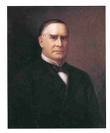
As for presidents who actually came here, you have to start with William McKinley, whose statue greets drivers heading north along Park Street in Adams.
McKinley was a close personal friend of W.B. Plunkett of Adams. He was a frequent visitor to the Plunkett home, which became the summer White House one year. He also laid the cornerstones of the Adams Free Library and one of the Plunkett mills. When he laid the cornerstone of the library, a chair was custom made for him for the event (it's still in Memorial Hall) but he refused to use it, insisting that he have a chair no better than anyone else's.<R3>
In 1897, he and Plunkett went to North Adams to attend the Hoosac Valley Agricultural Society fair; he paid another visit on June 26, 1899.
He had been approached the day before by a North Adams delegation that begged him to come and "...receive the adoration of the citizens." He agreed, and the following day a convoy of three coaches traveled north on the East Road.
The coaches were met at the corner of Church and Pleasant streets by Clapp's Band and members of the C.D. Sanford post of the Grand Army of the Republic. They escorted the carriages to Monument Square, where a reviewing stand had been erected on the steps of the Baptist Church.
Newspapers reports at the time say Monument Square was packed with people on the lawns, the sidewalks, the streets, and on the steps of nearby buildings. A few had climbed telephone poles. Someone had climbed up onto the Civil War statue and stuck an American flag in its fist.
A group of boys from Drury Academy were perched on the roof of the old library (the former Amasa Richardson mansion, located where the lawn of the Methodist Church is now; the North Adams Library opened several years earlier in this mansion, moving into the former Blackinton mansion about 1896). As the president's carriage passed, they treated him to "the Drury Yell," which they altered slightly to include "McKinley" in it. (No one knows what the Yell is anymore.) The crowd was cheering itself hoarse, the chimes at St. Francis' were playing and the church bells of the Baptist, Methodist, and Congregational churches were all ringing.
The president and his party were ensconced in the reviewing stand with dignitaries including Mayor H. Torrey Cady, U.S. Rep. George Pelton Lawrence of North Adams and Lt. Gov. Winthrop Murray Crane. The Civil War veterans marched in review and, at 3:30 sharp, the parade began, led off by Clapp's Band, and followed by three phalanxes of North Adams School students led by Mr. Hall, the superintendent of schools.
The first group stopped in front of the reviewing stand to sing "The Star-Spangled Banner." The second unit consisted of parochial school students, who sang "Our Beautiful America," and they were followed by the remaining (and possibly youngest) public school students, who sang "The Battle Hymn of the Republic." (Paul Marino: I say the youngest as a guess, simply because many in this group were so excited they forgot they were supposed to sing.)
The children were followed by a host of civic and military organizations: Capt. Frink and his aides of the North Adams Police Department, the Independent Drum Corps, the Tunnel City Drum Corps Council 17, Knights of Pythias, Clan McIntyre, the Williamstown Band, the Lafayette Guards, the St. Jean Society, the Franco-American Society, the Father Total Abstinence Society and Drum Corps, the Italian Band with Societie Italiana, and the North Adams Fire Department.
After several encouragements, the president finally spoke, as reported in the North Adams Transcript:
"I am here today for the purpose of expressing faintly my feelings for the most generous welcome of the people of North Adams that young and old have extended to the president of the United States.
"I know something about North Adams from my visit two years ago, but as I rode through the beautiful streets of your city today I must confess I was wholly unprepared to witness its splendid progress and prosperity. As I leave you, leaving with you my 'Goodbye,' I can only wish for your increased prosperity in your mills and workshops, and contentment in your homes. Thank you, thank you."
McKinley was assassinated in 1901; Vice President Theodore Roosevelt succeeded him. Two years later, he was in Williamstown, accepting an honorary degree from Williams College. Following Commencement, his train made a six-minute stop in North Adams. An estimated 8,000 people turned out in a driving rain to see him. He gave a six-minute speech from the rear platform of his car, ending it as the train started to pull away.
(The year before Roosevelt had barely escaped serious injuries after his carriage was struck by a speeding trolley in Pittsfield. The crash killed William Craig, the first Secret Service agent to die in the line of duty.)
<L4>In 1905, the president was back touring the Berkshire Hills and greeting Pittsfield schoolchildren. On April 29, 1912, Roosevelt was here again, this time campaigning for his newly formed Bull Moose party. The Roosevelt Special pulled into Union Depot in another driving rain in the late afternoon. The exhausted president had been making speeches at 20 or so stops that day. He was taken by car to the Empire Theater (behind the Wilson House hotel, which is where the Empire Building is now. The hotel burned down later that year). The Empire seated 1,000; every seat was full, and some 500 more were standing in the aisles.
Roosevelt spoke for 20 minutes, thundering against political corruption. He was asked to give another speech for the factory workers and was taken to Monument Square, where he gave a shorter version of the same speech from the back seat of the car. Then he was taken to the depot, where he boarded the Roosevelt Special and headed off to give speeches in Adams and Pittsfield.
The last visit by a sitting president was Sept. 22, 1928. Coolidge stopped at the end of a vacation trip; he and his wife had traveled by train up one side of Vermont and down the other.
Coolidge spoke in Bennington, Vt., that morning and was scheduled to make a six-minute stop in North Adams. It took six minutes to prepare a train to go through the Hoosac Tunnel; the fire had to be banked, and an electric engine hooked up. The work was to be done in the depths of the railroad yard, but former state Sen. George Hastings contacted the president's secretary, and arranged to have the preparations done at Union Depot instead.
At least 3,000 people turned out on the bright, sunny day to watch "Silent Cal" live up to his nickname. He only spoke to three people: Hastings ("I'm pleased to see you again"), Mayor William Johnson ("How do you do, sir") and young Herbert Walter Clark II. A fourth, a Mr. Decker of the YMCA, only got a handshake.
Herbert, however, was the subject of a question Hastings asked Coolidge. The grandson of H.W. Clark was the second Boy Scout in the area to earn the rank of Eagle.
Hastings asked Coolidge if he would pin the badge on him. The president apparently replied in the affirmative because Herbert was boosted up onto the rear platform of the car, the badge was handed up and the Coolidge pinned it carefully in place. He gave the boy's shirt a gentle pat to smooth out the wrinkles and said, "I am glad you have accomplished this. Good boy." With those words, Herbert may have become the only Boy Scout in history to be made Eagle by a president of the United States.<R5>
There have been some "near misses." Franklin Roosevelt drove through North Adams after he was nominated, but before he was elected; Kennedy marched in the first Fall Foliage Festival Parade and, in the early 1950s, just after his administration came to an end, former President Truman drove through town.
His car came over the Mohawk Trail and headed with its state police escort for New York state, where they would rendezvous with another state police escort at Petersburg Pass. Transcript photographer Randy Trabold and a reporter followed them there, and interviewed him at the pass. The former president was courteous, they reported, but his wife looked worried.
More recently, there have been Berkshire County visits by two first ladies. Laura Bush toured Edith Wharton's The Mount in Lenox in 2006; Hillary Clinton visited the Colonial theater in Pittsfield in 1998 - only time will tell if that could be categorized a "near miss."
For more information on the presidents, go to the History Channel and the White House Web sites.
Special thanks to local historian and iBerkshires columnist Paul W. Marino for providing the bulk of the information in this article. The movie short below dates from the 1950s and can be found at archives.org.