'Mystery of Irma Vep' Leaves Them Laughing
LENOX, Mass.
"The Mystery of Irma Vep" can be enjoyed on three levels: as pure entertainment, as literary wordplay, and as a testament to the outrageous sensibility of Charles Ludlam. Ludlam's life was cut short by AIDS at 44 and he left behind a rowdy collection of bawdy theatrical works, the most popular of which is "Irma Vep."
He often played the lead in his own plays and, it turns out, much of what he put into his shows is not scripted, including the essentials: the basic words and stage directions. Farceurs such as Georges Feydeau would spend days writing out the detailed comic elements such as stage directions, but not Ludlam. As a result much of the essential humor is up to the actors and director to complete on their own.
 Ludlam's imagination provided on-stage antics that were unique and enjoyable: the rolling eyes, the larger than life acting, the hairy chest peeking out from under the bodice. It's high camp and low humor blended into an outrageous whole. It is one reason he created such convoluted plots.
 Sometimes his plays remind you of Moliere, or Shakespeare, and at other times they simply conjure up the workings of a deranged mind.
Once in a while he used plays to say something meaningful, but mostly they were just a way to incorporate quotes and whole scenes from the classic history of theater for his showmanship. His works are full of allusions to great stage moments over the ages. While Ludlam's contemporaries liked to do Joan Crawford or Betty Davis, he preferred instead to spoof "The Ring Cycle" or "Hamlet." In "Irma Vep" it is the Holmesian blend of murder and mystery on the moors that engages his fertile imagination.
Ludlam wrote "Irma Vep" in 1983 and performed it in 1984 at a theater company he called Ridiculous – because he found most of the theater of the day absurd. It was his first big commercial hit, yet he rebuffed offers to take it to Broadway, or to tour the world. Instead, he took it on the road, and for the first time in his life he became financially secure.
He died of AIDS a couple of years later and left behind a huge body of work. "The Mystery of Irma Vep" remains his most popular and, one might say, the safest for general audiences. He specified that the two actors must be played by a same sex pair of actors. Though generally performed by two men, some companies have performed it with two women with great success.
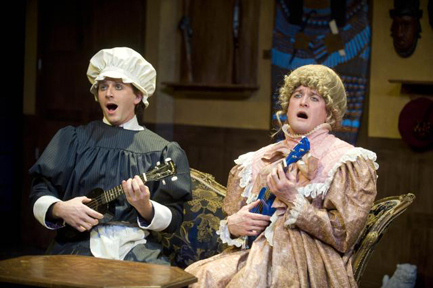
In the Shakespeare & Company production directed by Kevin G. Coleman, the two funniest men in the company take on the multiple roles with their usual manic energy.
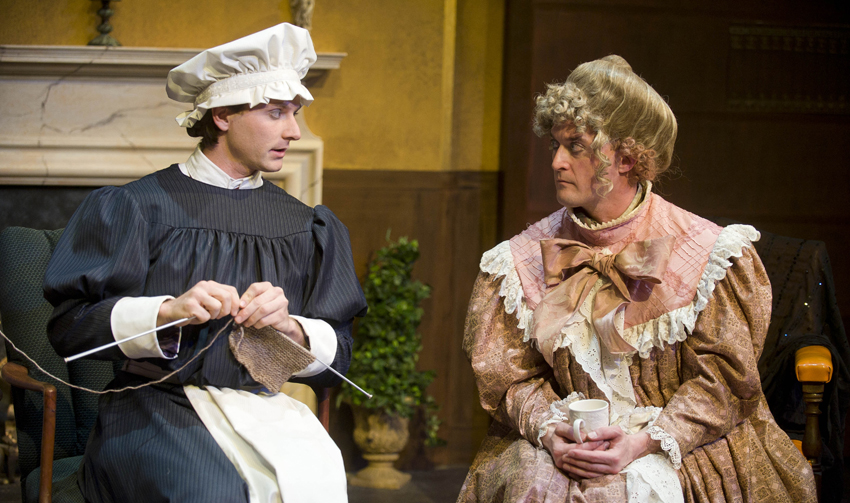
Ryan Winkles sets the play in motion as housekeeper Jane Twisden – whose first actions include taking the flowers out of a vase and roughly dusting them suggesting that we might be in for a replay of the "The Real Inspector Hound," where the blind maid bumbled around, constantly evoking audience laughter. The bumbling was there, but with fresh and different stage business.
Soon the play was speeding through its 35 costume changes and into its own world of werewolves, vampires, Egyptian princesses and double entendres. In addition to the housekeeper, Winkles also played Lord Edgar Hlllcrest and the Intruder. Of course the changes in costume, voice and intonation went off without a costume malfunction, which is to say almost perfectly.
Josh Aaron McCabe took on the roles originally played by Ludlam, appearing as Lady Enid Hillcrest, Nicodemus Underwood, Alcazar and Pev Amri. Lady Hillcrest is the new mistress of the manor, marrying Lord Hillcrest after the demise of Irma Vep. She is confused by the unsettling happenings around her. She continues to be perplexed as the play progresses. It is the perfect role for playing a "ditzy broad." Like some Wagnerian "Ring Cycle," there are endless threads that come apart but they are more or less woven together by the end.
|
In many ways it is like waiting for two hours for the kettle to boil – and it never does. "The Mystery of Irma Vep" is far from a serious theatrical experience, but in this production something was not quite right.
Shakespeare & Company has a wonderful way with farce and from that standpoint all the elements were in place for a perfect evening. You can not ask for better actors than McCabe and Winkles. Coleman is a highly regarded director. The set was excellent, one of the nicest ever seen at the Bernstein. The numerous lighting and sound cues all got delivered without a hitch.
So, all the elements were in place for a simply delightful experience, and yet something was not quite right. Part of it might have been the pacing, which was a bit slow in parts. The costumes were OK, but a bit too dowdy, not over the top, which this play calls for. The Bernstein continues to have acoustical problems (on a thrust stage with the audience on three sides voices can easily get lost), and actors do not always remember to project a little more so that everyone can hear. Because some lines were swallowed, not delivered, there were witty lines that were lost on the audience. Perhaps Shakespearean iambic pentameter and contemporary vernacular don't mix well.
Then it dawned on me. Mostly it was missing the over-the-top gay sensibility that takes Ludlam's humor from the funny to the hysterical. This version of "Irma Vep" has been subdued, somewhat dumbed down and made safe for straight audiences. It was cross dressing, not drag; potty humor, not ribald; and laughs, not guffaws.
What was needed were a few more ounces of flounce, a smidgen of lipstick and bigger busts. That and the hundred tricks a drag queen could have added might have provided the missing camp, the audience gasps and the delight of being transported to hilarity heaven.
Still this "Irma Vep" has really great laughs, is competent, workmanlike and solid entertainment, so don’t hesitate making plans to see it. But like so much in the Berkshires, this "Irma Vep" stuck to the script, and gave us basically a straight rendering of a gay play. Some people will never know the difference. But I did. The kettle never whistled.
Larry Murray is a contributor to iBerkshires.com and offers reviews and arts news from around the region at Berkshire On Stage.