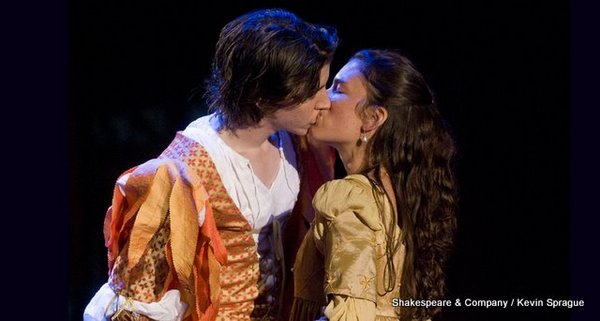
Shakespeare's 'Romeo & Juliet' an Odd Mix of Old and New
LENOX, Mass. — Some familiar stories can be made new though theatrical innovations. Especially those written by the masters of the form: Shakespeare, Ibsen and Chekhov. This summer you will find one of the most innovative "Romeo and Juliet's" in years at Shakespeare & Company. Much of it is quite wonderful. But it also derails now and then.The unwilling participants in this experiment are Romeo and Juliet themselves. Wrenched from the relative comfort of 16th-century Verona, their costumes bleached out in most scenes to ghostly white, director Daniela Varon takes a young cast on an amazing journey into her personal imagination.
 Much of it works brilliantly as theater, but some of the director's creative touches border on the absurd, or simply don't work. At the end, for example, Romeo finds Juliet like all the other corpses in the tomb, sitting upright. He takes his own poison, and promptly dies, also sitting upright. This strains the notion of "suspending disbelief" the contract that audiences make with themselves to enjoy a play.
Varon's first foray into Shakespeare in Lenox reminds me of the first productions at the old Boston Shakespeare Company that were directed by Peter Sellers (1983-1984). After he left, Tina Packer was asked to take over to fix the mess he left. In the end, she ended up concentrating on the company we all enjoy today. (And nothing could stop the Boston Musicians Union from selling the theater out from under the 15-year-old company, assuring its demise.)
L'enfant terrible Sellers used radical approaches that caused consternation wherever he went. Still does.
Happily Varon does not go as far out on the limb as Sellers did. For example, he would incorporate a cameo for Chief Inspector Clouseau from the "Pink Panther" films, or the music of The Beatles. But she does as many first-time Shakespeare directors do, stirs the creative pot. Or in this case, mashes them up using different styles and periods to create a new experience.
One of the things she does do is drain the costumes of all recognizable clues as to who is who, Capulet or Montague. Except for the ball scene, this makes the audience rely on the text for clues as to who is doing what to who and why. But some of the young players in this company are slight of build, as are their voices.
When the older players were on stage you could rely on them to enunciate, phrase and project their lines with enough force that young people with tinnitus or older folks with hearing loss could understand their every word. (For the truly hearing impaired there are listening devices available.)
As physical actors, both Susannah Millonzi (as Juliet) and David Gelles (as Romeo) were impressive in their roles when things were going normally. But as the plot thickens, and fights and deaths intervene, the actors simply go up the scale, and end up at times yelling or screeching instead of delivering their lines. No subtlety there. Too much like fingers on a blackboard, and proof that even the schools are not teaching acting for the theater, but for the screen. There the quieter passages that disappeared into the vapors would have been picked up, the whisper and the extreme close-up being a common tool for both film and TV.
|
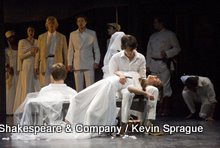
The design is amazing, as with the scene at the Apothecary, and it also worked well for the chapel scene with its suggestions of flickering candles and gothic arches. But it did nothing to make you feel that you were in Verona, or Siena, or any of the other mid-sized Italian cities that various authors over the centuries have used for the story's setting.
In fact, we are confronted by the inexplicable inclusion of a Shaker esthetic, with chairs hanging on the wall, and arcs that suggest oval boxes. Huh? The classic chairs are used to suggest a headboard, as weapons, and in the greatest sin of all, as the setting for the balcony scene.
Arguably the greatest scene in Romeo and Juliet, it was delivered in an unnatural, forced arrangement, Juliet hovering over Romeo, both facing forward, arranged on the chairs like acrobats. It drained the scene of all its heart, its emotion and its meaning.
But like much about this production, it was different
Different too were the contemporary references worked into various roles, most particularly those of Juliet's Nurse (Starla Benford), Tybalt (Equiano Mosieri) and Mercutio (Kevin O'Donnell). As Friar Lawrence, Walton Wilson found the perfect place between the old and the new, a classic interpretation in a totally new setting.
For this production the company has reconfigured Founders Theatre into a 3/4-thrust format, greatly expanding the playing area. Arrivals and departures were not only made from the traditional upstage set, but via the aisles as well, and many scenes were played there as well. Here director Varon succeeds in keeping things moving at a breakneck pace, with a sense of choreography and flow that is simply stunning. In many ways, the direction was filmic, with the tension between playing areas often proceeding like the cross cutting of a film.
That "Romeo and Juliet" is a total mashup of styles, periods and elements works to hold one's interest throughout the course of the play. The opening and closing scenes are highly theatrical, stylized and absolutely wonderful. In the final scene, Shakespeare's "star cross'd lovers" are elevated, on those same chairs, to rise above the heads of everyone gathered, like the King and Queen of Romance, on their throne of love.
If you want to see a "Romeo and Juliet" that is completely fresh and different, this is the one. It is all spectacle, swirling motion and swordplay. But you can leave your hankie home. It's probably not gonna make you feel much. The feeling has been drained out, like the color of the costumes.
Larry Murray is a contributor to iBerkshires.com and offers reviews and arts news from around the region at Berkshire On Stage.
Tags: Shakespeare & Company,