Downing Nearly Joined 2012 Congress Race
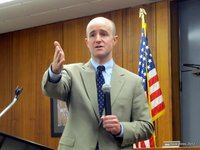 |
The Pittsfield Democrat hired a political consulting group, Washington D.C.-based 4C Partners, to explore a congressional run in January 2011. Downing said recently that he knew U.S. Rep. John Olver was nearing retirement, which the Amherst Democratic announced in October 2011, and considered running for the seat but the "pieces didn't fall into place."
Redistricting in 2011 lumped part of U.S. Rep. Richard Neal's 2nd Mass District into Olver's 1st District. The Berkshires' Andrea F. Nuciforo Jr. announced in 2008 and Bill Shein in January their candidacies for the Democrat nomination.
While Downing didn't specify why he decided not to run, he did say he would have been more likely to if the district hadn't been changed so dramatically. Then again, he also said that 12-termer Neal was not unbeatable.
Downing paid a total of $15,837 to 4C for consulting fees, $3,500 a month for six months, according to campaign finance disclosures.
His probe of a possible run came months after a 2010 letter from Democratic leaders urging Nuciforo, Downing's predecessor in the state Senate, not to run against Olver. The letter, from "Concerned Democrats of Berkshire County" and signed by Democratic leaders Sherwood Guernsey and Lee Harrison, asked Nuciforo to step out of the 2012 race over concerns it would "fracture" the party. It came at a time when Democrats had lost a majority in the House of Representatives.
The letter made no mention of Downing and encouraged Nuciforo to run if Olver, about to begin his 10th term, decided to retire. Olver had frequently reiterated his determination to run in 2012 but many believe he was pushed into retiring by fellow Democrats to avoid a battle between political veterans because of redistricting.
Just two days after Olver announced his retirement last fall, Shein, a political activist and writer, wrote a lengthy article in the Berkshire Record criticizing Downing's funding raising , which brought the 4C Partners expenditure to light.
Shein jumped into the race in January with a platform that includes banning contributions from lobbyists. Lobbyists were the topic of Shein's Oct. 28, 2011, article (posted on Red Crow News) in which he alleges Downing voted on anti-worker laws related to Cranwell Spa & Resort because of campaign money he received from lobbyists.
Downing would arguably have been the best-known Berkshire candidate, considering his Berkshire, Hampden, Franklin Senate district overlaps much of the western section of the new 1st Mass District. Neal, who brings his home ground of the Springfield metro region and east to Charlton along the state's southern border, has at least five times as much money and the endorsement of Olver.
While Downing believes Neal is beatable, the race could be an uphill battle for the two "home team" candidates because of lack of funds and the likelihood of splitting votes.
For the most recent reporting period ending Dec. 31, Neal had $2.5 million in cash, more than a half-million from political action committees. Nuciforo reported $137,000 on hand, and raising the bulk of his funds, $98,000, from individuals. Shein had nothing to report.
No Republican candidate has yet emerged so the Sept. 6 Democratic primary could determine the district's next congressman.
As for Downing, he said if he had to support a term limit for state officials, it would be 10 years. This is Downing's sixth year in the Senate. When asked what's next, he said he wasn't sure yet but he doesn't expect to be a state senator for life.
Tags: Ben Downing, election,