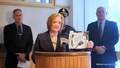
Zombie Action Committee: 'No Substantiated Cause For Alarm' In Miami Biting Attack
 |
Our organization has received a number of inquiries this week regarding our position on reports of a grisly "cannibalistic" assault in Miami on Saturday, May 26, which have provoked a national media and internet explosion over the past few days. In response to questions, concerns, and the increasing circulation of misinformation that have arisen since this incident, the committee's Supreme High Chancellor Autumn Doyle has made every effort to initiate a proper analysis and expedite a statement of assurance to the local community.
At her instruction, the ZAC's Department of Communications and Outreach conducted an investigation of the matter. After reviewing a mass of both credible and non-credible media sources and conferring with partner organizations in other parts of the country, the department came to the following initial findings:
- Miami Resident Rudy Eugene attacked Ronald Poppo on May 26, chewing a large majority of his face off as Poppo attempted to fight him off. The attack lasted for about 18 minutes and was captured on surveillance video which has since been made public. The attack ended when a Miami police officer fired on Eugene multiple times, after being shot the first time only caused him to growl at the officer before returning to biting Poppo's face.
- The cause of the attack has not been established, though some law enforcement officials have suggested it could have been a result of intoxication by Mephedrone-type drugs known by the term "bath salts." Toxicology analysis of Eugene's body could take weeks.
- There is no evidence of a connection between this and other biting-type attacks elsewhere in the country this month which have been correlated in some news media. In fact, database research conducted by the ZAC has found that various types of biting attacks can be found occurring somewhere in the world most months of the year, though there seems to be a marked increase during summer months.
- Reports of a "new virus" known as LQP-79 are not factual and appear to be a hoax that began within the last 48 hours. A screenshot of an "article" touting this virus seems to only exist as a jpg, and while there are now nearly 300,000 mentions of LQP-79 via Google, not a single listed news source contains the information in the "article" screenshot being circulated, which includes a fictitious quote from an actual Miami police officer. We have contacted the CDC and Ali Khan, director of the Office of Public Health Preparedness and Response there, to request some statement allaying any public concern in this matter.
- A certain level of additional concern or perceived plausibility of a greater threat may have been exacerbated by the fact that the CDC added several posts about zombie preparedness to its official Public Health Matters blog in mid-May only days before the tragic incident in Miami. The timing of this we believe to be an unfortunate coincidence - in actual fact, the Center for Disease Control embraced zombies as conceptual teaching tool last May, and the recent posts mark the one year anniversary of this, which has drawn more attention to CDC online preparedness materials than any other outreach effort.
The ZAC Department of Communications and Outreach concludes at this time that there is no cause for a heightened state of alarm regarding any of the media discussion of a "zombie outbreak" or "zombie apocalypse."
The ZAC received word late Wednesday night from allies at the Zombie Squad, whose chapters can be found in 40 cities worldwide. In a statement from the St. Louis headquarters last night, ZS leadership confirmed that they believe the Miami incident to be a random and potentially drug-related occurrence and are not moving to a state of higher alert.
"No matter how slim the possibility of a threat to the public, it was incumbent on me as the elected executive of this committee to direct staff to research the matter and report back," said Doyle on Wednesday. "The recent horrific occurrence in Miami is a tragic loss of life and humanity, just what we, your Z.A.C. try to prevent by raising awareness, in the hopes that atrocities of random violence will diminish."
Communications and Outreach Director Donna Chaney points out that the fact that this attack in Miami carried on for nearly 20 minutes while cars, bikes and pedestrians passed by is a good reminder to be aware of and try to counter the "bystander effect" in our daily lives.
"As human beings, we tend to think that we want to help one another," said Chaney, who has penned an opinion piece regarding this issue that will be available on our blog later today. "Most people will respond with, 'no way, I'd pull out my cell-phone in a matter of seconds.' According to studies, that's easier said than done; the larger the crowd, the less likely that you or anyone would summon help."
The Zombie Action Committee extends its condolences to the families and friends of both men involved in the incident in Miami, and while the nature of the attack will understandably generate curiosity and pointing out of parallels to the "zombie" concept, we urge all to try to be sensitive to the real loss of life and injuries that have taken place.
This message was sent to you by the Office of the Supreme High Chancellor
Zombie Action Committee
Berkshire County, Massachusetts