Pittsfield Police Chief Shares Israel Experience
|
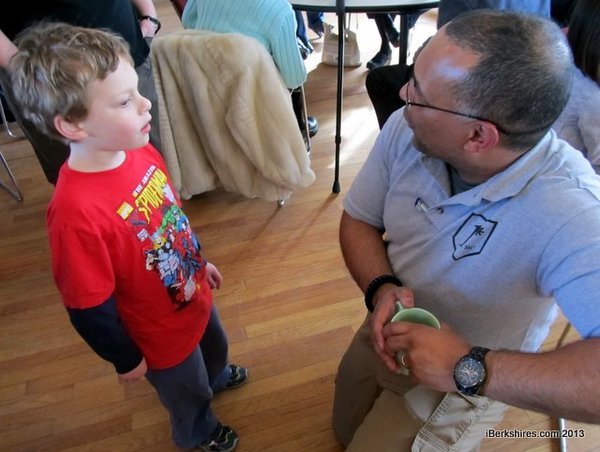
Chief Michael Wynn had two projectors — one for his presentation and another to show the thousands of photos the group of officers took during the week. |

LENOX, Mass. — A lot of the organizational and communication issues the Pittsfield Police are working to improve, Israel has down to a science.
Pittsfield Police Chief Michael Wynn recently returned from a weeklong conference to see firsthand how a country constantly on edge protects itself and its citizens. On Sunday, Wynn shared the lessons and experiences he gained with the Saint Helena's Church community.
"It was eye opening," Wynn said after showing hundreds of photos to a large crowd in the church's chapel.
Wynn was recommended for the Anti-Defamation League conference, which has taken American law enforcement agents overseas for the last 10 years to meet with nearly all levels of enforcement — from border patrol to navy to police — in the Middle Eastern country. Wynn traveled there with 15 other officers from the Northeast.
While the acting police chief has tactical training and has been to conferences in other parts of the world, the vigilance he saw in Israel was something new — starting at the airport gates.
"The security starts at the curb," Wynn said of El Al Airlines, which he took from New York to Tel Aviv.
After landing on Sunday, Jan. 27, the group had introductions and the majority of the work began the next morning.
On that Monday, the group met with a New York City police officer assigned to provide "on scene communications" followed by a tour and discussion with airport security there. They then went to see operations in Ramle and Lod — Central District cities — before learning about mall security and visiting the Western Wall.
Wynn said there are civilians with automatic weapons at the airport. Israel mandates its citizens to serve at least three years in armed forces and many go on to form or join private security companies that are contracted to protect the police.
"Their job is to protect the soldiers and cops," Wynn said. "It is completely backwards from our way of thinking."
Malls and most restaurants and hotels have security screenings. When he toured the Western Wall, the officers were asked to realize how difficult it would be to secure a location with complicated infrastructure. They were later brought back to the site and shown how the professionals there do it.
Tuesday featured briefings with border police, the Moriah subdistrict and meeting with officers whose job was constant surveillance of the Old City. The group met with media relations and then toured the Old City before going to the Church of the Holy Sepulcher. Wednesday included meetings with the Anti-Defamation League, a visit to the Yad VaShem Holocaust Museum, a tour of the Calandia border crossing and a briefing on the Iranian threat.
|
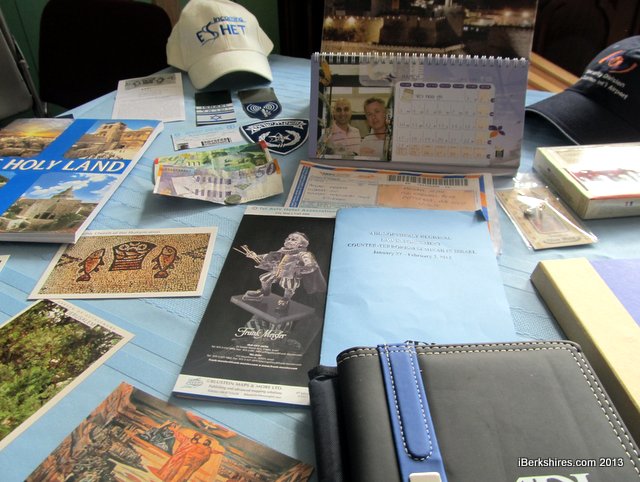
Wynn displayed a collection of souvenirs from his trip. |
"There are weekly attacks on the personnel working here," Wynn said of the border crossing.
Thursday included meeting with Eilat Police, tours of the Taba border crossing, meeting with the naval poolice and a trip to the Ice Mall to meeting with the police tourist unit. On Friday, the group flew back to Tel Aviv to visit holy sites and later the Syrian border.
On Saturday, they met with Brig. Gen. Nitzan Nuriel to tour the West Bank and Sunday wrapped up the trip.
Wynn said the most interesting thing was that the country has one police force so there are no jurisdictional debates and the communications go from the top to every officer creating efficiencies in operations.
"It is the state of Israel. It is one state, they have one police force, one chain of communications so there is no jurisdictional turf wars," Wynn said, adding that here, information sometimes has to go through multiple police agencies and there are still debates over who has what role in an investigation.
Additionally, Israel has plans for just about everything so every aspect of security knows what its role is in any situation whereas here, there are still meetings to sort out each role. Israel is also much faster in incorporating technology.
"They see a problem, they figure out a way to solve it," Wynn said.
Wynn added that in some places there are five to 10 times number of volunteer police than paid officers and even places that have few security issues will have dozens of officers in place and on call. The private security companies are always near by and can be deployed to scenes quickly.
Those types of provisions in place are a "force multiplier." However, the training of security personnel is much more strict here. While an Israeli can be out of the military and qualified in three years, an American would be just getting started in law enforcement here, Wynn said.
"I think we do more on our front-end recruitment and training," Wynn said.
Israel may be more efficient in some ways, but it is a completely different culture because of the high security risks. So Wynn said he can't recreate a lot of what they do but the trip has generated ideas that could be implemented by the Pittsfield Police Department.
Tags: Pittsfield Police, presentation,