Mount Greylock Students Try Hands at Robotic Surgeries
 |
|
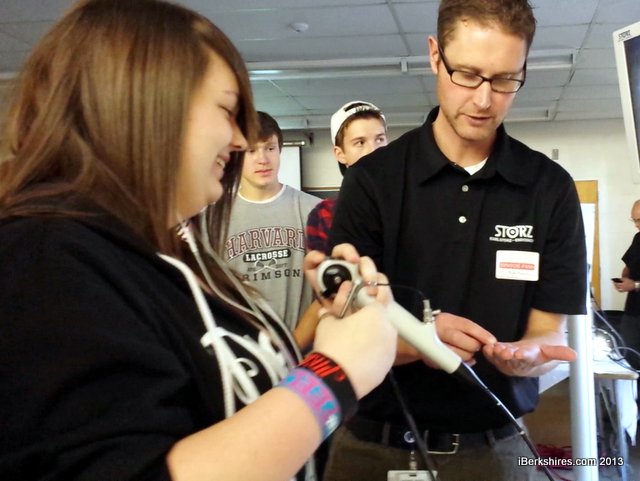 |
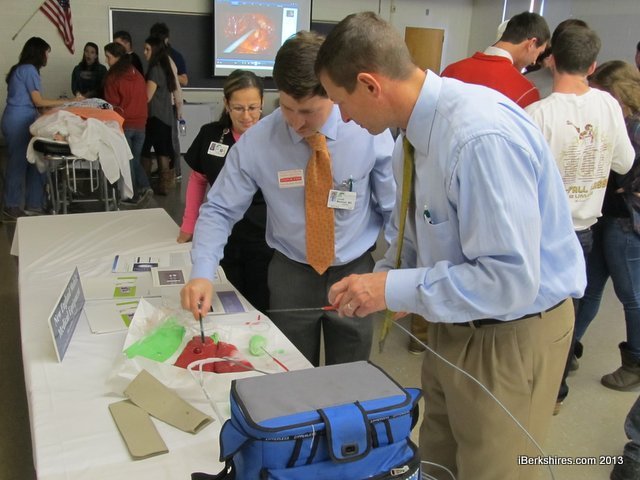
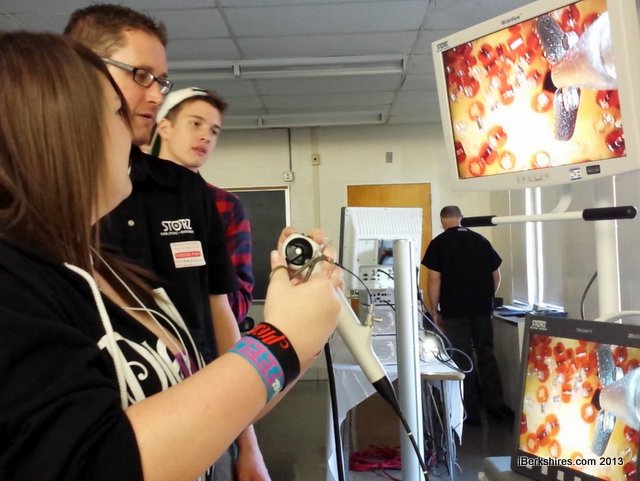
Alex Gilardi goes in for the pickup using an endoscopic tool on a pumpkin. Out comes a teeny tiny bead. |
WILLIAMSTOWN, Mass. — Alex Gilardi concentrated as she did minimal invasive surgery on a pumpkin.
The Mount Greylock High School student kept her eye on the monitor as she manipulated a tiny endoscopic tool to pick up an even tinier bead inside the small pumpkin. She proved pretty handy in grabbing a bead almost on the first try.
"It's really fun, it's hard, but it's fun," she said, after taking her turn on the Karl Storz equipment.
But it was about more than fun — it was a chance for some firsthand high-tech medical learning.
"You could pretend that one of the beads is a tumor in the colon," said Gary Quadrozzi, a registered nurse and robotics coordinator for Berkshire Medical Center. "Those beads are teeny tiny, but when you see things big like that you can do a better job of whatever it is you need to do."
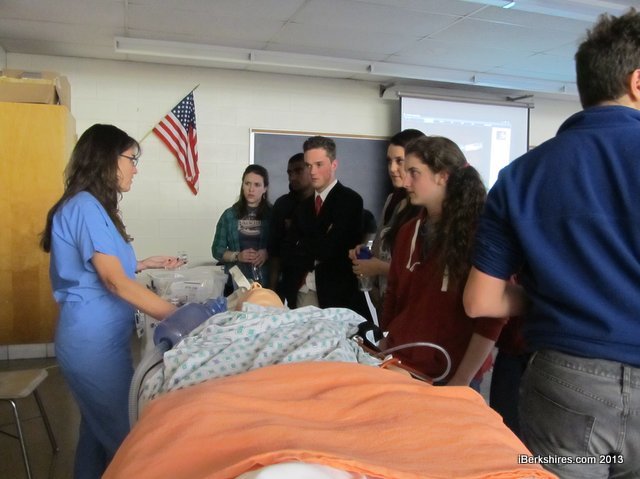
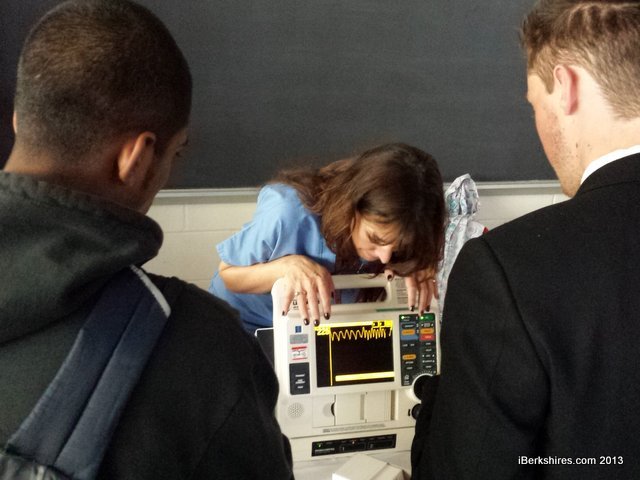
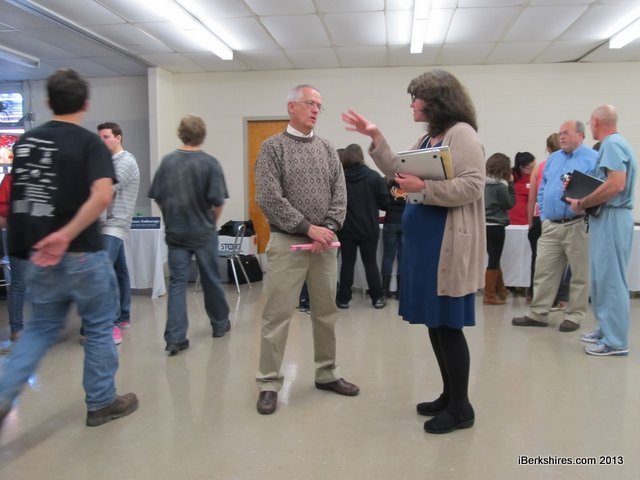
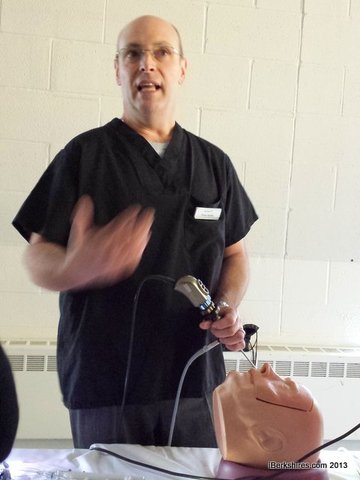
Some 60 or students in biology, physiology and anatomy courses learned something about laparoscopic surgery, cryoblation, sinus balloon dilation and other advanced surgical methods from BMC surgeons and representatives of the equipment manufacturers on Wednesday at the high school.
The demonstrations came about after a conversation between Superintendent Rose Ellis and Dr. Jonah Marshall, a Williamstown resident and urologist. Marshall said there were two reasons for putting on the demonstrations.
"For last five years, there's been a lot cutting-edge technology that is available here in the Berkshires and we want to get the word out and let people know about it," he said. "So that was one reason ... but we really are trying to get students this age interested in the technology that's out there so that they understand all of the opportunities and all the reasons of what they are learning here in their basic science classes and their engineering classes, and how they relate to the real world.
"So the idea is to get them excited about it and, hopefully, they'll come up with some new ideas."
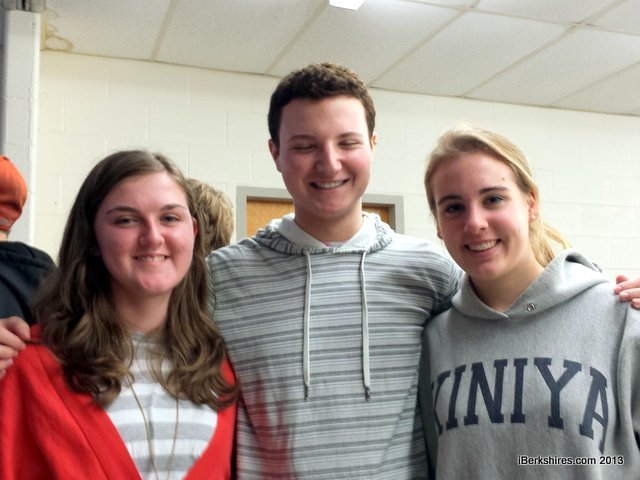
The students were definitely interested as they clustered around each station. Juniors Sara Rudd, Nick Darrow and Miranda Dils, all currently taking biology courses, said the event was eye-opening.
"I think it's so hard that everyone does this every day for a living, like I don't think I could do that," said Rudd, adding she had trouble trying to use one of the tools. "It gave me a whole different perspective on people's lives and how it works."
Darrow agreed, "I think it's really cool that they do this every day ... I don't know if I have the confidence to do that."
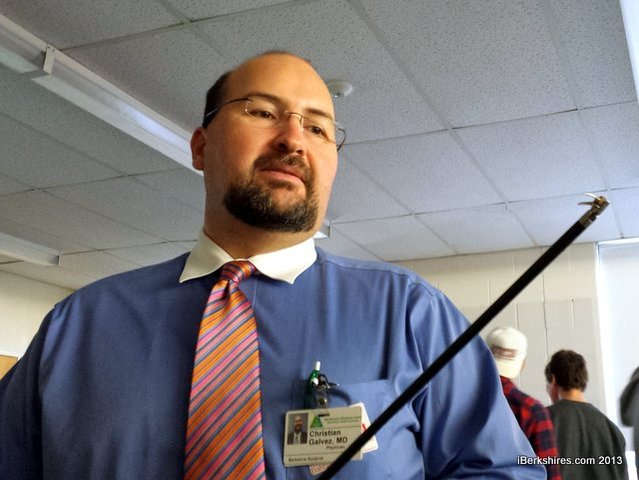
It does take a lot of practice. Dr. Christian Galvez, a thoracic surgeon, said it took him about a year to become proficient using the hospital's 3-D robotic da Vinci Surgical System, which is too big bring along to the school.
"It's a pretty rigorous course and it has a steep learning curve," he said, which included having a proctor trained in the equipment standing by during the initial surgeries.
That high-tech aspect intrigued Dils. "I'm kind of interested in the medical field so this is cool to see the surgery side of it and how all the technologies are able to help keep people alive," she said.
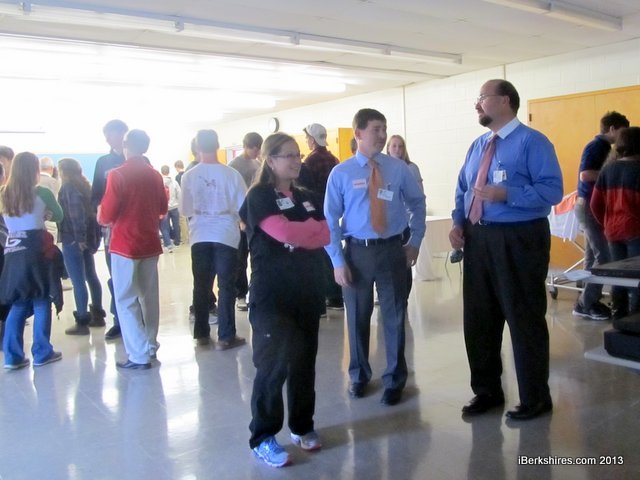
BMC spokesman Michael Leary said Berkshire Health Systems has partnerships with two schools in Pittsfield, but he could see the health system doing similar events at other high schools in the region to expose students to opportunities in advanced medicine and engineering.
"Why not? This is where our future employees are," he said.
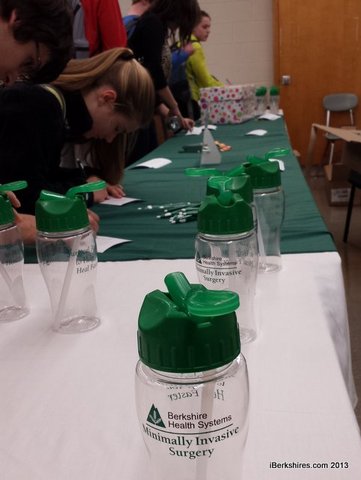
The health system also offered some swag — water bottles and pens — and a chance to try out the da Vinci robot (not on a patient) for 10 students. Everyone who attended the demonstrations could write their name on a slip of paper along with sentence about why he or she should use the robot at BMC. Those selected will get to go to BMC.
Rudd, Dils and Darrow all said they were putting their names in and were excited at the idea of using the machine. But maybe, in the end, the real test for getting into the medical field is not just adapting to the technology but also having an old-fashioned iron constitution.
"My mom said I could to that because I have a really strong stomach," said Gilardi.
Tags: BMC, high-tech, MGRHS, robotics, surgery,