Pittsfield Police Advisory Board Advocating For More Officers
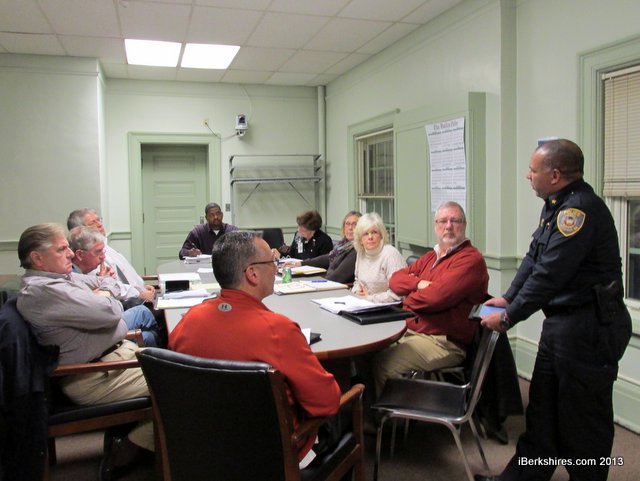 Police Chief Michael Wynn addressed the Police Advisory Committee on Monday when the group discussed staffing levels. Police Chief Michael Wynn addressed the Police Advisory Committee on Monday when the group discussed staffing levels. |
PITTSFIELD, Mass. — Ideally, Police Chief Michael Wynn would like to have 20 more officers on staff.
But, practically, he is just hoping for just a few more.
The Police Advisory Committee has begun looking into staffing levels and its initial findings is that the city would need to add seven officers to be in line with New England levels.
Committee members expect to continue researching the staffing levels and make recommendations to the mayor. But, with the costs associated with adding officers, they don't expect to see the levels increase to where they'd like for a number of years.
Heading a subcommittee on the issue, Police Advisory Committee member Ken Wilson said the FBI's uniform crime reporting statistics show that in cities in New England with populations between 25,000 and 49,999, there are 2.2 officers per 1,000 citizens.
With Pittsfield having a population of 44,168 and a staff size of 90 full-time officers, the city has 2 officers per 1,000 citizens. The city would need seven more to reach the 2.2 level.
Wynn said those regional numbers are particularly low because of the smaller towns and that the city should instead be comparing itself with the larger ones in the state.
"The number comes down because of our rural communities that have low reports of crime. My challenge has been to start thinking of us as a city and not as a town," Wynn said, adding that large cities in the state go beyond that number.
He said, "when I meet with Mass. major city chiefs, they're telling me to start moving to 2.7."
Both Wynn and the committee members conceded that it wouldn't be possible to raise staffing levels significantly at once but they hope for a long-term plan to increase the number of officers overall — citing the Berkshire's location (along major routes and in the center of the county), crime statistics, and increasing number of tourists as reasons the force needs to be larger.
"That's not accounting for the people who come into this city for an eight-hour shift or a 10-hour shift or a 12-hour shift and drive on our roads, crash into things on our roads. That number is only people who claim to sleep here. We police a much larger population," Wynn said.
The committee questioned if there were other ways to increase the number of patrols without hiring additional people but Wynn rebuffed that argument saying it wouldn't solve the problem.
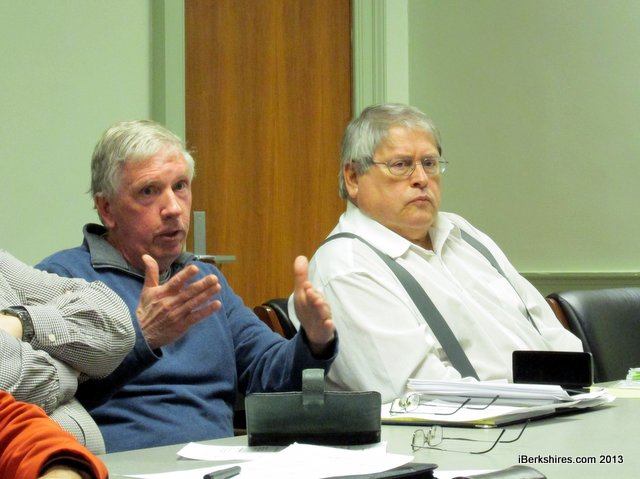 The committee members questioned if there were other ways to find efficiencies in operations without having to hire additional, full-time patrolmen. The committee members questioned if there were other ways to find efficiencies in operations without having to hire additional, full-time patrolmen. |
"Most of our cops are out on the street. Unless they are on limited or light duty there is very little station time except when they've done something law enforcement related and now they have to document it. And you get around the documentation," he said.
"We're saying for the five patrol cars we have on a day shift, we need seven patrol cars."
He said there are ways to increase efficiency in the documentation and required in-station work but that only increases the number of hours one patrol is on the road and not the need for extra bodies.
He said the department is already implementing ways to decrease the number of hours spent off the road.
But, some other duties can't be done by others, Wynn said, such as monitoring prisoners. If there is an arrest, only an officer can monitor a prisoner because they need the training and equipment in case something happens.
"The minute we arrest someone, we have to take a cop off the street," Wynn said.
Other tasks are contractual and would be difficult to remove from the contracts, he said.
Even if the department was given approval to increase staff size to 120, Wynn said it wouldn't be possible to do in a single year. The committee is going to continue looking into staffing levels and at this point, is hoping to convince the city to slowly increase the staff levels.
In other business, the committee elected Alan Righi as the new chairman — taking over for Cliff Harewood. Katie Roucher was elected vice chairman and Diane Ferrero as secretary.
Also in other business, Wynn reported that the department has most recently been busy investigating a series of armed robberies. While the department has not named a suspect yet, Wynn said they have "good, solid leads" and "we'll get 'em." The department is also investigating shots being fired on First Street last week.
A selection committee has narrowed the firms who bid on doing a feasibility study for a new police station down to two and will be conducting further interviews before selecting a firm.
The department is also narrowing its field of candidates for a crime analyst position and hopes to offer the position to a candidate in the next week.
Tags: advisory committee, Pittsfield Police, staffing,