Clark's Renovations Are Greening Up The Campus
|
The Clark's three-tiered reflecting pool, while not yet fully operational, did hold rain water earlier this week. |
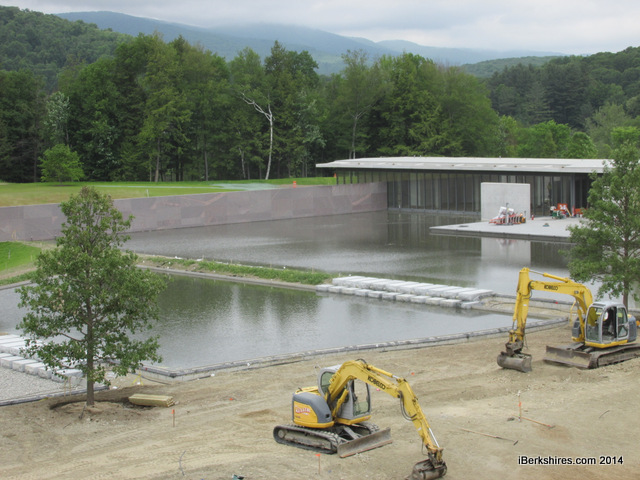
WILLIAMSTOWN, Mass. — For six decades, the Clark Art Institute has brought you art in nature.
This summer, the Clark brings nature into a work of art.
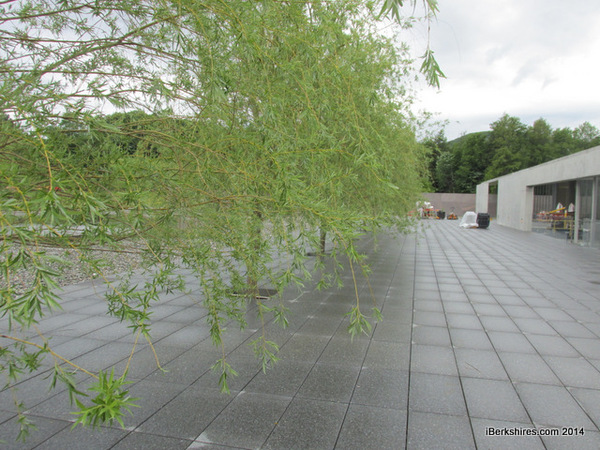
The centerpiece of the Clark Art Institute's newly remastered campus is a three-tiered reflecting pool designed by Pritzker Prize-winning architect Tadao Ando to accent his new visitor and exhibition center.
The 13.5-inch deep pool does more than just beautify the campus and reflect the beauty of Ando's art. It also is part of a hydrological system that lessens the Clark's impact on the environment.
"One of the biggest challenges to the project was weaving in the wetland that goes through the property," said Beka Sturges, a senior associate with the Watertown, Mass., landscape architecture firm Reed Hilderbrand.
|
|

"How do we make this as thoughtful a project as we can at every level? How do you make this ... fully engaged with everything the site has to offer?"
The solution was to take the water element, a theme in Ando's work, and combine it with the numerous streams that run downhill on the Clark's 140-acre property and into its main campus.
"Instead of sending the water away, we wanted to make it part of the experience," Sturges said.
Thus the reflecting pool is fed by those streams and by rainwater collected on the green roofs of the new visitors center. That rainwater also will be captured for use in the Clark's plumbing and irrigation systems.
The pools, which will contain more than 300,000 cubic feet of water when full, will cycle every three and a half hours as the water cascades down to the lowest level, where it will be filtered and the clean water fed back into the watershed.
Overall, the Clark's water plan -- of which the pool is an integral part -- will reduce the museum's water consumption by a million gallons per year, or about 50 percent of its levels before the expansion project.
And it is part of an overall campus beautification that makes the most of the Clark's natural surroundings.
|
Tall grass in rain gardens throughout the Clark's new parking lot will help filter stormwater runoff. |
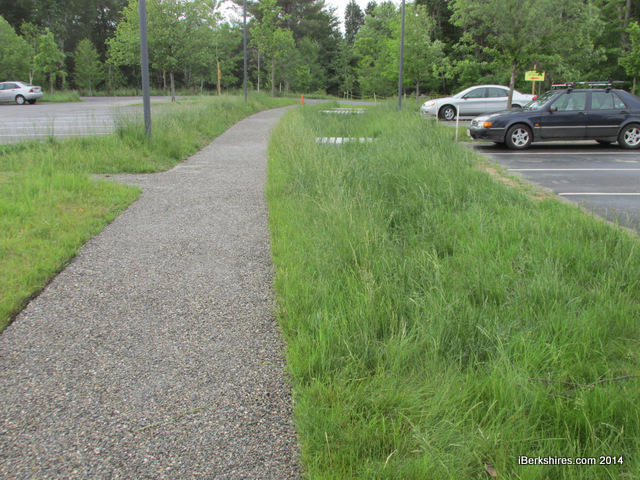
Visitors will get that sense even before they get out of their cars.
The new parking lot at on the north side of the campus features rain gardens in between rows of parked cars. The tall grass not only helps set the right tone for the pastural setting of the Clark's world class art collection, it also filters and reduces the volume of stormwater runoff.
Visitors will come from all over the world to view the Clark's Renoirs and Homers, but the the museum's home is likely to make as much of an impression as any painting or sculpture. The campus has been enhanced wit more than two miles of additional walking trails and more than a thousand native trees planted since the beginning of Phase 1 of the expansion: the opening of the Stone Hill Center in 2008.
Sturges has been working on the Clark's campus for nine year and said that Stone Hill has turned out to be everything Ando and the team at Reed Hilderbrand hoped it would.
"We're very happy with the way it worked out from an aesthetic standpoint," she said. "We really wanted it to feel like you were coming into a clearing when you approached the building. You get a sense that you're driving through a wooded drive. There's a sense of stiching the woodland back together."
And there will be more of the same when Phase 2 debuts on July 4.
"One of the things we recognize as particularly charged with meaning is the way the Clark ... knits into the downtown and the campus of Williams," Sturges said. "Because the graduate program is here, it is some way part of that campus. Because of the way the community uses Stone Hill and the trails, it also is sort of like a local green or commons, kind of like local park land.
"Simultaneously, there's the amazing context of the Green Mountains and the Taconic range and the Berkshire hills, which is really more about walking and mountains and streams and lakes. That was important to us."
Tags: Clark Art, Williamstown,