GMO-Label Bill Stuck in Ways & Means Committee
 |
|
 |
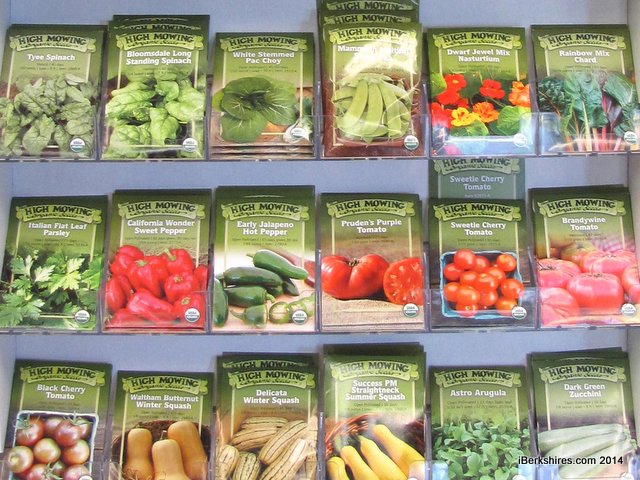
Above, non-GMO High Mowing Farm seeds at Berkshire Organics in Dalton; left, a label on a cereal box. A bill to require GMO labeling on foods and seeds is stuck in committee on Beacon Hill. |
STOCKBRIDGE, Mass. — With the clocking counting down to the end of the legislative session on Thursday, a bill requiring GMO food labeling is still sitting in committee.
"This is a very simple bill," state Rep. Gailanne Cariddi, D-North Adams, said. "People have the right to know what they are eating. The labeling gives the consumer a clear choice."
Bill H.3996, An Act relative to the labeling of seed, requires that "food for human consumption and seeds that produce food for human consumption carry a clear and conspicuous labeling, 'produced with genetic engineering' on the package, shelf for unpackaged retail food or bill of sale in the case of wholesale products."
Unlike Vermont's genetically modified organism-labeling bill that went into effect on July 1, Massachusetts' bill has what is referred to as a trigger clause. Bill H.3996 requires four other Northeast states, at least one of which borders Masachusetts, with an aggregate population of at least 20,000,000 as of the 2010 Census before it would go into effect.
Maine and Connecticut passed GMO-labeling bills with trigger clauses last summer. The New Hampshire House of Representatives voted down its GMO-labeling bill in January. A bill is pending in the Rhode Island House and bills are moving through the legislatures of New York, New Jersey and Pennsylvania.
Once the trigger clause requirements are met, procedures would begin within 30 days to implement the Massachusetts bill.
State Rep. Paul W. Mark, D-Peru, said that of "the 8,000 or so bills that come through the House every year, there are still hundreds, maybe over a thousand bills waiting to be voted on before Aug. 1."
Mark and his fellow Berkshire delegates supports the bill; some are sponsors.
But after having been reported favorably — meaning the bill is recommended for a full House vote — out of two House committees in March and May, H.3996 has been sitting in the 28-member House Ways & Means committee with those 999 other bills.
Cariddi said she was behind the bill "110 percent."
"It is something that is very important to my constituents. I get emails almost daily. I have had more constituent contact on that one particular issue than any other this session," she said.
"I have asked the Ways & Means to report it out favorably. They have to vote on it before it goes to the floor."
If Ways & Means reports it out favorably, there is still one more committee it must pass through before it comes to the House floor for a full vote — the Third Reading Committee.
"This committee's job is to make sure bills are constitutional," Mark said. "But it's only a three-member committee so it can come to the floor quickly. They can vote it out very quickly."
At least 119 out of the 160 House and about 27 of the 40 senators would vote to adopt mandatory labeling for genetically engineered food and seed to produce food for human consumption.
Rep. Brian Dempsey, D-Haverhill, chairman of the house Ways & Means committee is not on the list of bill H.3996 supporters.
"This is something everybody wants," state Rep. Tricia Farley-Bouvier, said. "The community is still very engaged."
"It is extremely busy at end of session," the Pittsfield Democrat said with concern. "Our job is to make enough noise so that [bill H.3996] doesn't get lost."
State Rep. William "Smitty" Pignatelli, D-Lenox, is also on board, having sponsored a similar bill calling for "Genetically Engineered" to appear prominently on labels for such foods and banning the use of the word "natural" in their advertising. Pignatelli also sits on Ways & Means.
Since the House meets every 72 hours, in formal or informal session, year-round, it is not impossible to pass bills all the way to the end of the year, although it is rare.
|
"We really have until Dec. 31, if there is very little opposition, so there are still four more months," Mark noted. "But, once Aug. 1 happens, one member could raise an objection to table any bill. Before Aug. 1, you only need a majority [of representatives] to pass a bill. After Aug. 1, one person can object and the bill is dead."
Mark said the most effective way to let your representative know what you want him or her to do is to call, email or write a letter. He said calls from constituents influences what he does.
Farley-Bouvier said she notices and appreciates how active Berkshire people are on the GMO-labeling issue.
"Some people are very persistent and that's great," she said. "Some people, I don't hear from on any other issue."
State Sen. Benjamin B. Downing was not a supporter of GMO-labeling until some of his constituents went to speak with him as part of the advocacy group MA Right to Know GMOs.
An aide to the senator said he was persuaded to change his mind by what he learned about the potential dangers of consuming genetically engineered food.
"The senator is currently advocating for passage of bill H. 808, put forth by Rep. Todd Smola of Palmer, which is currently going through the Joint Senate and House Committee," said the aide.
From 11 to 4 today through Thursday, MA Right to Know GMOs is conducting a "Rolling Reminder to Label GMOs" inside the State House.
"With 146 of 195 legislators voicing their support for this commonsense legislation, we, too, are surprised it hasn't yet come up for a vote," the group's website states.
Tags: Berkshire delegation, GMO, State House, ways & means,