Mount Greylock School Committee Votes to Send Towns Higher Budget
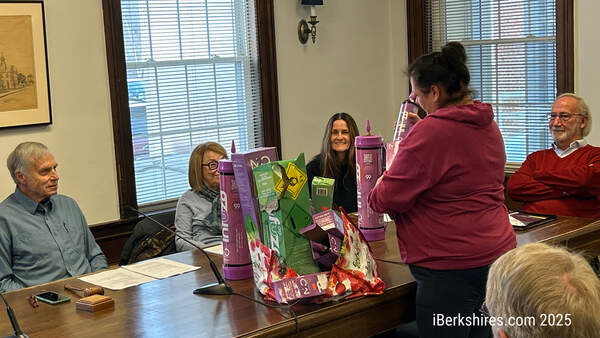
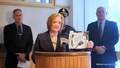
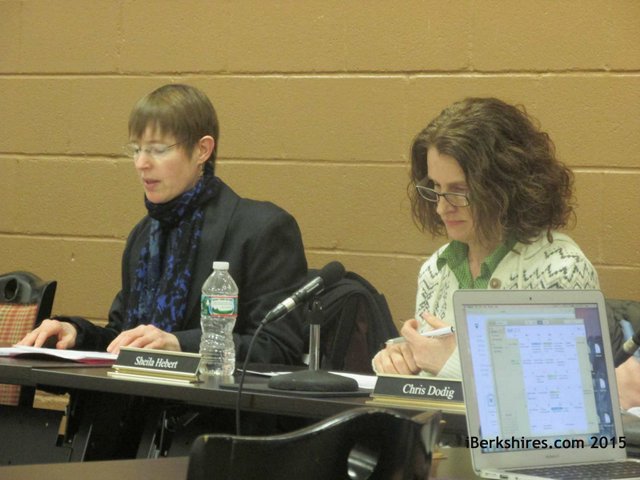 Mount Greylock Regional School Committee Chairwoman Carolyn Green, left, and Sheila Hebert participate in Monday's meeting on the district's budget. Mount Greylock Regional School Committee Chairwoman Carolyn Green, left, and Sheila Hebert participate in Monday's meeting on the district's budget. |
WILLIAMSTOWN, Mass. — By a vote of 4-3, the Mount Greylock Regional School Committee on Monday voted to add $42,100 back to its $10.5 million fiscal 2016 budget.
The proposed budget the committee will send to Williamstown and Lanesborough will include $33,000 to support one late bus run to each town and $9,1000 to continue the current structure of team meetings for middle school faculty at the junior-senior high school.
The committee last week asked the administration to come up with a prioritized list of possible items to add back to the budget, along with price tags.
Each of those five items had proponents on the School Committee at Monday's meeting. So did the option of leaving the budget as is, with a .85 percent increase, particularly since that budget appeared to have the support of the town administrator in Lanesborough.
"I'd like to point out that [Paul Sieloff] has taken the figure we used at the [March 16] Lanesborough public hearing and plugged that into his budget," School Committee Chairwoman Carolyn Greene said. "He has accepted that request. He's not asking us to lower it."
In fact, Greene said, the Lanesborough official went a step further. When she informed him that the budget numbers had changed slightly since the March 16 meeting due to information from Boston and the assessment to the towns was set to drop by about $4,500, Sieloff agreed to keep that $4,500 in the town's budget, Greene said.
But a majority of her seven-person committee decided to ask the towns for more than that. Steven Miller, Chris Dodig, Richard Cohen and Wendy Penner voted in favor of the expanded budget. Gary Fuls, Greene and Sheila Hebert voted against it.
Greene noted that the committee's vote was not along town lines. Cohen, Dodig and Hebert are Lanesborough residents; the other four reside in Williamstown.
Prior to Monday's meeting, Mount Greylock was planning to ask for assessment increases of $86,974 from Lanesborough and $205,312 from Williamstown (the towns split cost based on a five-year rolling enrollment average). That would have produced a 3.32 percent increase in Lanesborough's assessment and a 4.3 percent increase in Williamstown's assessment over FY15.
Now, the district will ask for $102,870 more from Lanesborough ($12,460 for the buses; $3,436 for the middle school team meetings) and $231,516 more from Williamstown ($20,540 for buses; $5,664 for the meetings).
In other words, based on Monday's vote, Lanesborough's assessment stands to go up by $15,896 from the figure supported by Sieloff and at least one member of the Lanesborough Board of Selectmen, Robert Ericson, who spoke publicly at last week's public hearings.
The total proposed school budget increased from the $10,531,320 previously pitched to the towns to $10,573,420.
The administration presented the committee with five possible budget items, ranked in order of need: 1. the middle school team meetings ($9,100); 2. the reinstatement of a technology position focused on professional development of the faculty ($64,500); 3. upgrades to computers ($33,000); 4. textbooks and equipment ($25,000); 5. late buses ($33,000).
Cohen advocated strongly for keeping the late buses, which serve students engaged in co-curricular activities. He argued that such a move would be politically popular, especially in Lanesborough, which is farther from the school, which is located in South Williamstown.
"We've eliminated programs with high impact to a small number of people," Cohen said, referring to cuts already in the proposed budget. "The [late] buses not only affect the people on the buses. They affect the whole drama program and the whole sports team."
Cohen's point about the political backing for the late buses is supported by the numerous public comments the committee has heard the last two years when it attempted to trim them from the budget.
Greene alluded to those same discussions in the context of whether the district will keep coming back to the late buses year after year or whether — if there is so much community support — that amenity should be paid for through fund raising.
"I'm not sure we can fund the late buses on an annual basis," she said. "We need to think about what is sustainable."
Hebert agreed.
"There are a lot of high schools that don't have late buses anymore," she said. "If we put it in this year, like she said, we're just going to cut it again next year. It's a hard decision, but I'm not in favor of [putting it back]."
There was no opposition raised to the top funding priority the administration presented: the continuation of twice-weekly team meetings for the middle school faculty. It was the smallest ticket item on the list of five options offered, and Principal Mary MacDonald made a persuasive argument for its inclusion in the budget.
"The middle school is designed with a team approach," she explained. "We give the teachers common planning time. With the the budget cuts, we've been making arrangements to only meet once per week. But that can affect how [teachers] work with students and families."
Even Greene said the expense was doable, especially given the existing $4,500 cushion in the assessment agreed to by Lanesborough's Sieloff.
"Anything beyond that I see as highly problematic," Greene said.
"If we end up getting increased revenues from the state, we can always rethink adding things back. Like the transportation money last year enabled us to fund the late buses. It's always possible there will be revenues we didn't anticipate. It's not likely, but possible. It's valuable to have this as a priority list when funds become a little more available.
"It's different to go back to the towns and say we gave you a budget of .85 [percent increase] to seriously consider and now we'd like you to consider significantly more. If that's the will of the committee, that's a discussion we'll have on the floor of town meeting."
Before that discussion takes place, the Williamstown Finance Committee is scheduled to take up the Mount Greylock budget again at its Wednesday meeting. At least one member of the Lanesborough Finance Committee at last week's public hearing at Lanesborough Elementary School called for another meeting with that panel. The regional school's budget will go to voters at Williamstown's annual town meeting in May and Lanesborough's annual town meeting in June.
Tags: fiscal 2016, MGRHS, school budget,