
image description
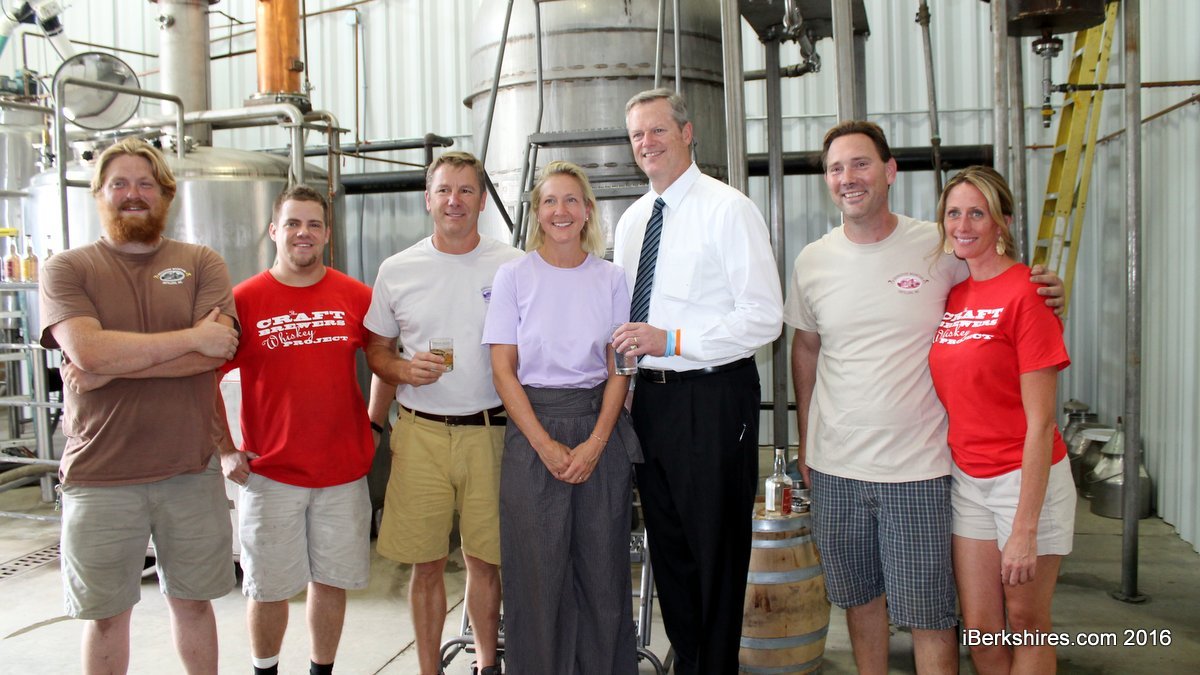
Gov. Charlie Baker poses for photos with the staff and owners of Berkshire Mountain Distillers.
image description
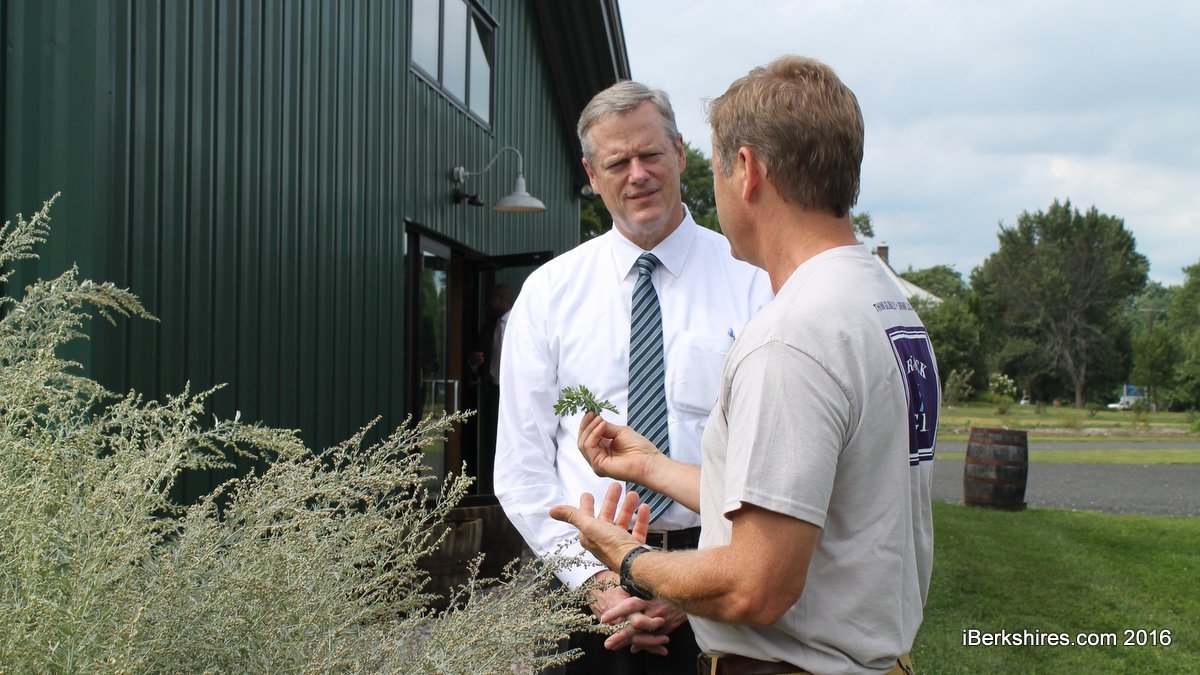
Weld told Baker that he grows many of the ingredients on site.
image description
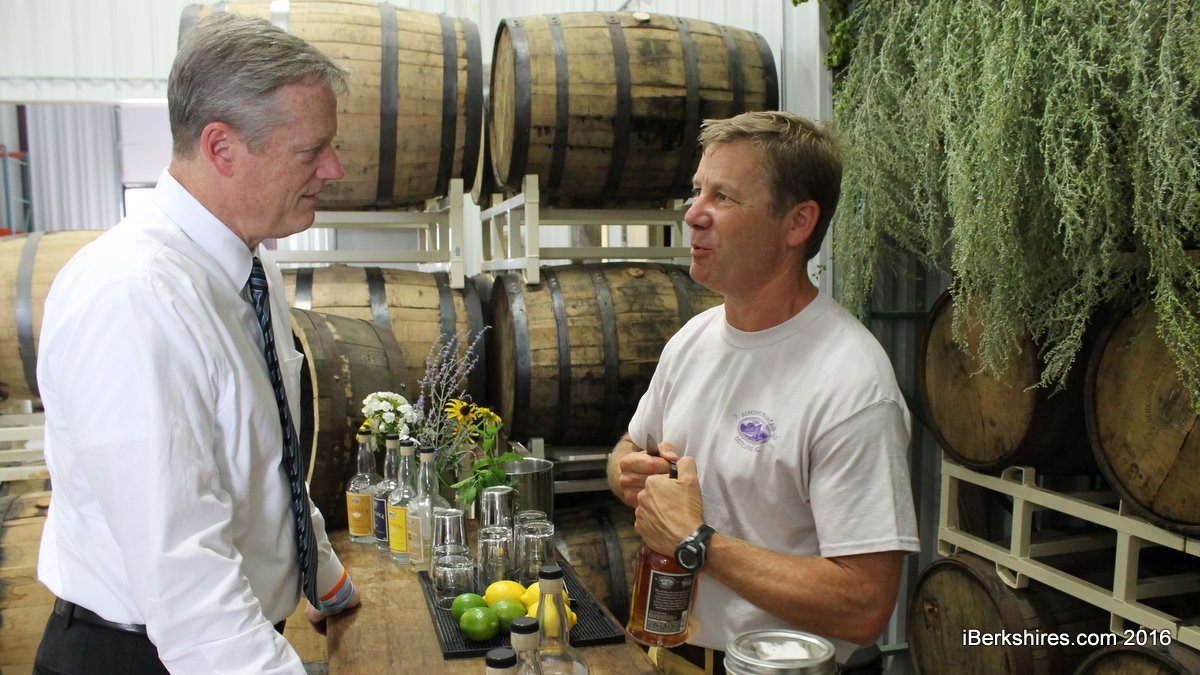
Weld started his company on his farm in 2007.
image description
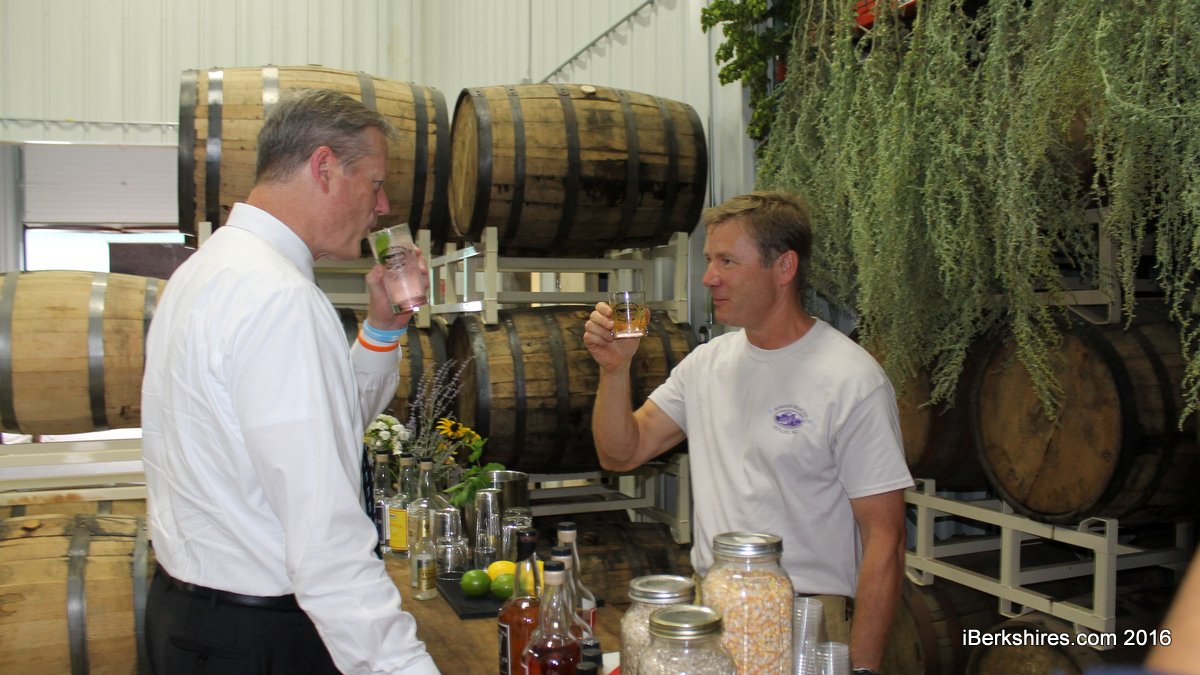
Baker signed the bill he paid with when purchasing the cocktail sold from the location.

Baker Highlights Craft Industry With Trip to Berkshire Mountain Distillers
By Andy McKeeveriBerkshires Staff
Print Story | Email Story

The governor bellies up to the bar to become the first customer to purchase a cocktail from the distillery — thanks to new legislation making that possible.
SHEFFIELD, Mass. — Twelve years ago Chris Weld had grown tired of his work in emergency rooms. So, he moved back to Massachusetts and bought an apple farm. 
 
With all of the products he needed right on site, Weld started to distill. He makes whiskeys, gins, vodkas and other spirits. In 2007, he turned it into a business — Berkshire Mountain Disillers. The company began to grow and two years ago he opened a tasting room and store along with a new distillery. He now employs eight people and ships his products to some 19 states.
 
"It is a small mom and pop business and we are growing organically. It's taken us this long to get our feet underneath us but we're getting a lot of recognition for the work we do," Weld said.
 
One of those bottles found its way to Gov. Charlie Baker. Just a month or so ago he was at a friend's house when he discovered the bottle and decided he wanted to visit.
 
"I had literally been at a friend's house a few months ago and they had the vodka and gin at their house. I said jeeze, I haven't heard of those guys so I'll have to make a note that if I am out in the area, I'd pay them a visit. I figured I was in Springfield and I was going to Taconic, I could just swing by and check out how these folks are doing," Baker said. "It also happens to be coming on the heels of the legislation we signed to make it possible for craft distillers and brewers and others to have open tables."
 
On Thursday, he made that visit and toured the facility with Weld, who showed him the ins and outs of how to distill the spirits and even put Baker to work bottling. 
 
"The most interesting part about this is the mixing and measuring of a whole variety of ingredients to make the projects. There is a lot of thought that goes into how he builds his products and how he thinks about it," Baker said.
 
Baker became the first customer of Weld to have a full cocktail at the distillery. Previously, the company's license only allowed for tastings and retail and didn't allow for table service. But that changed with the passing of the economic development bill Baker signed just two weeks ago.
 
"Recently, Massachusetts passed a law that is a farm distillers pouring license that allows you to actually sell cocktails," Weld said. "Starting the week after Labor Day, on Thursday and Friday nights we will be open from 5 to 7ish selling cocktails. It is going to be a short window, people are going to come in and can buy a cocktail with their spirits and then we'll farm them off to local restaurants to eat."
 
Being able to pour cocktails on site may seem like a small thing but for Weld it gives him an opportunity to tackle his biggest competitive disadvantage.
 
"For us, the industry is still dominated by the larger distillers. The Diageos of the world. It is very tough to compete in that arena. We don't have the marketing dollars they do. What we do have is a wonderful product. For us, the biggest problem we have is getting our product out for people to try. So for them to have the opportunity to come in and actually have a cocktail with it and try it, then they will see it is something special and bring home a bottle or tell their friends," Weld said.
 
Craft distillery, wineries, and breweries have been a growing industry in Massachusetts. Weld said when he first received the farm distillery license he was just the fourth in the state. When he moved locations to Route 7, he reapplied and was the 21st. All across the state craft companies are popping up and Baker said part of his visit Thursday was to highlight and celebrate that industry.
 

Chris Weld, on the right, led Baker on a tour through the distillery. 
"We have an extraordinary number of craft brewers of all kind of things. We have craft wineries. We have craft distilleries. We have craft breweries, we have two of the originals in Sam Adams and Harpoon. They are literally dotted all over Massachusetts and what I love about them is that it is local grown, local employment, local consumers for the most part. It is a wonderful example of creating value and product that never leaves the neighborhood," Baker said.
 
Baker said places like Berkshire Mountain Distillers help nearby companies as well by being an attraction. Customers will stop in at the distillery and them are leave to eat a local restaurants or shop elsewhere.
 
Weld referred to that local influx of business the "local multiplier effect."
 
"There is something to be said about looking after your own back yard. But supporting local and buying locally and regionally it helps take advantage of what's called the local multiplier effect, which dictates that for every dollar you spend in your community, you would have to spend $3 at a business that wasn't owned locally in terms of infusing the same amount of revenue into the local stream," Weld said. 
 
Weld added that it isn't simply shopping locally, but also providing a quality product. And he prides himself on the craft work he's doing — included being ranked by The New York Times has having the best craft gin. 
 
Prior to touring Berkshire Mountain Distillers, Baker participated in the topping off ceremony of the rail car manufacturing plant in Springfield and afterward the tour went to Taconic High School to meet with county educational leaders. 
 
What Baker didn't realized ahead of time was that Chris Weld and he have something in common — William Weld. Chris Weld is the nephew of the former governor whom Baker had worked under.
 
"I didn't even know it was owned by a guy who is related to my former boss, Gov. Weld. I found that out by accident," Baker said.
If you would like to contribute information on this article, contact us at info@iberkshires.com.

Sheffield Craftsman Offering Workshops on Windsor Chairs

By Breanna SteeleiBerkshires Staff

Andrew Jack uses hand tools in his wood working shop. 

SHEFFIELD, Mass. — A new workshop is bringing woodworking classes and handmade items.

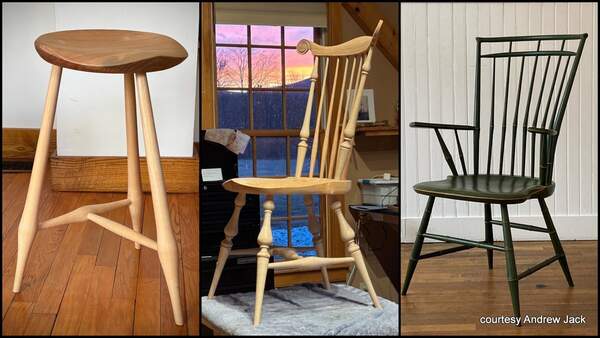
Andrew Jack specializes in Windsor chairs and has been making them for almost 20 years.

He recently opened a workshop at 292 South Main St. as a space for people to see his work and learn how to do it.

"This is sort of the next, or latest iteration of a business that I've kind of been limping along for a little while," he said. "I make Windsor chairs from scratch, and this is an effort to have a little bit more of a public-facing space, where people can see the chairs, talk about options, talking about commissions.

"I also am using it as a space to teach workshops, which for the last 10 years or so I've been trying to do out of my own personal workshop at home."

Jack graduated in 2008 from State University of New York at Purchase, and later met woodworker Curtis Buchanan, who inspired him.

"Right after I finished there, I was feeling a little lost. I wasn't sure how to make the next steps and afford a workspace. And the machine tooling that I was used to using in school." he said, "Right after I graduated, I crossed paths with a guy named Curtis Buchanan, and he was demonstrating making really refined Windsor chairs with not much more than some some flea market tools, and I saw that as a great, low overhead way to keep working with wood."

Jack moved into his workshop last month with help from his wife. He is renting the space from the owners of Magic Flute, who he says have been wonderful to work with.

"My wife actually noticed the 'for rent' sign out by the road, and she made the initial call to just see if we get some more information," he said. "It wasn't on my radar, because it felt like kind of a big leap, and sometimes that's how it's been in my life, where I just need other people to believe in me more than I do to, you know, really pull the trigger."

Jack does commissions and while most of his work is Windsor chairs, he also builds desks and tables, and does spoon carving. 

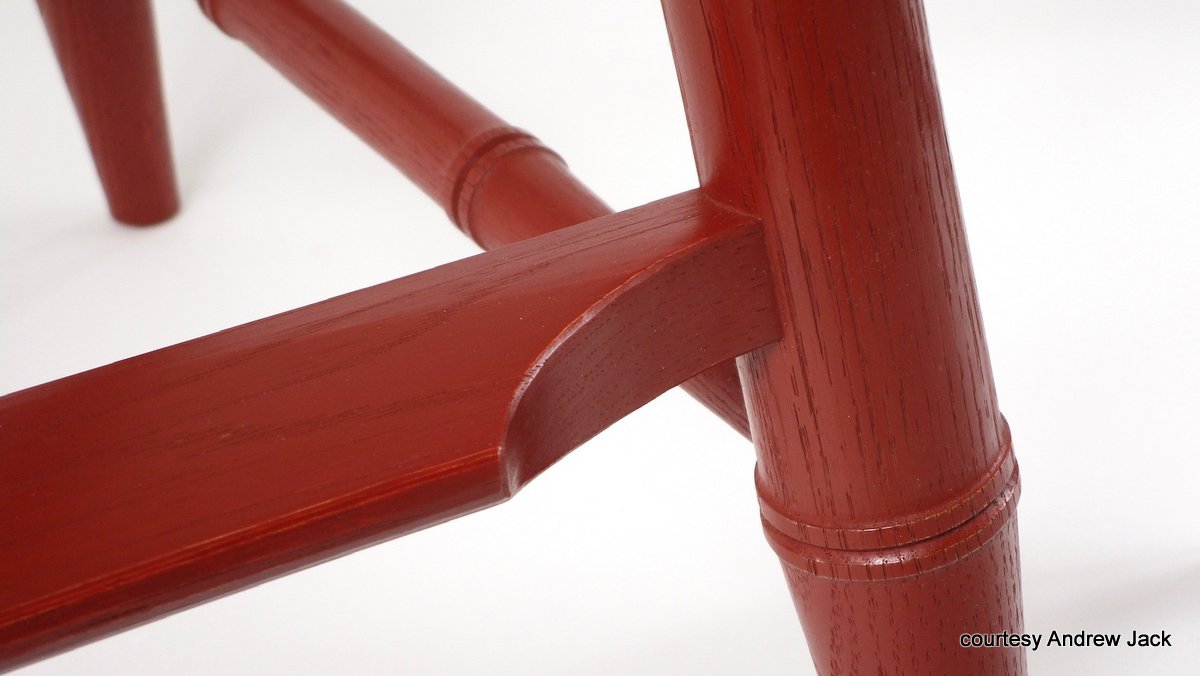
Windsor chairs are different because of the way their backs are attached into the seat instead of being a continuous leg and back frame.

"A lot of the designs that I make are on the traditional side, but I do some contemporary stuff as well. And so usually the legs are turned on a lathe and they have sort of a fancy baluster look to them, or they could be much more simple," he said. "But the solid seat that separates the undercarriage from the backrest and the arms and stuff is sort of one of the defining characteristics of a Windsor."

He hopes to help people learn the craft and says it's rewarding to see the finished product. In the future, he also hopes to host other instructors and add more designs for the workshop.

"The prime impact for the workshops is to give close instruction to people that are interested in working wood with hand tools or developing a new skill. Or seeing what's possible with proper guidance," Jack said. "Chairs are often considered some of the more difficult or complex woodworking endeavors, and maybe less so Windsor chairs, but there is a lot that goes into them, and being able to kind of demystify that, or guide people through the process is quite rewarding."

People can sign up for classes on his website; some classes are over a couple and others a couple of weekends.

"I offer a three-day class for, a much, much more simple, like perch, kind of stool, where most of the parts are kind of pre-made, and students can focus on the joinery that goes into it and the carving of the seat, again, all with hand tools. And then students will leave with their own chair," he said.

"The longer classes run similarly, although there's quite a bit more labor that goes into those. So I provide all the turned parts, legs and stretchers and posts and things, but students will do all the joinery and all the seat carving the assembly. And they'll split and shave and shape their own spindles, and any of the bent parts that go into the chair."

His gallery is open Wednesday through Sunday 10 a.m to 2 p.m., and Monday and Tuesday by appointment.

View Full Story

More South Berkshire Stories