Adams Looks at Medical Marijuana Dispensary Process
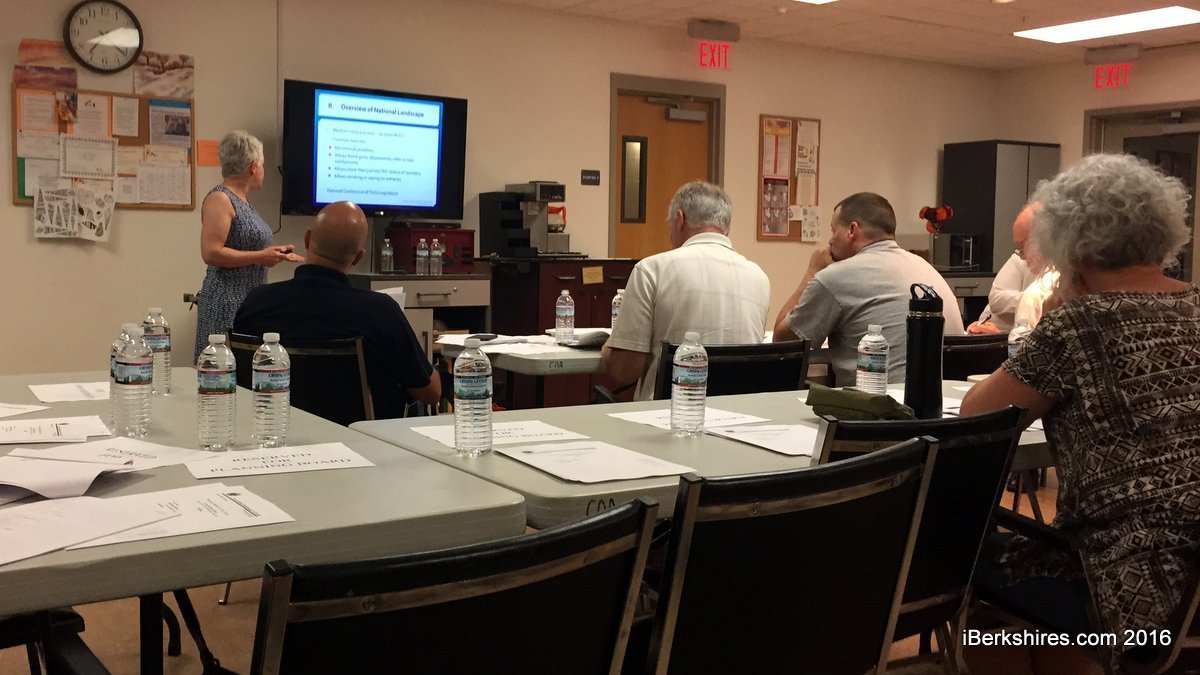
ADAMS, Mass. — The Selectmen and Zoning Board of Appeals got a detailed primer on medical marijuana, zoning and state laws.
The joint session held at the Selectmen's workshop meeting Wednesday included a presentation by attorney Jody Lehrer of the Northeastern Institute of Cannibis and was prompted by discussions over the taxation potential of marijuana dispensaries.
Selectman Joseph Nowak brought the idea forth earlier in the summer and although some Selectmen questioned it, they all agreed that the town must have something on the books so to regulate a possible dispensary.
"What we are really looking at tonight is the zoning regulations, the state regulation and how an entity becomes a registered medical marijuana dispensary," Town Administrator Tony Mazzucco said at the public meeting held at the Visitors Center. "That is really what we need if the town wants to go forward and craft a zoning bylaw."
Lehrer briefly went over the history of medical marijuana in Massachusetts, which in 2013 became the 18th state in the country to legalize it when a ballot question received 63.3 percent of the vote.
As of this summer, there are 635 patients who are licensed to use medical marijuana. Adams itself has 34.
Lehrer said people can apply for hardship cultivation and grow from home in other parts of the country if they can prove specific difficulties in reaching a dispensary. Because there are only seven dispensers in Massachusetts, patients in Adams right now can grow their own marijuana under specifications without hardship cultivation approval.
"They can only grow in their primary residence in an enclosed locked facility that can be any room in the house, including a closet," she said. "It can be accessible only to the person or the caregiver."
Lehrer said communities can develop local laws and policies in regards to a dispensary.
"Municipalities have a role in adopting local laws controlling land, buildings and structures and that includes dispensaries," she said. "You can approve zoning regulations or a bylaw that control the development and operation of the dispensary as long as they are consistent with state law."
She said boards of health can adopt policies and regulations and communities can mandate that the dispensary license with the town and charge a fee.
Cities and towns really are not required to be involved at all and can solely rely on state Department of Public Health regulations.
But communities cannot prohibit home cultivation and accessory use, require registration of patients through the town, limit home cultivation to certain areas, require a special permit for home cultivation, prohibit home delivery or set buffer zones around home cultivation.
She said communities can set their own zoning or none at all.
"I have seen it range from 300 feet to 100 feet," she said. "Some of the setbacks I have seen are schools, churches, libraries, swimming pools, places that sell alcohol, [Alcoholics Anonymous] and [Narcotics Anonymous] meetings, sober houses and public housing."
If a community does not designate zoning, it adopts the default state 500-feet law that applies to schools and daycares or other places children meet regularly.
Lehrer said once a dispenser follows the long state approval and licensing process, a dispensary must meet very stringent testing standards and operational standards. She said the state is very thorough with testing.
Also, there is no advertising.
"You cannot have 'women get in free' night, you can't have promotions, you can't put fliers on the car windows, you can't have billboards," she said. "You can't have promotional material, you cannot use neon ever and you can't light up the outside of the dispensary more than a half hour before sundown."
She said products cannot be visible from the street and the name can't mention medicine, marijuana or anything related or allude to it.
ZBA member Peter West said he was recently in Denver and found that the dispensaries are discreet and actually hard to find in the downtown area. Colorado was the first to legalize recreational pot in 2012.
"You can't see it, and you don't know where it is. We didn't see anything that resembled one," he said. "So when you see it on TV that may be one shop in all of downtown Denver but really walking around it is so discreet."
Lehrer said dispensaries must obtain a letter of support or non-opposition from the community. This often is attached to a host community agreement.
"You basically get money from the dispensary for the privilege of operating in your community ... they need one to open in your town so to sweeten the pot, no pun intended," Lehrer said.
She said dispensaries have directly given communities money, have donated to local charities, have created payment plans or set up a combination of payment options.
Mashpee receives an escalator base that increases each year. In 10 years it is anticipated that the dispensary will pay the community $1 million, Lehrer said.
The Mashpee dispensary also donates to a local charity and is required to pay taxes and has even agreed to a reopener provision.
"If the town manager in Mashpee comes across another municipality that has negotiated superior financial terms with a dispensary they get to reopen the agreement and get the higher rate," she said.
Lehrer also touched on recreational marijuana that is not yet legal in Massachusetts but will be on November's ballot.
Unlike medical marijuana, the buyer doesn't have to register with the state and just has to be 21 and over.
Also, unlike medical marijuana, it can be taxed.
"It is regulated like alcohol, it is taxed like alcohol," she said. "In Washington State, is it taxed at 36 percent and they are making a lot of money off of it ... if you are an adult, you make adult decisions about what makes you feel good and you just need an ID to prove you are 21 or over."
If it becomes legal, medical dispensaries just can't start selling, they have to go through a process in which the community can regulate.
ZBA member Michael Mach said he thought a medical dispensary would be great for the town.
"Where do we find someone who really wants to do this in our town?" he said. "There are jobs to be had and there is income for the town."
ZBA member Francie Anne Riley said it could even be a good fit for the empty Memorial Building.
Selectman Jeffrey Snoonian asked if there was a way to contact possible interested dispensaries.
Lehrer said there are groups that can accommodate this and it would be worth contacting them if interested.
Mazzucco said depending on how the town feels after the town adopts a bylaw they can go for it.
"Once we get a bylaw in and depending on how residents feel we can send some letters out see if anyone is interested in operating because we might be interested in negotiating," he said.
Mazzucco said the town will have a community meeting in the future to see how residents feel about medical marijuana in town.
Tags: medical marijuana, zoning,