Williamstown Zoning Board OKs Former School's Conversion to 'Live/Work' Rentals
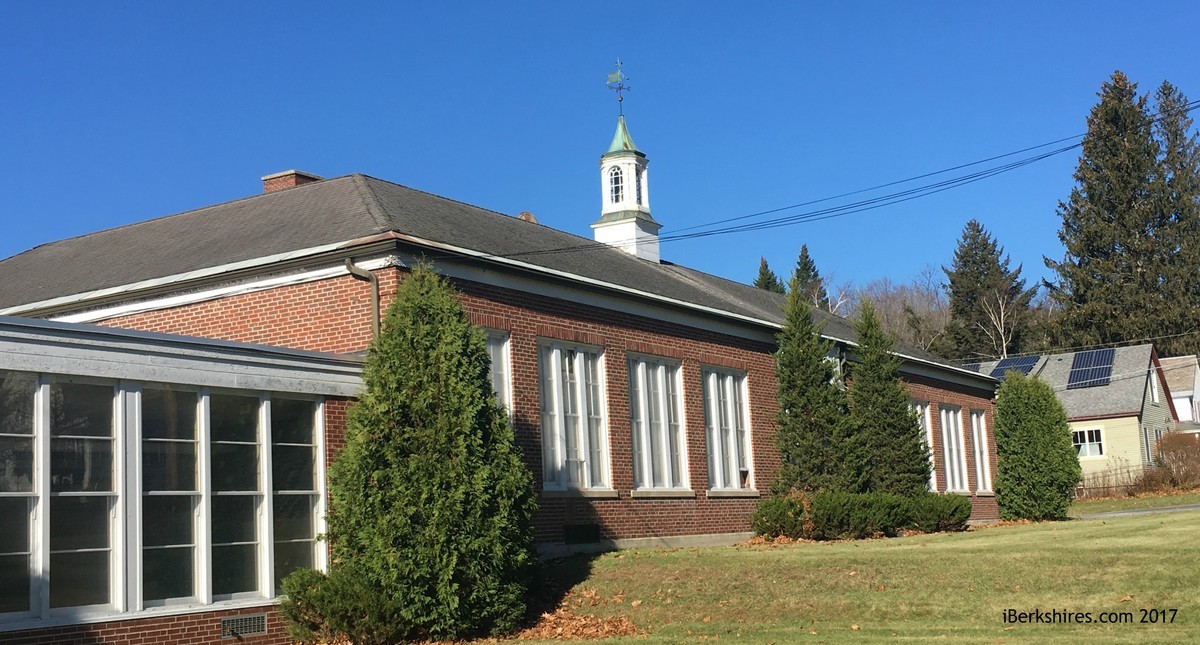
WILLIAMSTOWN, Mass. — A local man has the town's go-ahead to develop the former Broad Brook School into eight live/work studio apartments.
The Zoning Board of Appeals last week issued three special permits sought by Williamstown resident Ben Greenfield to renovate the school, which was opened in 1931 and closed in 1982. That year, the ZBA approved the former school building's use by a music publishing company.
The changing nature of the publishing industry with the growth of the internet has pushed that business out of the 141 White Oaks Road site, Greenfield's attorney, Donald Dubendorf, told the Planning Board earlier this month.
Greenfield's vision of live/work spaces is made possible by a relatively new provision in the Massachusetts Building Code.
"Live/work [refers to] a dwelling unit or sleeping unit where a significant percentage of the space includes a non-residential use that is operated by the tenant," Dubendorf told the ZBA. "It has studio characteristics: an artist, a remote worker, etc. The building code goes on to create conditions. The unit has to be a certain size and can't exceed 3,000 square feet, the unit has to be no more than 50 percent in the non-residential area. Then it goes on to specify ventilation and egress requirements."
Dubendorf said the school, which was expanded in 1954, is suitable for the kind of apartments envisioned by the Building Code but difficult to use in other ways.
"The building itself presents some real challenges," said Dubendorf, who was part of an ad hoc committee the town formed in the 1970s to look at closing the former neighborhood school. "It's presented a lot of challenges to adaptive reuse. I think [Town Planner Andrew Groff] can speak to the number of people who have gone through his office and tried to find a use for it.
"We found one here, and we're excited about it. This use is analogous but not the same as home occupation. In our bylaw, home occupation is incidental. It's accessory. The non-residential use is incidental."
As the name implies, the intention of live/work units is that the dwelling unit will serve a dual purpose.
The idea of the hybrid residential/commercial space was particularly appealing to the Planning Board, whose chairwoman addressed the ZBA last Thursday in support of Greenfield's application.
"We have seen with the lease out of Cable Mills that people want to live in places like this," Amy Jeschawitz told the Zoning Board in a meeting telecast on the town's community access television station, Willinet. "There are people who want to move to our community in buildings like this. We're trying to encourage people to move to Williamstown. We're trying to have more economic development in Williamstown. … This does both of these in one building."
The Zoning Board did hear some concerns from a couple of the school's neighbors, who worried about increased traffic and lighting — external and internal — from the proposed changes. They noted that the property has not been a school for more than 30 years and that the comings and goings of workers at the publisher were limited to business hours.
Greenfield agreed to a couple of changes to address those concerns, seeking the Zoning Board's permission to change his application in a couple of respects to mitigate problems raised by an abutter who attended the hearing.
Greenfield said he would be happy to install lower light poles in the parking area than are required by the bylaw. And he moved a couple of parking spaces from a planned four-space lot that was next to the adjoining property into a lot at the rear of the school and away from neighboring homes.
The latter required relief from the setback requirements that were not part of Greenfield's original application but which the ZBA was happy to grant in order to foster amity in the neighborhood.
Neighbor David Ascevich of 117 White Oaks Road said that in general, he thought the reuse of the building would be a positive thing, but he wanted to see some changes made to reduce the impact on current residents.
"It's going to make noise, and we'll see the lights," Ascevich said. "And if we can move the parking lot to the back, I'll be happy. I don't want noise on that side. Our bedroom is there, our living room is there. It's not something we've dealt with for 34 years.
"If everyone says that's what it's going to be, we'll live with it. But I have to say my peace."
The Planning Board's Jeschawitz, who addressed the board a couple of times from the floor in the course of the two-hour hearing, said if the redevelopment of the former schoolhouse fails, the property could be subdivided into "two or three" building lots that also would change the neighborhood.
"I know this is a change," Dubendorf said. "This building's future is at stake. I'm not exaggerating when I say I know of five serious attempts to redo this building. There are real challenges to making this thing work.
"Given the ability with this use category [live/work] to reduce the residential burden, we think we've found an answer that works well for this space and the neighborhood, and that's what we've been trying to do."
After outlining the approving the special permits needed to move the project forward, ZBA Chairman Andrew Hoar encouraged the applicant to make any other changes he can during development to reflect the needs of the neighborhood.
"We need to be as conscientious as we can to what we heard tonight and try to address those concerns as best we can," Hoar said.
Tags: ZBA, school reuse,