Cecropia, Our Sylvan King

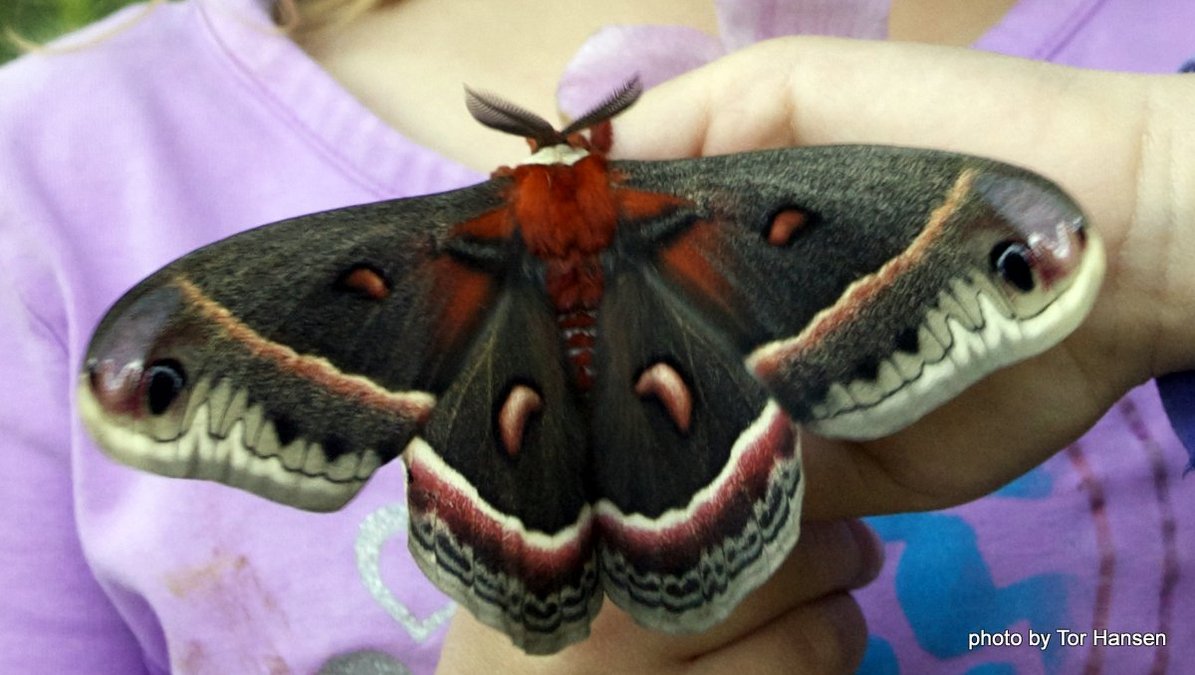
Soleil Osprey Cole, taken some years ago in Wellfleet, who found a rainbow larvae and cared for it until it emerged as a cecropia moth the following year. Below, a watercolor by Hansen of 'Cecropia Moth Lifecycle with Blackburnian and Wilson's Warblers.'

Just how this regal silk moth can engineer survival despite an inborn handicap is to its credit all the more remarkable. That such a resourceful creature can change form, starting with a tiny egg advancing to an enticing armored caterpillar, to a slumbering pupa inside a silken cocoon, emerging transformed into a wondrous moth is totally amazing.
Cecropia is an ancient moth, but its remote origin remains a mystery. So named by the father of binomial nomenclature, the taxonomist Carrolus Linnaeus, this resplendent moth takes its name from Greek mythology, plus a tweak of the imagination.
Thus we have H. cecropia, the genus Hyalophora — from a sacred amphora comes — "he with a feather in his cap." Cecrops was considered the first actual king of Attica, today known as Athens, Greece. But wrapped in legend and myth, Cecrops was a reformer who initiated the union of marriage, burial of the dead, and divided Attica into eight votaries.
Both sexes have feathery antennae, but the males' are more plumose, so the name fits the moth. King Cecrops, sometimes configured as half serpent, is pictured with a feather in his cap. And he was said to act as referee in the dispute for the godly ruler of Greece, namely Poseidon who offered water that sprang from a rock when touched by his trident, and Athena, who was chosen, gave olive oil for the people.
The cecropia inhabits the diurnal realm by day as a hungry caterpillar or emerging from its silken cocoon; and by night, the male moth may be seeking a mate, or the female moth searching for a likely leaf well selected where she will lay her fertile eggs.
Larvae will grow fast on apple, crabapple, cherry, maple, sweet gum, viburnum, even rhododendron. It will develop through five instars in all before pupation (an instar is a time span between molts). The larva will molt, or shed its old skin four times before reaching full size, containing enough tissue to supply needs for another metamorphosis, or change of form.
Elaborate silk glands yield silken threads that build first an outer cocoon, and once inside, the larva spins a second golden tightly knit cocoon, aiding the dormant pupa to survive a long cold winter here in the Berkshires and all that is east of the Mississippi River. All this is neatly packaged within the sleeping pupa, encapsulated like a slumbering Egyptian pharaoh.
When leaves are fully formed from springtime budding, the moths will emerge from their cocoons, and relying on stored energy only, will seek mates by pheromone production.
Females that very night will initiate a fast way to attract a male moth, solving an age-old riddle of vestigial mouthparts, so decreased in function as to prevent any eating or drinking as an adult moth.
But the resourceful moth capitalizes on an innate ability to survive by means: the female will secrete her sex-attractant pheromone, a perfume that will drift on the wind as a steady stream of molecules that may be detected by the wild male moth. He will fly a long distance or short to quickly couple with the female in a working strategy for securing reproduction of their progeny.
If I may be so bold as to peruse the thought, perhaps God created cecropia for his own pleasure. And his gift over evolutionary time to mankind is the ongoing generations of the cecropia moth to enable us to think upon the nature of such beauty and complexity of strategy for survival. That God brought forth the process of evolution to manifest great diversity, to show us how else could God have stirred the DNA in the chromosomes that yield a most resplendent moth.
Michelangelo may be quoted to have said: "Beauty is the purgation of superfluities." And Cecropia is a key example of these apparent traits. And Ralph Waldo Emerson says "Beauty rests on necessities. The line of beauty is the line of perfect economy."
Yes, I am attracted to cecropia by its beauty that leads me to promote awareness and acts of replenishment to recover this elegant messenger much decimated in habitat by attacks of an unfortunate deleterious tachinid fly released to control outbreaks of the gypsy moths.
Tor Hansen, a naturalist writer, photographer, and musician, is a recent addition to the North County community.
Tags: wild life,