Northern Berkshire Community Coalition, Police to Hold Alcohol Compliance Checks
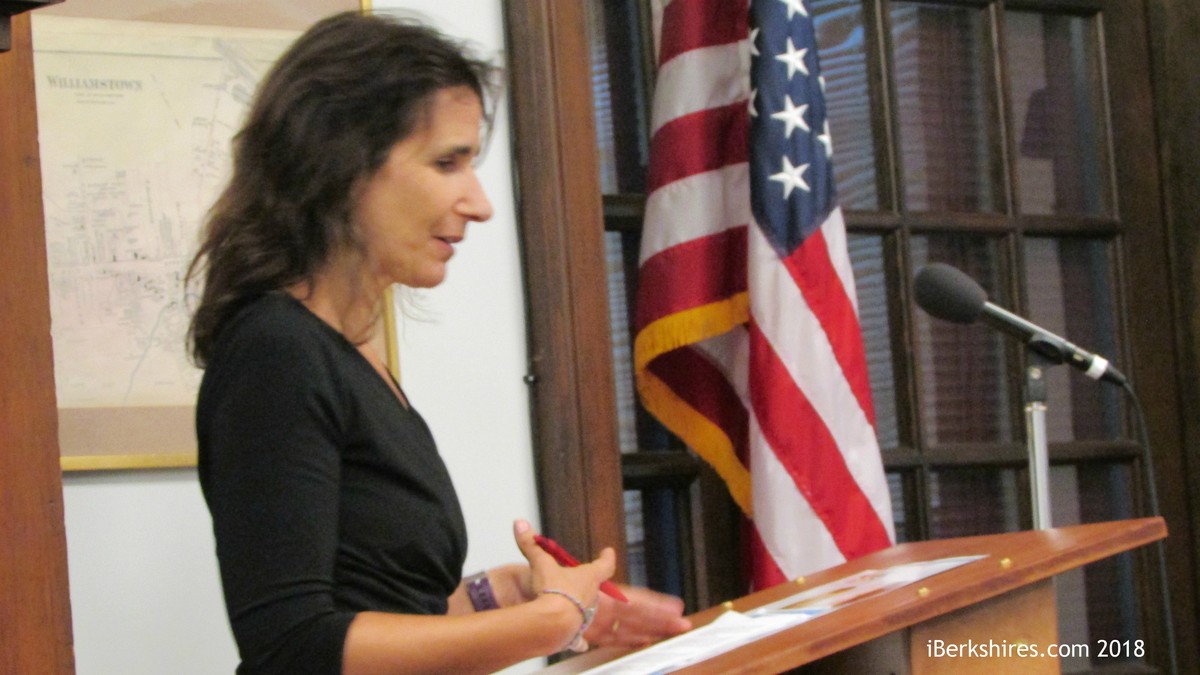
NBCC's Wendy Penner speaks to the Select Board about upcoming compliance checks.
The NBCC's director of prevention and wellness told the Select Board on Monday about the coalition's plan to work with local police departments to send underage volunteers into retailers and restaurants that serve alcohol to see whether the prospective "buyers" will be carded.
Wendy Penner said that several years ago, the coalition decided for a couple of reasons to direct its efforts away from the compliance checks and toward at-risk behavior it perceived as more prevalent in the region.
"In the student health survey, they don't report a lot of retail access [to alcohol]," Penner told the board on Monday. "They're getting it in other ways. So we're focusing on the greatest risk factors.
"That's good news. According to the self-reports by youth, there's not a lot of retail access. But we're not surveying people 19- and 20-years-old, either."
At the same time survey data indicated business noncompliance was less of an issue, area businesses were passing with flying colors the compliance checks the coalition did conduct, Penner said.
Now, the North Adams-based nonprofit wants to make sure that trend is continuing.
"We reached out to police departments in Northern Berkshire County," Penner said. "There have been no compliance checks in three years. We said … let's make sure there's no backsliding."
Penner said that the coalition put out a press release to alert licensees to the checks, which will be conducted in the next three months.
Penner said trained youths aged 17 to 19 are paired with police officers to visit multiple establishments in a single night.
"The youth goes in," she said. "They don't have ID. They have money. They order a drink. If they're served, they don't consume it. They pay for it, and they leave.
"If they get carded, they leave. And that's what usually happens."
Select Board member Jane Patton, who has experience in the hospitality industry, added that if the youth comes out and reports to the officer that he or she was served, the officer goes in and speaks to the manager, and the server and establishment are cited.
"Where I'm at, if a server is cited, they're out of a job immediately, period," said Patton, who manages the Taconic Golf Club clubhouse. "It's zero tolerance. Whether or not the server is held accountable by the town, it's the business' issue."
To help businesses train their employees, Amalio Jusino of Northern Berkshire Emergency Medical Services will conduct a TiPS training course on Sunday, July 1, from 5 to 9 p.m. at Taconic Golf Club. For information, Penner recommended people contact Jusino at ajusino@911rc.com.
Accountability at the town level comes when incidents of noncompliance are reported and the establishment is subject to potential suspensions from the local Alcoholic Beverages Control Commission.
In Williamstown's case, the Select Board acts as the ABCC, which is why Penner wanted to alert the board to the coming checks.
"They're uncomfortable experiences to have," Select Board member Andrew Hogeland said of the experience for business owners who have to appear before the board during one of its twice-monthly televised meetings. "Part of the remedy is the owner is contrite, and they do something about the server.
"There's an array of hammers out there for us to choose from — from, 'That is bad,' to 'That is bad, and you're out of business for a month or so.' "
While alcohol remains "the number one drug problem among youth," Penner said that the NBCC continues to focus on other risk behavior as well.
"The use of e-cigarettes has become a nationwide epidemic among young people," she said. "According to our survey, 80 percent of Northern Berkshire County youth choose not to vape, but that data is from two years ago, and I'd expect that number to change.
"Normally, tobacco us is not a focus of our work but because the schools are seeing so much vaping, including in school, we're doing more work around that."
Tags: NBCC, underage drinking,