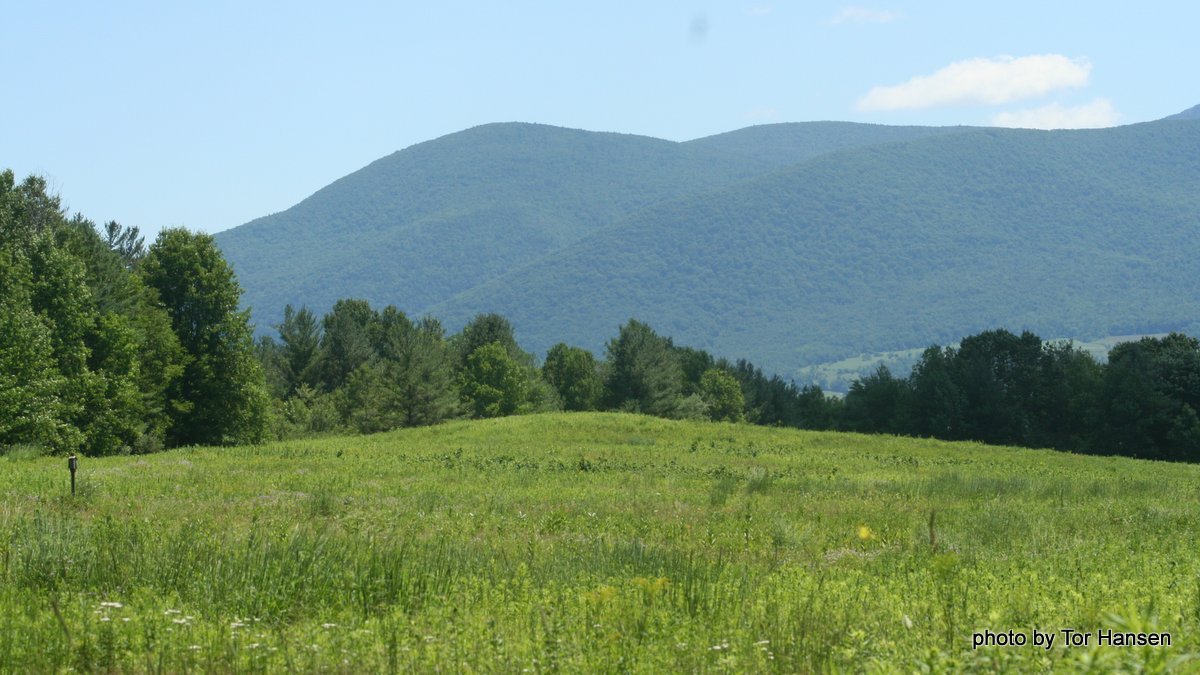
Hidden Bio-Gem Discovered at Mountain Meadow
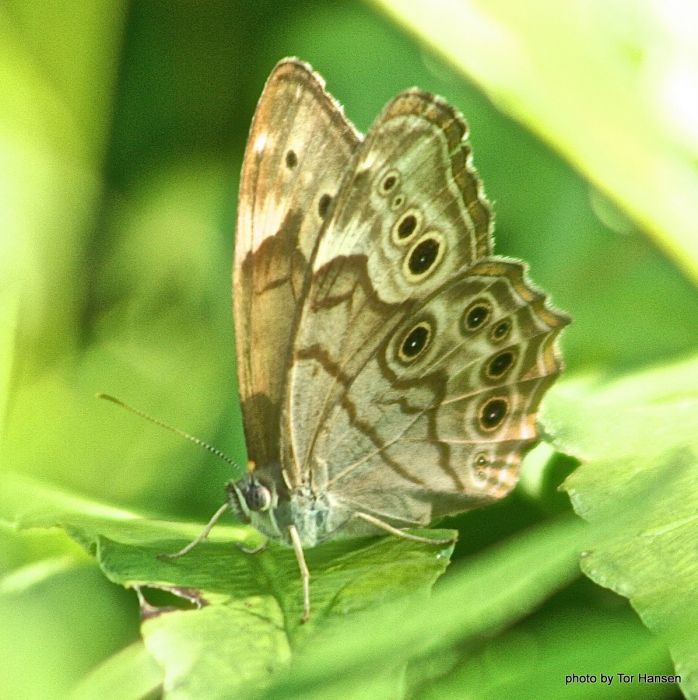
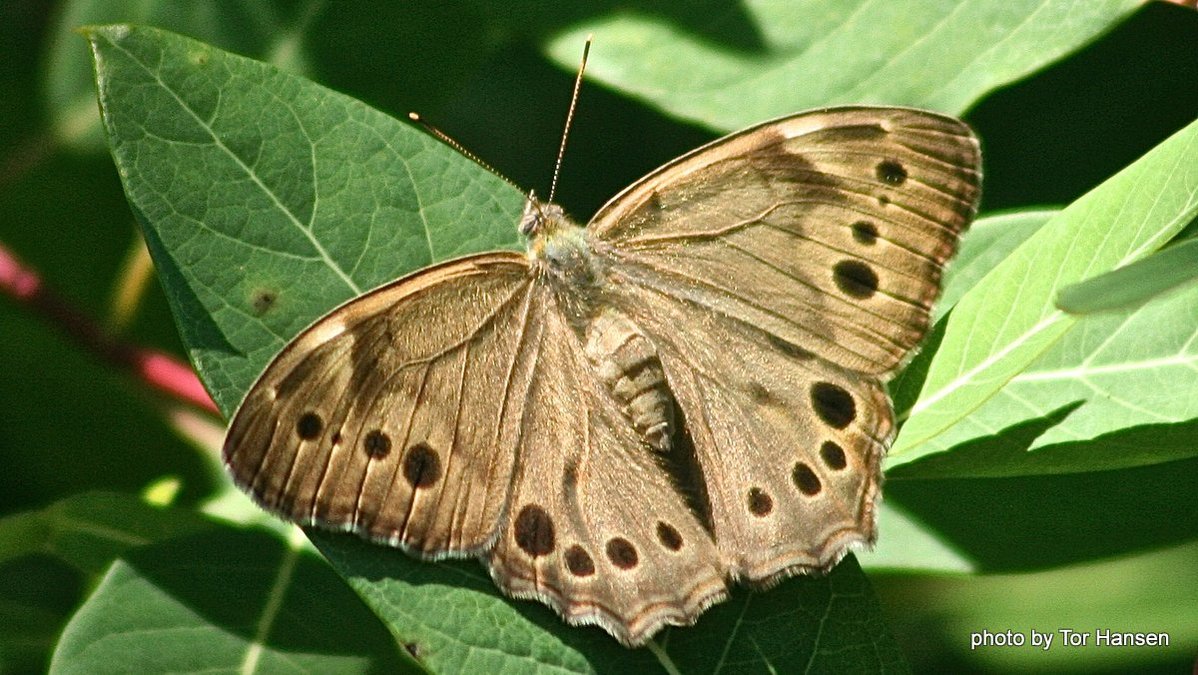
Another image of the northern pearly eye found at Mountain Meadows and enhanced by Erik Hansen.
Following a zigzag erratic flight of what looked like a common little wood satyr, a closer look when it roosted on a blade of grass before I could close the shutter, what flew off turns out to be a heretofore unlisted satyrid for Mountain Meadow, the multi-Argus-eyed northern pearly eye.
Enodia anthedon is hard enough to find on Cape Cod, my former home for more than 30 years, let alone here in the Berkshires.
Watch carefully the sylvan fringe where green shrubs and trees merge with the open meadow weeds and grasses. Smaller day-flying moths may zoom out at your footfall but look for a larger grayish-brown upstart, somehow eager to parade before your presence, and approach with stealth, because they are easily startled.
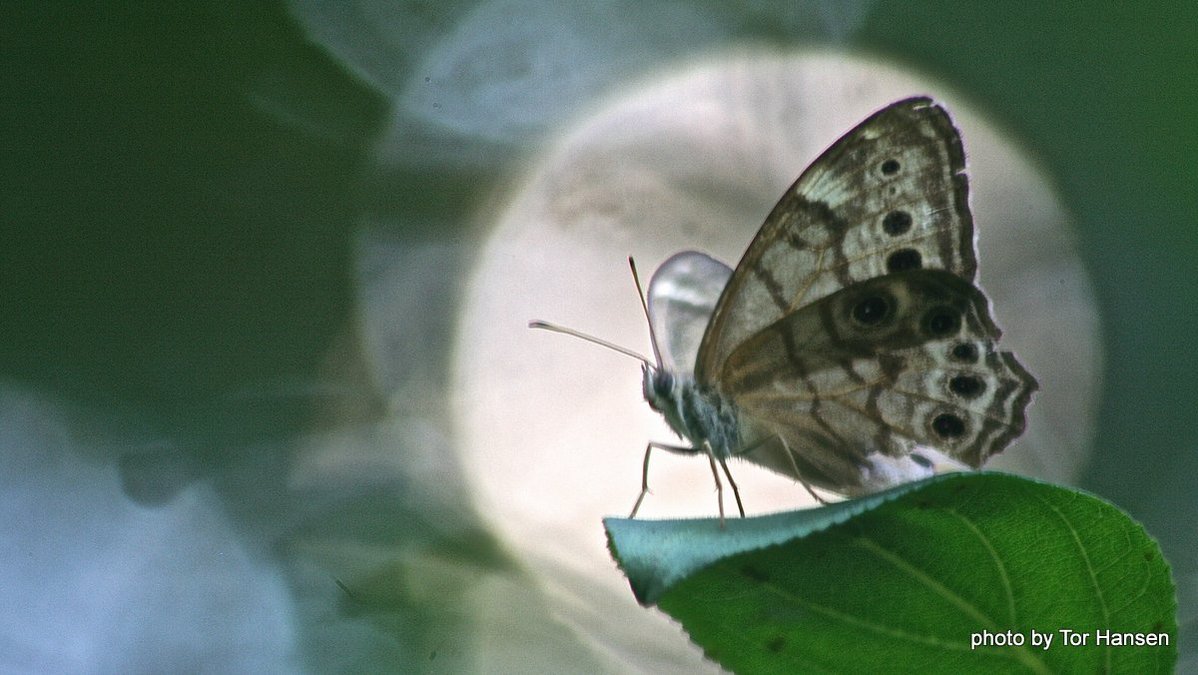
Look for a string of dark pearl-like eyes, coal black on very pale yellow on pale brown, indeed a ghostly multi-eyed distraction. Easy it is to cast off its significance and move on dismissing it as not so noteworthy. But gaze at its underside or ventral wings when folded, and a visual feast is at hand, beholding a string of gold encircled eyespots dotted with a bright light bluish-white central dot, indeed suggesting its namesake, northern pearly eye. Or since there are so many false eyes on each wing, one may say "pearly eyes."
They appear to be easily missed by lepidopterists, as they seldom venture out into the moist meadow rich with nectar-bearing weeds in July/August. Rather it will roost still as a drab leaf until you pass nearby. Its larvae can find its chief food source here, since those who crafted and procured this open meadow engineered for attracting resident wildlife, namely the Trustees of Reservations. Together with informed local residents, they planted tall bluestem and other grasses. But camouflaged in the leaf-like green, big-headed larvae with two prominent orange horns may be hard to spot.
I have yet to see an adult imbibing at a nectar source, but hopes are high. Perhaps they like to sip sap from woodland trees and shrubs.
Much ado about nothing? Not at all. All those eyes looking at you; let them mesmerize you. Then you may recall a fitting name for those multi-eye wings. "Argus Eyes" refers to Greek mythology. Argus the monster with 100 eyes became the protectorate of Io, a goddess of great beauty, who fled the amorous advances of Zeus. She sought protection with Argus and changed into a Hereford. But shrewd Zeus sent Hermes who played his flute before Argus, with 50 eyes open and 50 eyes closed. But the lullaby put him to sleep, 100 eyes closed, and Hermes sped past him and chased Io across the Ionian Sea. She reached Egypt where she gave birth to a child. Ho-ho-ho! By the time you equate the bejeweled eyespots the butterfly has flown away!
To some, the eyespots may suggest a large spider! In ethology, the study of animal behavior, these eyespots may cause fright posture or aposematic behavior, effectively apposing the senses, thus preventing attack. Or are these markings also visual cues, called sign stimuli, for confirming recognition for an approaching wild male eager to mate with a calling female?
Like other satyrs, the northern pearly eye will flit away into the security of a deep woodland where no large predator like man is likely to follow in pursuit. Then I resolved to pursue extended studies to reveal more unknown facts about the natural history of our small but evident population of this mid-summer herald, and to investigate its population dynamics. And luckily I can find time to further research additional habitats to study their range and distribution throughout the Berkshires.
Expect to find only one for every 70-100 yards since pearly eyes are widely dispersed when walking the perimeter of the sylvan fringe. If you have seen a pearly eye, please claim your sighting in feedback including when and where. Lighting assists the photographer is fascinating ways. Backlighting with the light source placed behind or beside the flutterfly may yield intriguing results. This white circle behind the pearly eye is really our sun quite diffused yet prominent in late afternoon, strong enough to show the thin wing membranes as translucent.
In pursuit of the hidden secrets in butterfly biology, I have experienced a number of "little revelations" — this "hold still while I focus" is among those magical moments. And to add to the merriment, as I returned to the trail, a certain winging flutterfly did flutter around twice and then landed briefly on my head! Not that I turned somersaults, but I did give in to momentary anthropomorphic exclamation, giving pearly eye enough time poised on my head to see my reaction. Virtual jubilee!
Tor Hansen, a naturalist writer, photographer, and musician, is a recent addition to the North County community.
Tags: berkshires wild, butterflies, wildlife,