Federal Reserve Bank Chief Shares Economic Outlook at Dalton Luncheon
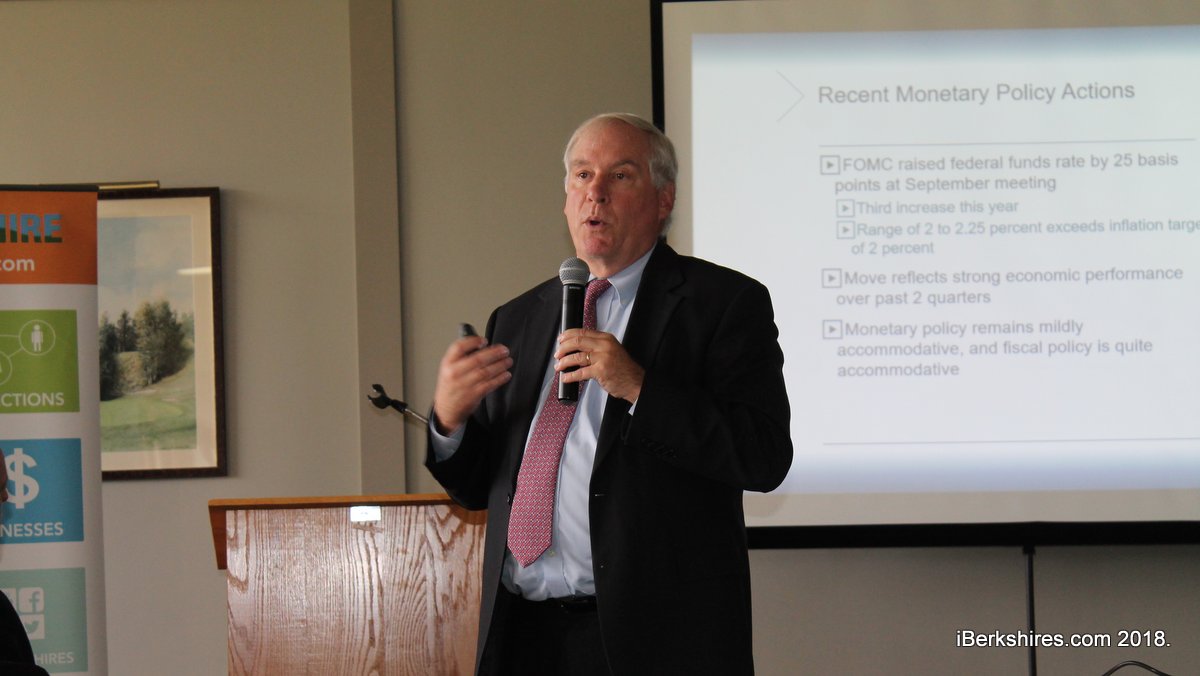
Eric Rosengren said the baseline economy in America is healthy and expects that to continue. But, he said there are some threats that could derail it.
But that is also when inflation skyrocketed and wasn't ultimately curbed until a painful recession hit. The expectations of the Federal Reserve Bank of Boston President Eric Rosengren is that the United States will hit that 3.5 percent unemployment mark soon and federal interest rates will again be raised to curb inflation.
"Three and a half percent hasn't been reached since the 1960s. The last time we did that in the 1960s was a period when we had an expansionary fiscal policy, the Vietnam War was going on, monetary policy was quite accommodative and at that time we started to have an inflation problem. That was the inflation problem that continued through the '70s," Rosengren said.
Rosengren said the Federal Reserve has been "moderately accommodative" to the economy. It had recently upped the interest rate from 2 to 2.25 percent, for the third increase this year, but said that is still below where it should be under "normal" economic conditions.
"We are really pushing the economy more than we usually do. The reason we are able to do that is because inflation has been very well behaved," he said.
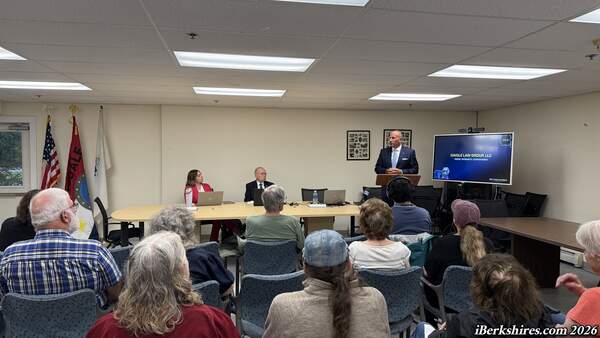
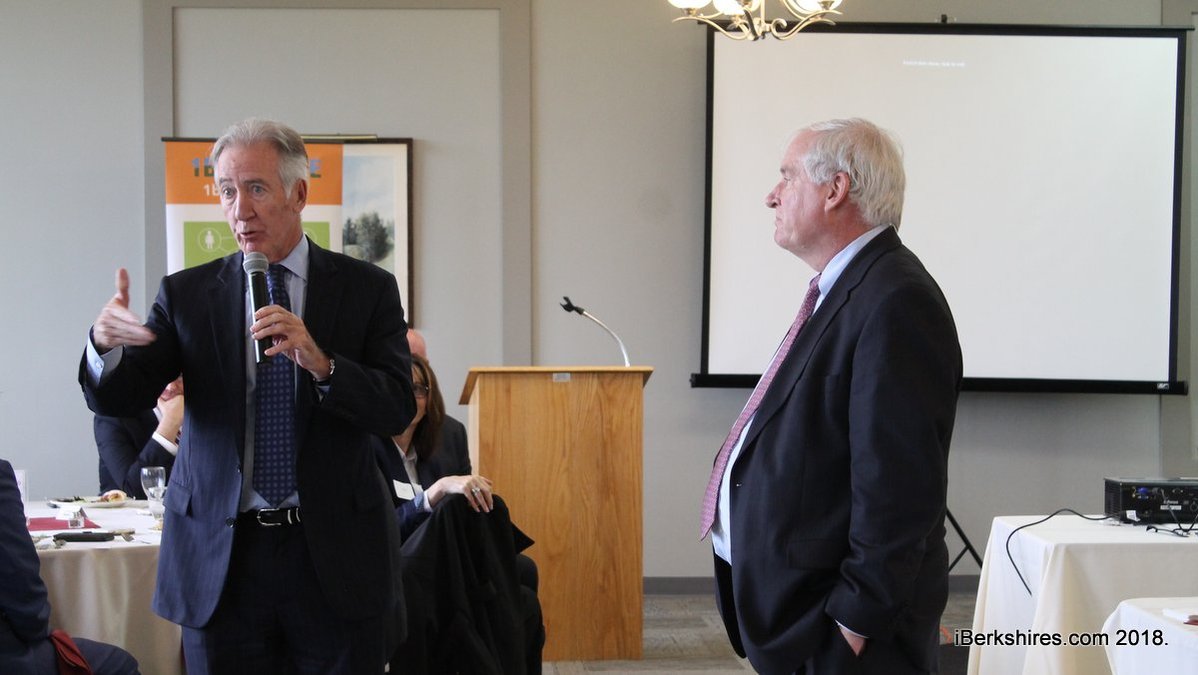
Rosengren presented data points on the status of the economy at the Wahconah Country Club to a room full of business leaders, with a particularly notable representation of those in financial services and banking in the audience. He was joined by U.S. Rep. Richard Neal as part of a luncheon put on by 1Berkshire.
Rosengren says the baseline economy is strong with low unemployment, low inflation, and rising gross domestic product. He said a normal interest rate would be at 3 percent in this case but the Federal Reserve has been holding back somewhat to keep that growth going.
However, if projections remain true, within a few years the interest rate will be up to 3.4 percent to keep the economy from speeding out of control.
The national unemployment rate is 3.7 percent, which in turn creates a tight labor market. Neal added that the unemployment rate can be deceiving because of low worker participation rates.
"We've now had 96 months of economic growth. The stock market has been going up since March of 2009. The unemployment rate is advertised at 3.7 percent, we all know that is not an accurate snapshot of the economy largely because of the decline in labor participation rates," Neal said.
"That has been part of the profound change in our society. Another thing we have to be mindful of is that there are two million people sitting on the sidelines with opioid addictions who used to work, who have secured disability."
Nonetheless, Rosengren said the unemployment rate is sinking so quickly that "we are going to be running out of bodies if we keep pushing the economy too hard." A tight labor market leads to prices increasing.
Rosengren agrees that the worker participation rate isn't ideal. But in projecting the economic environment, there are other data points wrapped into that number that he is looking at.
Right now the initial claims for unemployment, which happens after somebody involuntarily loses a job, is the lowest it has been since the 1960s.
"It is a time when even if your business is slowing down, you aren't going to be inclined to lay off labor because in very tight labor markets it is going to be hard to replace anybody who leaves," he said.
Another data point is that the rate of which people voluntarily leave jobs has gone way up — whereas during the recession that rate plummeted.
"The quit rate is a good indicator of wages going up. How do we see a tight labor market manifest itself in higher wages? When somebody quits one job and goes to another job for a higher salary. The person who has to hire to replace that person probably has to do it at a higher salary," Rosengren said.
As more people leave for higher-paying work, wages go up and thus, in turn, companies raise prices. Rosengren said while wages haven't yet gotten to the pre-recession level, it has been increasing. Rosengren said good wage increases would be 3 percent, two to cover inflation and one for increased productivity.
At this moment, the wages aren't causing inflation but they are increasing. There are a lot of job openings and people willing to move, setting the stage for more steady wage and price increases.
"My own personal view is that inflation is going to pick up faster than this forecast," Rosengren said.
Neal said there are some 16,000 unfilled manufacturing jobs in New England. There are challenges in having enough skilled labor to power the needed workforce.
Rosengren said another reason he expects inflation to grow faster than others do is because of recently imposed tariffs. He said prices are starting to rise for goods because of tariffs imposed on China and an offshoot is that some companies are losing competitors but still raising prices to account for such things as the tight job market.
"What they don't say is that steel and aluminum are a small component of the goods and services in terms of their pricing. They're really using this as an opportunity to make up for some of the labor market tightness that is occurring," Rosengren said.
He said he is seeing a lot more flexibility among companies to raise prices.
There is some extra concern with tariffs for Rosengren, too. He said tariffs tend to be seen as "one-time" disruptions but in this case, it seems to be a "supply chain war" in that it is an intentional move to change the way goods and services are provided.
He said companies may decide to look for other suppliers but that's not easy and other places in southeast Asia don't have the infrastructure and programming to make exporting as easy. He said that is a fundamental change to the economy.
Another concern of Rosengren is the exchange rate, particularly when it comes to emerging markets. He used Turkey as an example saying Turkish firms borrowed in dollars and as the exchange rates move away from their favor, it is increasingly harder to pay off the debt.
"They already were having serious problems and part of it is because they were borrowing in dollars. If you are a Turkish firm it was much cheaper to borrow in dollars than it was to borrow in other currencies. The problem is you are selling goods in Turkey for lira, you are paying off your debt in dollars. That becomes hard to do if the exchange rate moves," Rosengren said.
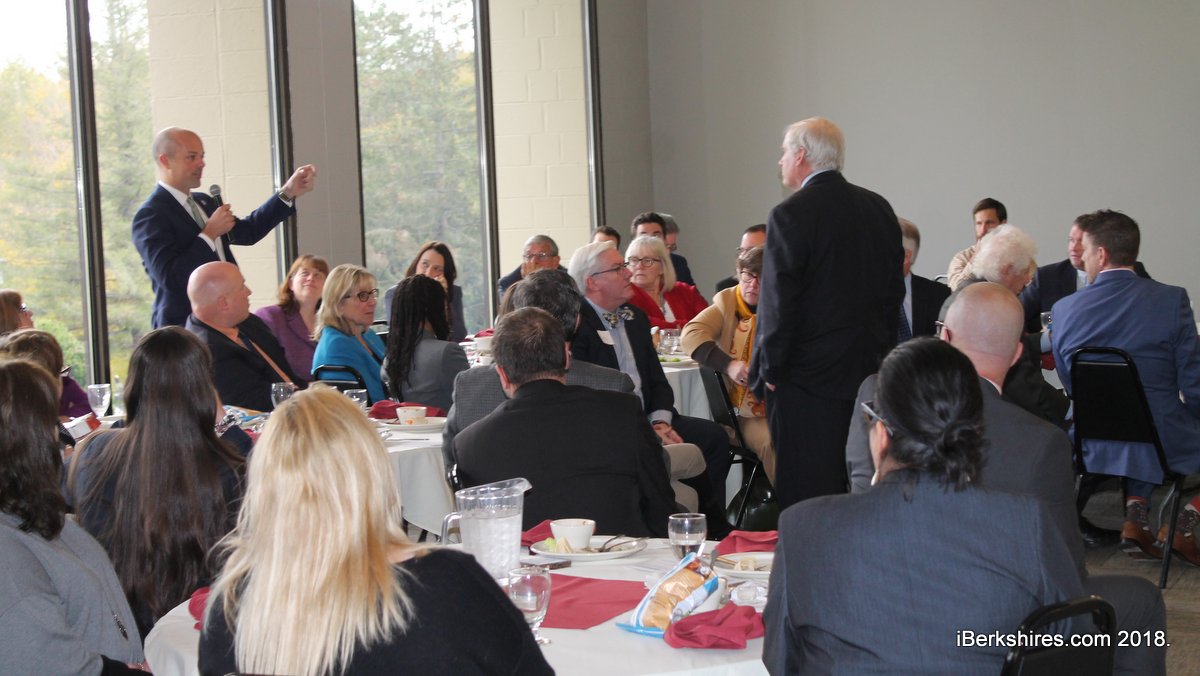
Following a 30-minute presentation, Rosengren answered a number of questions from the audience.
If any of those economies struggle, it could have a negative effect in America.
"We are monitoring those risks but just because it is a risk, you don't start reacting on monetary policy," Rosengren said.
"As long as these risks don't materialize, we are going to have a strong economy and the interest rates are going to have to move to being mildly accommodative to being mildly restrictive."
Rosengren made a strong distinction to what Neal does on the Ways and Means Committee and what the Federal Reserve does. He said the country's fiscal policy is set and then the Federal Reserve adopts policies reacting to what is happening.
In this case, since the economy is growing, the Federal Reserve is slowly moving its interest rates up in an attempt to control the negative effects of that — and so far is keeping inflation at or below 2 percent, which is the target. The setting of interest rates is eyed to level pricing and at the same time pushing for a lower unemployment rate.
Neal would be working on essentially developing another piece of the economy — growing it.
"If we are successful 10 days out, we want a big infrastructure program for the nation. The country is begging for a change in our highways, roadways, bridges, broadband, and also sewer and water," Neal said, a concept he has been pushing for years.
He cited the recession when the federal government cut taxes and increased spending to stimulate economic growth.
"In an economic downturn we all used to agree — Democrat, Republican, Libertarian, Socialists, far right — all agreed on two things, in an economic downturn you increased spending and you cut taxes. We did both. We cut the payroll tax and we embraced Obama's plan for almost a trillion dollars in public spending and that helped get us out of where we were," Neal said.
The two perspectives essentially balance out and that's why Neal said he likes to listen to the information and thought process of people like Rosengren while considering measures such as tariffs.
But, he said the independence of the Federal Reserve must be preserved — and Rosengren joked that he doesn't tell Neal how to set fiscal policy and Neal doesn't tell him what to do with interest rates.
"We don't need Democrats or Republicans setting interest rates a month before an election," Neal said.
Boston Fed Presentation by iBerkshires.com on Scribd
Tags: 1Berkshire, economy, federal reserve, interest rates, luncheon, Neal,