Williamstown OKs Accessory Dwelling Unit Bylaw
WILLIAMSTOWN, Mass. — Eighty-six percent of voters at town meeting Tuesday approved an unamended version of the zoning bylaw amendment crafted by the Planning Board to allow construction of new accessory dwelling units in town.
By a margin of 205-32, members of the meeting approved the bylaw amendment, which will allow construction of up to one ADU on any building lot that conforms to zoning bylaws for setback, frontage, acreage and building coverage in the town's General Residence, Southern Gateway, Rural Residence 2 and Rural Residence 3 zoning districts.
But before voting on Article 33 itself, which needed a two-thirds "supermajority" for passage, the meeting first voted down an amendment that would have required a special permit from the Zoning Board of Appeals for all new ADUs.
That vote, to amend the article, failed by a narrower margin of 175-78 after a 55-minute debate that consumed about half of the meeting.
Amy Jeschawitz, who was voted off the Planning Board last Tuesday but served as its chair throughout the development of Article 33, said she was encouraged about its prospects when she heard some of the residents who took the floor at the meeting.
"I think when people started coming up to the microphone, it was good to hear the townspeople who hadn't been to the Planning Board meetings," Jeschawitz said. "When I started to see that, it gave me some hope that we might be able to get it.
"I thought it would be much closer than it was."
Jeschawitz said she thought the results of last week's town election, where the the ADU bylaw was a major issue, led some voters to take another look at the Planning Board's proposal.
Dante Birch, who defeated Jeschawitz in last week's election and was sworn in for this seat on the Planning Board on Tuesday night, made the amendment proposing a requirement for special permits — as he said he would do in the weeks leading up to the election and town meeting.
After Tuesday's meeting, Birch said the amendment was about providing a level playing field for homeowners in town — a point he and Krista Birch made during the debate on the amendment. As drafted by the Planning Board (and passed by the voters), the bylaw amendment allows "by-right" ADUs on conforming properties but requires a special permit on lots that don't conform to zoning.
"No one bats 1.000," Dante Birch said. "I feel like my heart was in the right place. I'm really about having equality and equity in our communities."
Birch said he did not think that the town election, which he won with 64 percent of the vote, was necessarily a bellwether for the town meeting votes.
"People vote on what's important to them, and every issue is different," he said. "We don't have a one-size fits all community, so everyone has different interests. So I can understand that.
"People are with you on some issues and not others, and it's a very complex metric. … All I'm thinking about now is how best to serve the community going forward."
As expected, the ADU bylaw amendment generated the most debate at the meeting, but there was discussion of two related articles that dealt with town funding for the non-profit Sand Springs Recreation Center.
The non-profit pool was before the meeting seeking $19,000 to support its operational expenses and $34,800, in a separate warrant article, as a one-time appropriation of Community Preservation Act funds to support a lift that will make the second floor of the building at Sand Springs accessible.
Both articles passed in nearly unanimous voice votes, but only after Sand Springs' current and former executive directors addressed the meeting to answer questions raised by residents about the recreation center's fund-raising efforts and how accessibility to the pool for all income groups.
Accessibility to the town itself for various income groups was at the heart of the Planning Board's proposal, board member Stephanie Boyd told the meeting.
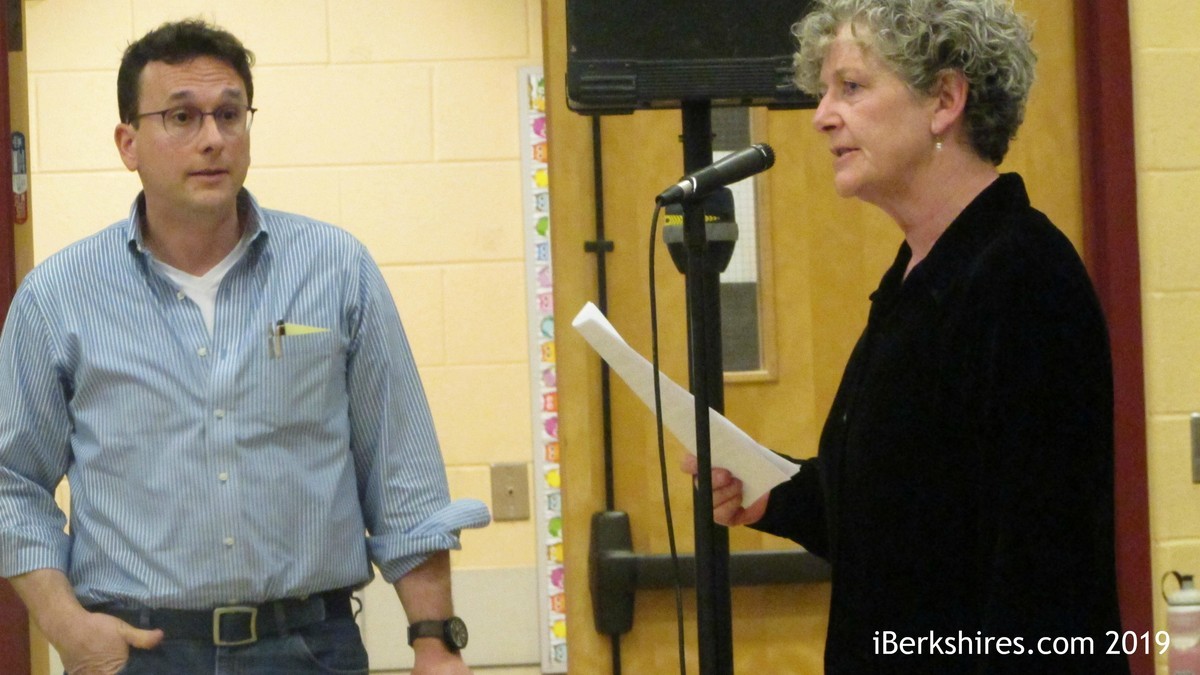
"We believe fairness in the fundamental sense of the word is providing those with fewer resources access to the benefits we enjoy as citizens of the Town of Williamstown," Boyd said in her prepared statement introducing Article 33. "This is one small step toward being a more inclusive community, to which we all aspire."
Proponents of the ADU bylaw — and a separate article on Tuesday's agenda that frees up conversion of existing homes to duplexes — say that by allowing more flexible housing types, the town creates the potential for more smaller homes that will be accessible to low- and moderate-income residents.
"Some of us will remember that there was something like ADUs in Williamstown — clustered together and swept away in the flood," Sam Crane said in speaking against Birch's amendment. "When we lost the Spruces [mobile home park], we lost the kind of diversity that this article seeks to create.
"I'm afraid this amendment is an obstacle to returning to that diversity, and I'd urge us all to vote against it."
Defenders of Birch's amendment pointed out that requiring a special permit allows oversight from the Zoning Board of Appeals and safeguards against the unintended consequence of by-right development as proposed by the Planning Board.
Jeffrey Thomas countered that the special-permit process can be an impediment to development that might otherwise conform to the setback requirements in the zoning bylaw.
"It turns out an abuttor has lots of ways to appeal a decision by the Zoning Board, and whenever they do that it adds significant time and cost to the person trying to build an ADU," the selectman said. "I've heard a minimum of 18 months delay when a case is being scheduled in appeals court.
"They can claim the ADU is going to, 'Mess up my drainage, mess up my view, create parking problems.' … They can appeal the ZBA, hold up my project and essentially wear me down, wait me out, spend my money until I'm likely to say, 'It's not worth it. I don't need an ADU that bad.' "
A current member of the ZBA, Keith Davis, was among those weighing in against the amendment to require more ZBA oversight.
"If it's a conforming structure … if [homeowners] want to put up a garage or a barn on the property, they can do that by right," Davis said. "They will have to conform with zoning and meet the development standards.
"If it's a conforming structure, the building inspector issues the permit [without ZBA oversight]. What we're doing [with the amendment] is putting an additional burden on the application for an ADU structure that conforms. I'm against the amendment and in favor of the bylaw."
Tags: affordable housing, town meeting 2019,