Williamstown Researching Potential for Municipal Broadband
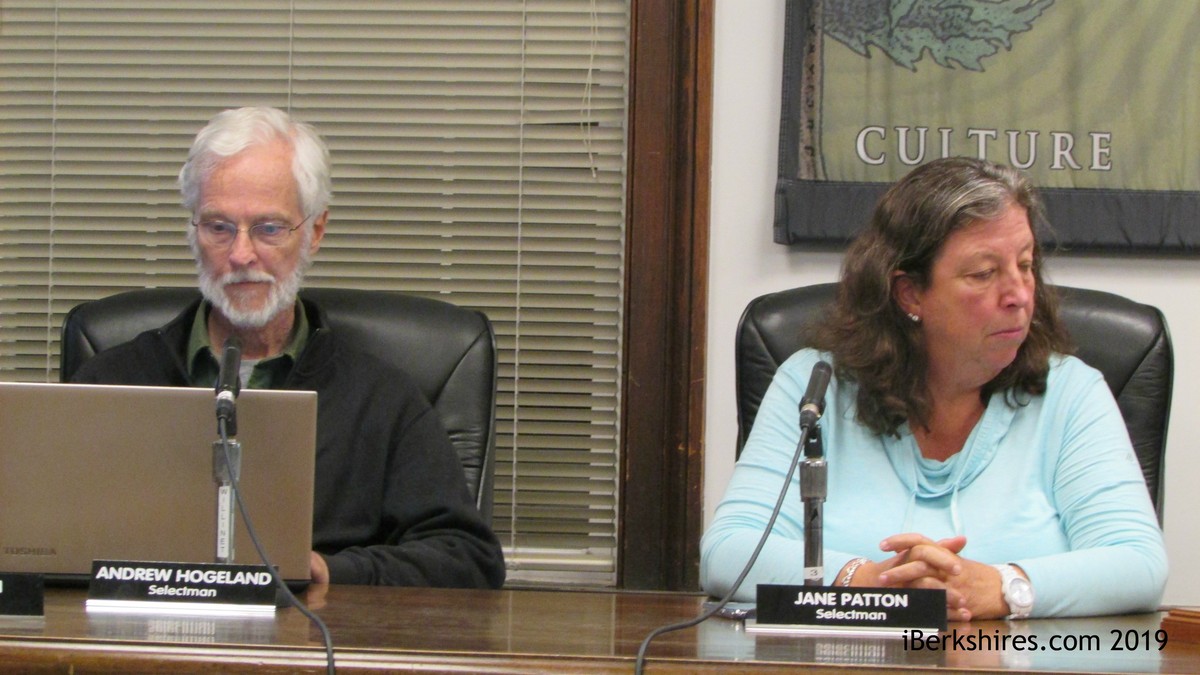
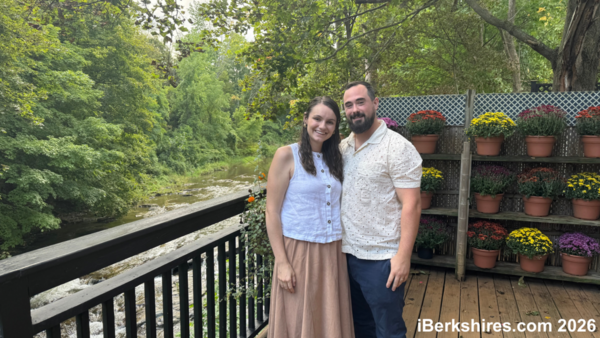
Andrew Hogeland, left, discussed the research of a group looking into a possible municipal solution to the town's need for high-speed internet.
But any such vote would be the first on a long road to realizing the dream of townwide fiber optic service.
Select Board member Andrew Hogeland on Monday gave his colleagues an update on the research of a working group of volunteers who have been looking at solutions to provide high-speed internet access in the rural town of 7,700.
The group's research shows that while municipal fiber optics are a solution that other communities in the commonwealth have used, many of those towns and cities had advantages Williamstown does not share.
One area where the Village Beautiful potentially could catch up: creation of a municipal light plant.
MLPs in other communities are municipally-owned utilities to provide gas or electric service to residents and businesses. In Williamstown, homes and businesses are served by utilities like National Grid and Berkshire Gas.
Where MLPs previously existed, adding a new service has been seen as a logical extension of its business model, Hogeland said. Other towns have created MLPs just for purposes of providing broadband internet.
The process for creating an MLP requires two separate town meeting votes, held at least two months apart but not more than 13 months apart. Hogeland said that since the town already is contemplating a 2019 special town meeting to approve land transactions related to the planned bicycle trail from North Street to the Spruces, an MLP question could be added to that warrant.
That would allow a second vote at the annual town meeting in May.
"If we do the MLP voting, it doesn't commit us to anything," Hogeland said. "It's just setting up a framework. You've founded an organization on paper only, not agreed to do the project."
There are other advantages that are outside the town's control, he noted.
Some of the communities that have added municipal fiber optics have benefited from grants from the commonwealth that Williamstown would not be able to access. Others have created the systems in markets where there is no competition from for-profit companies.
In Williamstown, Spectrum is the "predominant incumbent," Hogeland said.
That could mean that Spectrum would react to the potential competition by undercutting the municipal service's prices in order to retain customers. Or it could mean that the town could enter into a collaborative agreement with the internet provider, Hogeland said.
"We're contemplating starting conversations with them," he said.
The town also has a potential municipal partner, the MLP in Westfield, Westfield Gas & Electric, which already is providing broadband service to six other towns.
Whichever model the town ultimately pursues, a municipal broadband project would require internet users to switch away from their current provider to the public utility.
"Success of the system financially depends on the support of residents as consumers — not voters," Hogeland said. "Town meeting has to happen, but that's not success. Success is: Are you going to have more or less half the households sign up for this because it's going to take something like that."
Hogeland said the working group is planning on doing outreach later this fall and it may include a survey to assess demand along with the town's annual census in January.
"Further down the road, a more meaningful technique could be to have people make pledges — sign up with $50," he said. "But we can't do that until we can say more precisely what it is they'd be signing up for."
That's where the conversations with a potential partner, like Spectrum, will help inform decisions about pricing and where a recent initiative of state Rep. John Barrett III, D-North Adams, could help make the cost of a municipal broadband system more predictable.
Barrett was written a bill in Boston to remove the "make ready" fees that utilities charge municipalities to make connections to poles.
"Everybody I've talked to in [a Massachusetts Broadband Initiative] town, the one thing that sets them off in anger is make-ready costs," Town Manager Jason Hoch said. "They've been higher than expected and unpredictable.
`
"Earlier this year, the state of Maine passed a law saying utilities could not charge municipalities for a make ready cost for use of their poles in the service of building broadband. [Williamstown resident] Don Dubendorf shared that article with me, and I decided to give John Barrett a call.
"Taking on utilities is always a challenge at best, but here's a comparable in our back yard."
Hoch noted that utilities will fight the bill on Beacon Hill in order to preserve the revenue stream from make ready charges. But on possible outcome could be a law that regulates what the pole owners can charge.
"If at the very least, we could eliminate some degree of that uncertainty … it could be a key point to get this to go forward," he said.
Utility talk dominated Monday's Select Board meeting.
But unlike the broadband proposal, which is still a work in progress, another paradigm-shifting initiative is well underway.
The town's "solar coach" under the commonwealth's Solarize Plus program was at Town Hall to share an update of the project.
Susan Abrams told the Select Board that, to date, the joint Williamstown-North Adams project has produced 29 signed contracts between residents and project installer SolarFlair Energy of Ashland.
Those contracts account for just more than 195 kilowatt hours of clean energy, which puts the Northern Berkshire project halfway to its goal of 400 kWhs, the point at which SolarFlair promised to donate a free solar array to a North Berkshire nonprofit
Abrams said there are other residents in the pipeline who have not signed contracts and that volunteers in North Adams and Williamstown are continuing their outreach.
She also noted that Solarize Plus organizers have become aware that a solar installer has been attempting to "poach" business by claiming to be the installer that the her group selected after issuing a request for proposals under the auspices of the Massachusetts Clean Energy Center.
Abrams encouraged anyone with questions to reach out to either her at solarizeplus@williamstownma.gov or North Adams solar coach Adam Galambos at solarizenorthadams@gmail.com.
In other business on Monday night, the Select Board held an initial discussion about parking bylaw changes recommended by Hoch and Police Chief Kyle Johnson. Hoch reported the Fairfield Inn on Main Street continues to have troubles with state and local codes that are delaying its opening.
And Select Board Chairman Jeffrey Thomas noted that the special election for two new members of the Williamstown Fire District's Prudential Committee will have four candidates — two for each of two open seats on the expanding committee. David Moresi and Gerard Smith are running for the 18-month seat; Bruce MacDonald and Richard Reynolds will vie for a 30-month seat. The special election is slated for Nov. 19.
Tags: broadband, Internet,