Williams Astronomy Professor Heading to India for Annular Eclipse
WILLIAMSTOWN, Mass. — Jay Pasachoff, the Field Memorial professor of astronomy at Williams College and chair of the International Astronomical Union's Working Group on Solar Eclipses, is heading to India to view a solar eclipse on Thursday, Dec. 26.
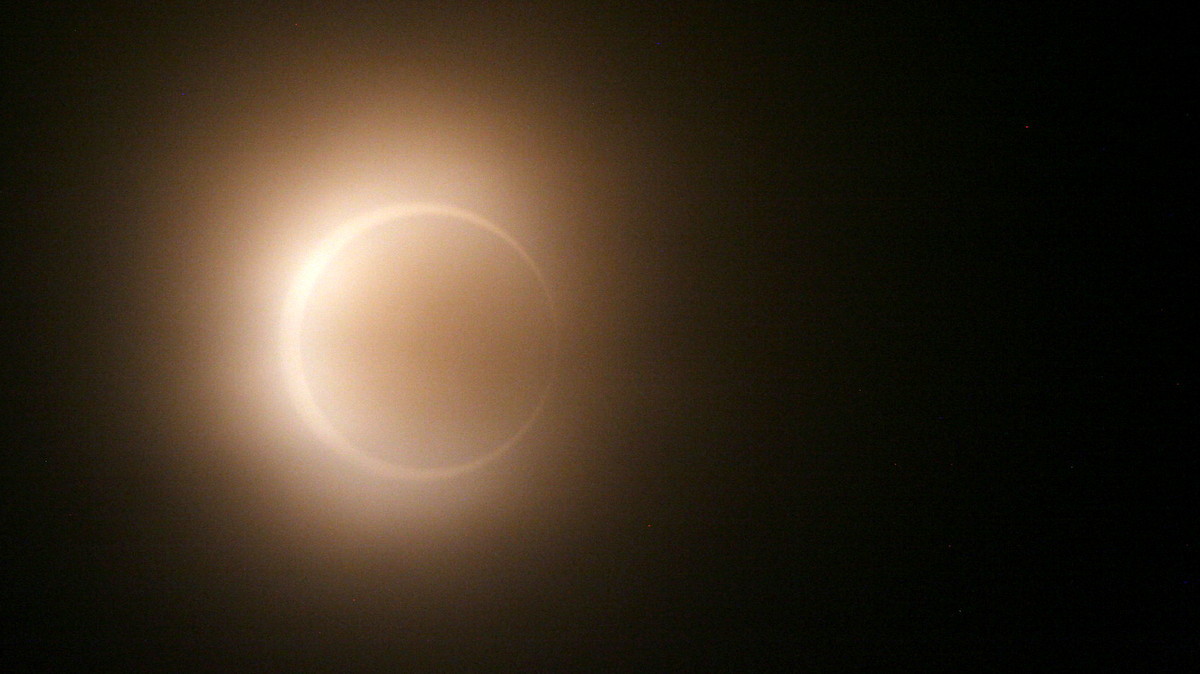
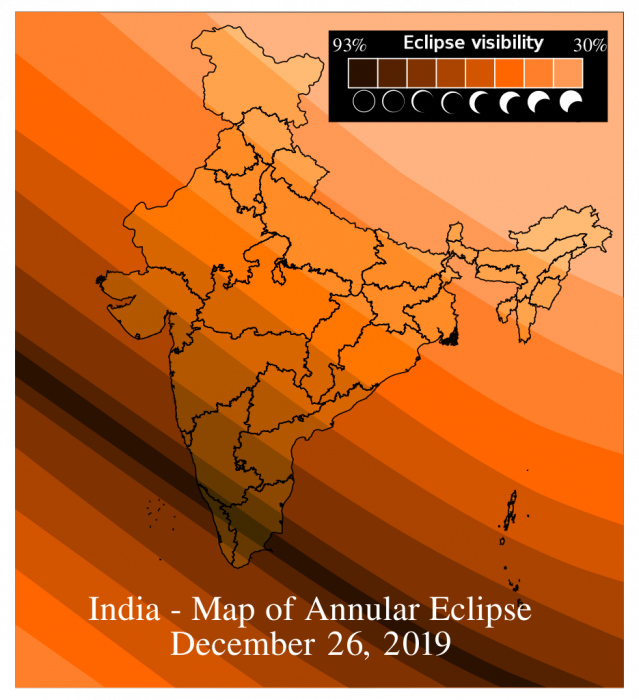
According to Pasachoff, the moon will be a little farther from Earth than average, so it will not completely cover the sun's bright disk, leaving a ring known as an annulus of bright everyday sunlight. Though up to 93 percent of the sun will be covered, to see this "annular eclipse" safely, people should still use special solar-safe filters or look at projected images. Near the maximum of the eclipse, images will be naturally projected under trees by the spaces between the leaves, so people can see the eclipse by safely facing away from the sun and looking only at the projected image.
The partial phases will be visible over a two-hour period throughout India. During the eclipse, the only noticeable effect on Earth will be less sunlight than usual; no extra rays are given off by the sun, so it is completely safe to be outdoors.
Pasachoff will view the annular eclipse, his 18th annular, together with professor Jagdev Singh of the Indian Institute for Astrophysics in Bangalore, who is also a solar astronomer and a member of the Working Group on Solar Eclipses. Pasachoff has also viewed 35 total solar eclipses, most recently in Chile in July and in the United States in 2017, as well as partial solar eclipses, making the forthcoming eclipse his 72nd solar eclipse.
Pasachoff will lecture about solar eclipses at the planetarium in Mumbai at 6:15 p.m. on Tuesday, Dec. 24, hosted by the planetarium's director, Arvind Paranjpye. Then he will travel to Madurai, where he will be hosted by professor Stephen Inbathan of the American College. Pasachoff, Singh, Inbathan, Robert Lucas from Australia, and their families will observe the annular phase of the eclipse from the Basri beautiful country resort en route to the venerable Kodaikanal Solar Observatory, where they will spend the night.
Near Madurai, the eclipse will begin at 8:07 a.m. local time, as the moon first begins to overlap the sun's disk. The peak of annularity will be visible there from 9:30 to 9:33 a.m., with the partial phases ending at 11:15 a.m. The sun will be about one-third of the way up in the sky, and 93 percent of its diameter will be covered at maximum. The path of annularity will be 128 kilometers wide, with Madurai and Kodaikanal near its southern edge.
The eclipse will begin to be visible in Saudi Araba, Qatar, UAE and Oman low in the sky, and at least one cruise ship will intercept annularity in the Arabian Sea. Information about the times and places for viewing the eclipse can be found at the International Astronomical Union’s eclipse website: http://eclipses.info. The maximum coverage of the solar disk will be 89 percent at Chennai, 84 percent at Mumbai and 56 percent in New Delhi. After the path of annularity leaves India, it will cross northern Sri Lanka, Indonesia's Sumatra and Kalimantan, and Singapore. Partial phases will be visible as far north as Shanghai, Beijing, Seoul, and Tokyo. Guam and some Mariana Islands will be in the path of annularity, as the eclipse exits across the Pacific.
At the website http://eclipsophile.com, meteorologist Jay Anderson uses decades of satellite observations to show that the chance of clear skies to see the eclipse is more favorable in the first third of its path, including India, than in the rest of the path of annularity.
Pasachoff's annular-eclipse observations from India will be compared with observations of the eclipse from several spacecraft: ultraviolet observations from U.S. and European spacecraft Solar and Heliospheric Observatory and GOES-16, and from an American x-ray telescope on Japan’s Hinode spacecraft.
Pasachoff has previously seen solar eclipses from the Japal-Rangapur Observatory south of Hyderabad in 1980 and from Mukandhar Fort, Rajasthan, in 1995, and an annular eclipse from Kanukamari at the southern tip of India in 2010. He will bring 5,000 safe solar filters to distribute in Mumbai and Madurai, courtesy of Astronomers Without Borders, which has collected once-used filters from the 2017 American eclipse.
At his lecture at the Mumbai planetarium, Pasachoff will discuss the Nov.11 transit of Mercury that he viewed from the Big Bear Solar Observatory, where he once worked with Arvind Bhatnagar, who later was director of the Nehru Planetarium in Mumbai and who founded the similar Udaipur Solar Observatory, adding to the history of solar astronomy in India relevant to the Kodaikanal Solar Observatory.
Following this solar eclipse will be another annular eclipse, with annularity visible from the Middle East, Pakistan, northern India and southern China on June 21, 2020. Annularity will be visible from Punjab, Chandigarh, and Uttarakhand. Ninety-five percent of the sun's disk will be covered at New Delhi, 70 percent at Mumbai, and 45 percent at Chennai. Again, safe solar filters or projection methods will be needed to allow viewing the eclipse without hazards to vision, and no other effects of the eclipse will occur.
The next solar eclipse to reach the United States will occur in April 2024.
Pasachoff’s current eclipse research is sponsored by the Solar Terrestrial Program of the Atmospheric and Geospace Sciences Division of the U.S. National Science Foundation. The NSF previously sponsored his 1980 eclipse expedition to India.
Tags: eclipse,