
Mental Health Providers Adjust to Provide Services During Pandemic
But it is not by choice.
Social distancing required by the fight against COVID-19 means the end of in-person counselling for many people.
Berkshire County's Brien Center moved all of its psychotherapists to a telehealth model last week, according to the agency's vice president of service operations.
It's not ideal, but it is better than the alternative, Paul Hickling said.
"I've been a psychotherapist since 1992, and there is no substitute for a face-to-face session, whether it's the initial session or ongoing," he said. "But I think a lot of our folks are pleased that we're continuing to operate and provide services.
"They understand it's not ideal, but they're just glad to have that continuing support."
Last week, the state directed that telehealth — consultations by phone or video conferencing platforms — be covered by health insurance in Massachusetts. Officials are encouraging anyone with symptoms of COVID-19 to contact their health-care provider by phone first to see if they need testing, rather than going to a doctor's office and potentially exposing others to the novel coronavirus.
That telehealth service extends to those who need mental health counseling, too.
It is a different therapeutic model than patients are used to, but even before the COVID-19 crisis, it was not entirely without proponents in the mental health community.
"It's interesting because I also teach at Baypath University, and we discuss what's called e-therapy all the time," HIckling said. "There's a younger subset that is much more open to that for any kind of regular therapy service. When people get to be middle-aged or older folks, they struggle with that.
"And a lot of folks don't have the capacity to do that over the phone or the computer."
Currently, the Brien Center is connecting with its clients (about 10,000 people annually) via telephone only, Hickling said. Video conferencing would require a separate license and a HIPPA-compliant platform.
"For psychiatric providers, we do provide audio and video for crisis assessment in emergency rooms," he said. "At this point, we're doing audio for outpatient therapy services."
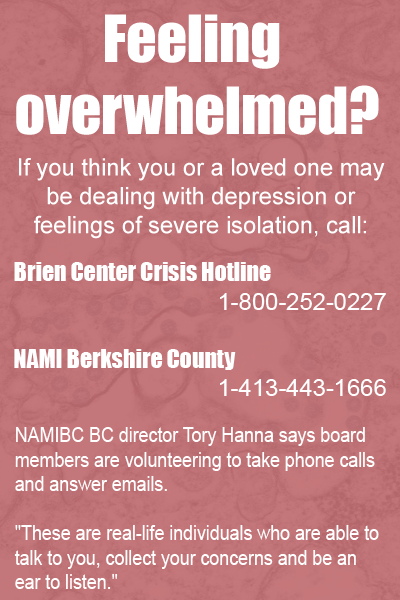
That's good news to Tory Hanna, the vice president of the National Alliance on Mental Illness chapter in Berkshire County.
His group, which educates and advocates for residents with mental illnesses, helps connect people with services like those provided by the Brien Center.
"We know the Brien Center is providing some telehealth for its existing population," Hanna said. "We're trying to understand if that will be opened up to a broader audience, to anyone who is seeking telehealth services. … The teleconferencing would be a huge help."
Feelings of isolation, depression and anxiety that come with social distancing in the age of COVID-19 may put more people at risk for mental health issues, advocates fear. In New York, Gov. Andrew Cuomo has said the state plans to set up a free hotline for residents affected by the crisis to talk to mental health professionals.
"One of the most vulnerable populations is folks that are older," the Brien Center's Hickling said. "In terms of the elderly, it's really important for family members to check on them, to make sure they're following schedules, to make sure they have food and they're staying occupied. Any changes in that routine, and that would be a red flag.
"I've heard people say … they haven't felt this way since 9/11. But even with 9/11, there was a kind of reboot in a short period of time, but it's less clear in this situation."
Hanna said NAMI Berkshire County has not seen a spike in demand for services, but the danger is real as people become increasingly isolated.
"Largely, people will call NAMI with concerns about loved ones — family members, friends, community members — who are suffering mental health issues," Hanna said. "We're kind of like the first line of defense.
"Our volume has not really picked up, but it hasn't slowed down. … Now the conversation is more about isolation and depression. Someone will say, ‘I'm worried about this being a more pervasive thing for my family member.' "
NAMI Berkshire County Program Director Stephanie Adornetto agreed.
"I am answering more emails from persons experiencing isolation and panic," she said. "We anticipate this will increase as the days go by."
Adornetto added that NAMI is working to increase the availability of telehealth options.
"NAMI BC and most affiliates are preparing to use teleconferencing for our Family-to-Family educational program we hope to start in mid April," she said. "We will be doing the same to continue our monthly support groups. We have to train facilitators who are volunteers in this technology."
NAMI's Family-to-Family classes are one example of how teleconferencing can be utilized even beyond one-on-one interactions.
While the Brien Center has suspended its own group sessions, the agency is directing people to groups, like Alcoholics Anonymous, who offer online meetings, Hickling said.
"We have suspended groups out of an abundance of caution, but we are using recovery coaches and addiction health navigators to be able to help engage people over the phone," He said. "We are still engaging them, just a little differently."
Tags: COVID-19, mental health,
More Coronavirus Updates