'Auntie Mame': 'Life is a Banquet, and Most Poor Suckers Are Starving to Death'
I wish that I were reviewing one of the half-dozen movies certain to be made when this pox upon our house is no more. But until that glorious return to normality has us resuming all the simple joys of life we take for granted, like going to the movies, I'll be retro-reviewing and thereby sharing with you the films that I've come to treasure over the years, most of which can probably be retrieved from one of the movie streaming services. It is my fondest hope that I've barely put a dent into this trove when they let the likes of me back into the Bijou.
…………………………………………………………….............................................................
The hilarious, sweet, touching and life-affirming "Auntie Mame" (1958) is an iconically vivid reminder for me that you remember some movies not just by their content, but by with whom you saw them. Y'know, milestones large and small.
I viewed the frightening "Sands of the Kalahari" (1965) with Sophie; the very grown up "The Subject was Roses" (1968) with Judy; the exciting "Vanishing Point" (1971), about a speed merchant and a 1971 Dodge Challenger, with Skip; and when, on a first date at the box office for Cassavetes' psychological astute "A Woman Under the Influence" (1974), Joanne pulled out her wallet and paid our admission, I decided, "this one's for me."
I was 12 on the day of the Great Movie Outing. Through no special cajoling on my part that I can recall, my sister Anne invited me to join her and immemorable Boyfriend No. 12, to a day's adventures in Manhattan, which included not one, but two movies, separated by a meal. I bet I had a hot dog.
I was enchanted. Double features had just about gone the way of the Dodo bird back in Newark. And now here I was seeing two first-run films in two separate, grand New York moviehouses. I don't remember the Western that was movie No. 2. But as evidenced by this writing and could probably be easily explained by any shrink who isn't too busy with more important work, like affirming that Trump is a sociopath, "Auntie Mame" has always held a special place in my heart.
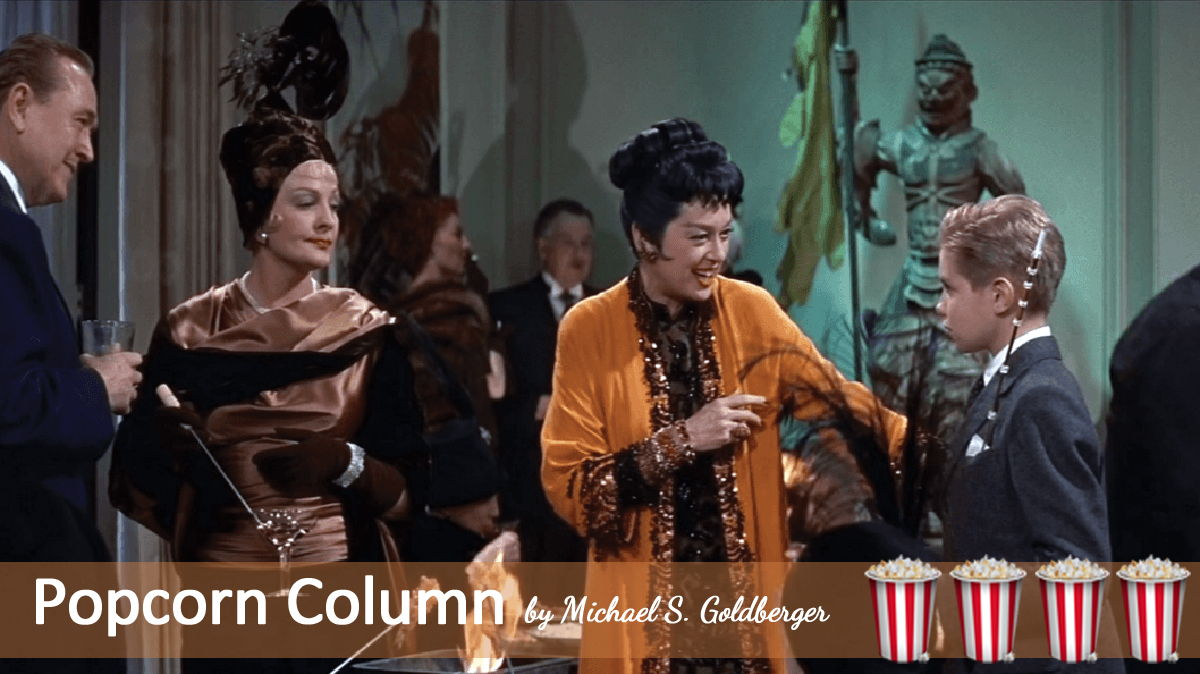
I deem that the fantasy engendered in me was of having just the sort of Pied Piper aunt who takes in little Patrick Dennis (Jan Handzlik) when his rich dad dies. Portrayed in fully deserved, Oscar-nominated grandeur and verve by Rosalind Russell, Auntie Mame is all-around confidante, mentor and cruise director of life in one vivacious package. And now at this date, proving my axiom that no matter how many times you see a favorite movie there is always
something new to glean, it occurs that I might owe a portion of my sociopolitical perspective to Russell's upper crust and refined but decidedly liberal resident of 3 Beekman Place.
Mame Dennis suffers no bigots. When as a college student, the adult Patrick, played by Roger Smith, brings home a girlfriend (Joanna Barnes) who informs that the homestead in Connecticut to which she invites Mame to meet her parents is restricted, Mame assures, "I'll get a blood test."
It's a running theme, the sophisticated liberalism of the Silk Stocking set vs. the repressively conservative powers that be, dogmatically represented by Fred Clark's Dwight Babcock, financial trustee appointed by Patrick's dad and pillar of the stodgy Knickerbocker Bank. The tug and pull of the contrasting forces will play into Patrick's upbringing and manifest in a nip and tuck competition right up to the closing credits.
In the meantime, while the kid's fate is being decided in one watershed and epiphany after the next, we are witness to the three-ring, albeit urbane and chic, circus that plays 24/7 at 3 Beekman. This includes the zanily witty, narrative banter of what serves as Mame's family: her Japanese houseboy, Ito (Yuki Shimoda); Norah Muldoon (Connie Gilchrist), the nanny that accompanied Patrick from Chicago and stayed; cynically catty Vera Charles, best friend and Broadway mainstay; and Peggy Cass' Oscar-nominated Agnes Gooch, nerd extraordinaire hired to transcribe the title character's autobiography. Tsk, tsk, what happens to her, and I was only 12.
But among the most important habitués at Mame Dennis' perennial celebration of life is Forrest Tucker's effervescently played Beauregard Jackson Pickett Burnside, a wealthy Southern gentleman who all but loses touch with our girl after their serendipitous meeting at Macy's. It pleases my romantic fantasy that in some Paris salon where perhaps Gertrude Stein held court and my then underaged Dad popped in for his first drink, a resident philosopher put forth that no matter the number of trysts and flings we venture, there is only one who is the real thing. And so for Mame, who made it to middle age on a steady diet of interesting but dispensable admirers, Mr. Burnside arrives to prove the philosopher's theory. Hey, I even like the guy.
Which brings me to the part of the review where I apologetically admit ruining it for you just a tad by sharing a favorite quote. Backdrop, the Stock Market Crash and ensuing Great Depression bring us to a Christmas season with Mame wondering how she'll make ends meet, let alone afford gifts. And then the doorbell rings.
Alas, clutching thick phone book and declaring a Christmas miracle in that there are 97 Dennises in Manhattan alone, Beauregard Jackson Pickett Burnside has found his true object of affection. Ebullient, he invites Mame, Patrick, Norah and Ito to dinner, informing that he'll just tell "that nice taxi man to wait" while they get ready. Mame asks in astonishment, "You mean you left the taxi meter running in the middle of the Depression?"
To which Beauregard answers, "Well Ma'am, I'm in oil. It just keeps gushing, and there's not much I can do about it."
Combine equal parts love, dreams, farcical folderol, a smartly elegant cascade of splendor and you have the feel-good potion that is "Auntie Mame."
"Auntie Mame" is a Warner Bros. release directed by Morton DaCosta, and stars Rosalind Russell. Forrest Tucker and Jan Handzlik. Running time: 143 minutes
Tags: movie review,