'The Wild One': Wandering Rebel
I wish that I were reviewing one of the half-dozen movies certain to be made when this pox upon our house is no more. But until that glorious return to normality has us resuming all the simple joys of life we take for granted, like going to the movies, I'll be retro-reviewing and thereby sharing with you the films that I've come to treasure over the years, most of which can probably be retrieved from one of the movie streaming services. It is my fondest hope that I've barely put a dent into this trove when they let the likes of me back into the Bijou.
…………………………………………………………….............................................................
Mildred: Hey Johnny, what are you rebelling against?
Johnny: Whadda you got?
"Cool."
If this term for the exalting approbation of a person, place, thing, or concept hadn't emanated from the American jazz culture of the 1920s and '30s, it would have to be coined in time to describe Marlon Brando's Johnny Strabler in "The Wild One" (1953).
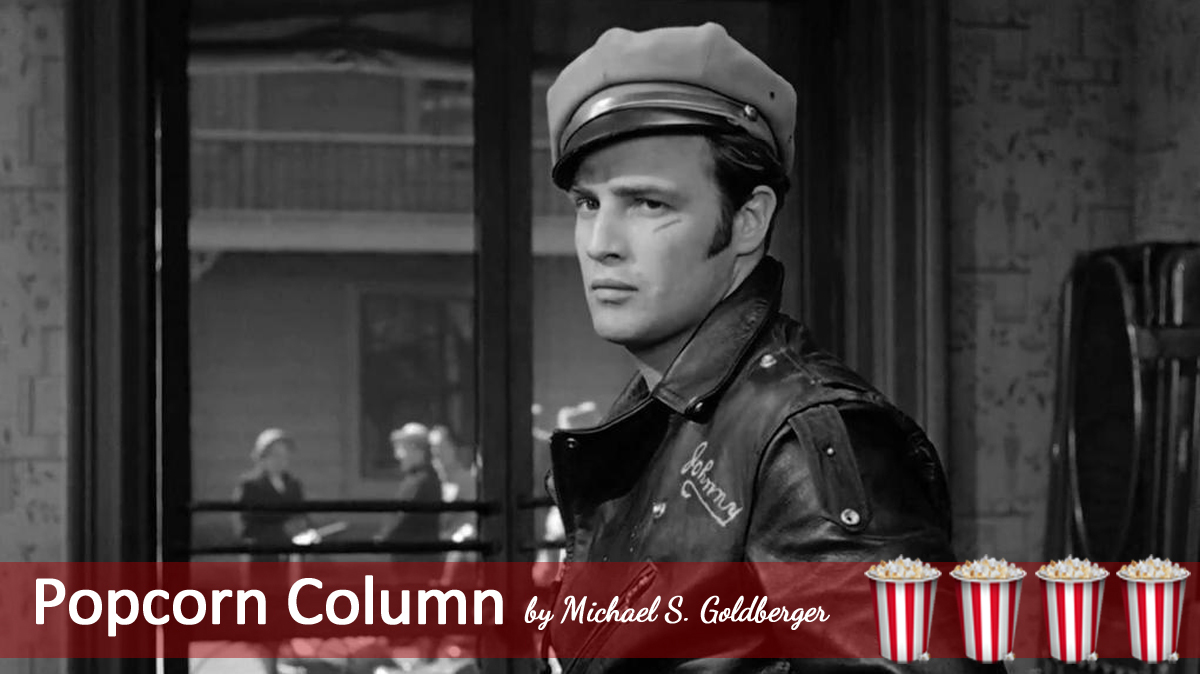
What's that? Not familiar with the iconic movie still of the black leather jacket-attired Johnny on his Triumph Thunderbird 6T motorcycle, his cap tilted to set off his moody glare? Find it now on Google. That's OK, we'll wait.
Cool, huh?
Everything else about the film inspired by the so-called Hollister Riot of 1947, wherein all hell broke loose when 2,000 members of the American Motorcyclists Association descended on that California town, Fourth of July Weekend, is up for conjecture.
Now, I wouldn't dare ask Johnny if the movie directed by László Benedek from John Paxton's screenplay, based on Frank Rooney's short story in Harper's, was a sociological pastiche of post-WWII melancholia and uncertainty about the future. He'd probably just scowl. But if he did answer, I bet it'd be with the same aloof scorn evinced in the following repartee with Mary Murphy's Kathie, the pretty, small-town café waitress and his off-center love interest.
Kathie Bleeker: Well, what d'ya do? I mean, do you just ride around, or do you go on some sort of a picnic or something?
Johnny: A picnic? Man, you are too square. I'm ... I ... I have to straighten you out. Now, listen, you don't go any one special place. That's cornball style. You just go.
In short, I'd also be going against the grain of what propels Johnny's vehement, anger-tinged wanderlust if I suggested that there was a scholarly explanation for this latest permutation in America's succession of lost generations. If anything, he is not to be pigeonholed. Dare not posit theories that might compromise the freelance, ad-lib lifestyle he features himself to have originated.
But, if over a beer in the joint where Kathie works and Johnny's gang has invaded with the presumption of an occupying army, and he still hasn't beat me up, I'd venture a hypothesis or three. Just as the Cold War begins to rear its ugly forebodings across the land, there are essentially two groups who coalesce into the roving, freewheeling bikers espousing rebellion.
Joining the small but well-established band of those already perched astride mostly Harley-Davidsons and Indians, are WWII's returning combatants in search of the excitement and camaraderie that overtook their psyches and souls. And then, Johnny, don't hit me, there's your group, the too-young-to-go-to-war, sore thumb and therefore socially impotent contingent in search of their manhood. Geez ... we humans don't give ourselves a break, do we?
These psychological building blocks of plot motivation are wrapped into a hardly novel, basic storyline that is merely the booster rocket for a seductive if not altogether shocking metaphor about the threat to middle class, conservative society. It is a foreshadowing of what Bob Dylan will later identify as "a change comin' on."
In any case, after Johnny's crew of neo desperados descend on the fictitious little burg of Wrightsville, Calif., and establish a toehold of mini terrorism, they in turn are uncomfortably joined by rival bikers led by the unapologetically loutish, full-on crazy Chino. Played with disturbing relish by Lee Marvin, there's no sense bothering to analyze him. He's a bum, a ne'er-do-well no matter the age in which he lives.
Whereas the town, read "polite society," is the story's victim, Chino is the convenient, nihilistic villain and the stereotype that those outside the subculture probably mistake Johnny for, which is almost as egregious as ending a sentence with a preposition. Doubtlessly angered by that misconception, his claims and actions of detached individualism unheeded, Johnny is, through an odd wrinkle of Social Darwinism, a new breed of antihero, his value invested in his professed inscrutability.
So, want to impress your sociology prof who was hip enough in the first place to choose "The Wild One" for examination of bourgeois mores and folkways during the McCarthy era?
Nonchalantly suggest that just a slim veneer beneath Wrightsville's parochialism you'll find a thick layer of good old Babbittry. Whether it is exposed and therefore deserving of chastisement through the catalytic energy of the two-wheeled visitants would be an apt source for après theater discussion at the café across from the art house. It'll be interesting to see if the professor treats. Careful crossing.
But obviously, Cupid has no time for such esoteric gobbledygook philosophized by a foppish film critic seeking to justify his position, nor can the winged god of love be outrun by a motorcycle. And so, if Kathie and Johnny were to take a crash course in French at Berlitz, they'd soon realize that they are precariously attracted to each other's je ne sais quoi. All of which suggests that regardless of whether or not love conquers all in this particular instance, Brando's "The Wild One" learns that romance possesses a mystique far greater than the one he tries to project.
"The Wild One," directed by László Benedek, is a Columbia Pictures release starring Marlon Brando, Mary Murphy and Robert Keith. Running time: 79 minutes
Tags: movie review,