'Ordinary People': The Truth Will Set You Free
I wish that I were reviewing one of the several movies about this pox upon our house that are certain to be made when the horror is deep into our rearview mirror. But until that glorious return to normality has us resuming all the simple joys of life we take for granted, like going to the movies, I'll be retro-reviewing and thereby sharing with you the films that I've come to treasure over the years, most of which can probably be retrieved from one of the movie streaming services. It is my fondest hope that I've barely put a dent into this trove when they let the likes of me back into the Bijou.
……………………………………………………………………………………………
I went to college amidst the corn fields of Iowa with a lot of "Ordinary People," rich boys from places like Grosse Pointe, Mich., Shaker Heights, Ohio, and Alexandria, Va. I liked them very much and they liked me very much.
It was the late 1960s and all bets were off on the Parsons College campus in Fairfield, where there was a cease fire in the Class Warfare and a safe haven from a tragically pointless war. And because I was from Newark, my newfound dorm pals decided that I was "Bad," and because I was Jewish, I was "Rich." After a while I relented in my albeit halfhearted attempts to dispel their ennobling myth. It suited their picture-perfect world of which I had become an honorary citizen.
When Dave's handsome father, a WWII pilot who now flew the commercial airlines so as not to get underfoot while his similarly Brahmin wife pursued her numerous charity interests, popped in with said stately missus for just a minute between social soirees, I later told Dave I was jealous.
"Why?" he asked.
"Because they basically leave you alone. Short and sweet. Stop in, say hello, ask how you are, and off they go. My mother calls all the time, drives me crazy ... asks me this, asks me that, sends me care packages until I don't even have any more room for the sweaters, cookies and candy bars. Hey, she even calls you, I know she does, to ask if I'm not lying that I'm feeling OK. Heck, she even knit you a sweater."
A saddened look on his face as if I had unearthed some great truth, he looked at me and said, "I'd switch with you in a minute."
"Geez," I thought to myself, and thus began my official, lifelong list of epiphanies attesting that there's more to this existence than is readily apparent.
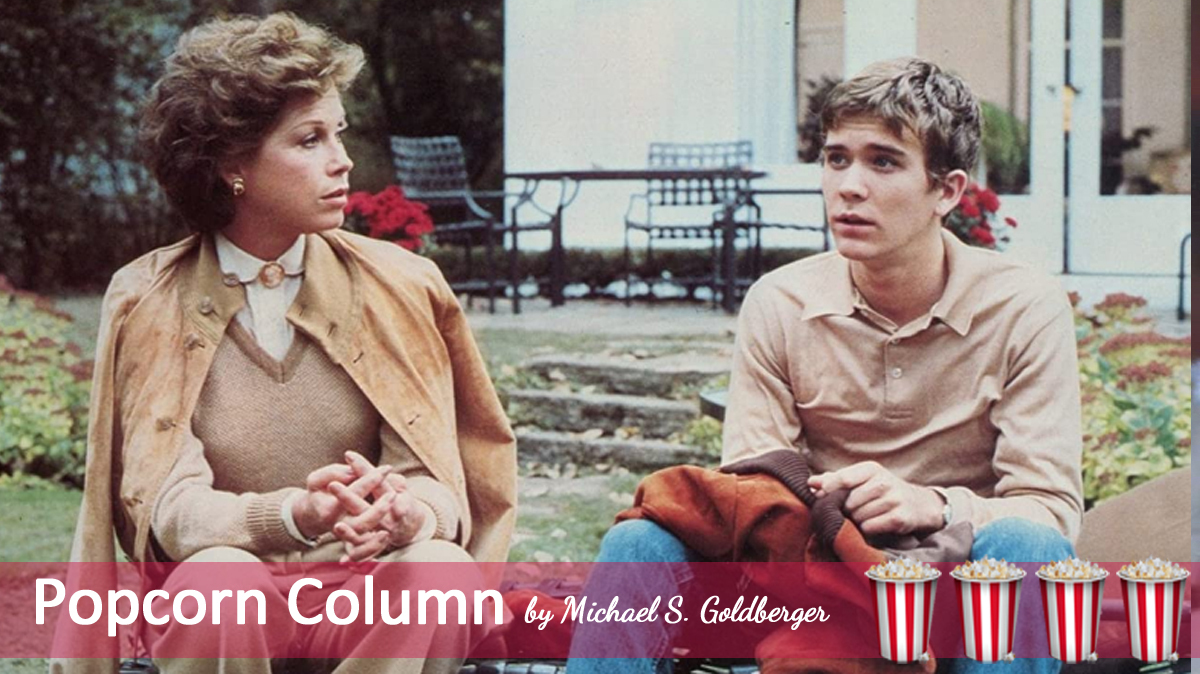
In thinking back on those salad days through rose-colored glasses, Dave's pretty Mom looks just like Mary Tyler Moore's Beth Jarrett, the female lead in Robert Redford's "Ordinary People," a beautifully embroidered opus about the tragic chink in the armor of a family of privilege. She likes things just so. Well, gosh, who doesn't?
But if you've got a whole lot of heritage and the money to back it up, the change that the psychologists say it is healthy to embrace is often troubling if not earth-shattering anathema.
Were I teaching a film course in comparative female American types, I'd liken Beth Jarrett to Fitzgerald's Daisy Buchanan. Everything in its place, all perfectly proper and happy. I mean, what's the use of accumulating all that ancestral endowment and legacy wealth if you're going to let the facts of reality derail your fairy-tale existence — like your eldest son dying in a boating accident?
Such is the cross that Beth refuses to bear if hardly acknowledge, though it occupies every sinew and grain of the gracious center hall colonial in Lake Forest, Illinois, where the ghost of Conrad's older brother, Buck, the one Mom doubtlessly preferred, wreaks the havoc of loss.
The younger son, Conrad, portrayed by Timothy Hutton in a performance that won him an Oscar, is seeing Judd Hirsch's Dr. Berger, an avuncular psychiatrist whose office is a cozy fortress of divulgence and hoped for remedy, its motif traditional but with a tinge of Medieval.
Connie, as his dad, Calvin, played by Donald Sutherland, lovingly calls him, is recently released from the hospital following a suicide attempt, guilt-ridden by both surviving the boating accident and having been unable to save Buck.
Beth isn't too keen on slicing to the truth of the heartbreak, and has invited a miasmic disavowal to suffuse the air in and around the North Shore manse, not too unlike the self-delusion that has sickeningly gripped Trump and his more duped followers in the face of loss. Bitter loss, granted, but undeniable loss just the same.
The anti-civilization pathology of the acutely unremitting denial flies in the face of all the wisdom humankind has gleaned, the veracity learned from the example of Eve's apple, through Socrates, Plato and Aristotle's meditations, and up to Dr. King's incantations for justice, sullied.
It is a secular sin not to use every bit of our ability in the purpose of our improvement, truth being the most important tool to that aspiration.
All rationalizations and follies to the contrary reject the joy and potential of our humaneness in no lesser way than if we were to routinely excise our opposable thumbs at birth.
This isn't to say that those who for whatever result of upbringing don't want to be part of our species' progressive pageant should be victimized for preferring to sit on their couches, drink beer, eat Fritos and watch men running up and down a field rendering each other brain damaged.
That is, just so long as they don't, to justify their chosen lifestyle, decry through political disingenuity that portion of humanity that will make their big screen TVs bigger, their medicines more lifesaving and their air fit to breathe. And that, as Redford's "Ordinary People" points out in the personal example of Beth Jarrett's self-deception, is the truth.
"Ordinary People," rated R, is a Paramount Pictures release directed by Robert Redford and stars Mary Tyler Moore, Timothy Hutton and Donald Sutherland. Running time: 124 minutes
Tags: movie review,