Clark Art: Virtual Artist Conversation
 |
WILLIAMSTOWN, Mass. — Artist Jennie C. Jones discusses her site-specific installation in the Clark's "Ground/work" exhibition with Dr. Kimberly Juanita Brown, associate professor at Dartmouth College and author of "The Repeating Body: Slavery's Visual Resonance in the Contemporary" (Duke University Press), on Tuesday, March 23.
This free program takes place over Zoom at 6 pm.
"Ground/work," the Clark's first outdoor exhibition, consists of newly commissioned site-responsive installations by six contemporary artists set throughout the woodland trails and open meadows of the 140-acre campus.
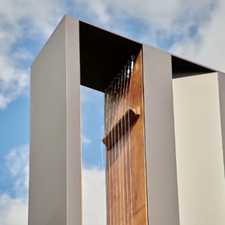
Working outdoors for the first time, Jones uses both sonic and visual abstraction in a sculptural form that both responds to the landscape and acts as a physical extension of the Tadao Ando–designed Clark Center building. Her sculpture, "These (Mournful) Shores," is a contemporary take on an Aeolian harp, whose strings are activated by the shifting winds and weather patterns on the Clark's site. Influenced by two Winslow Homer paintings from the Clark's permanent collection—"Eastern Point" and "West Point," "Prout's Neck" (both 1900)—Jones interprets these turbulent seascapes of the Atlantic Ocean to be also considered as portraits of the Middle Passage.
This conversation is part of Dr. Brown's guest-curated CARE SYLLABUS module, "Black Elegies in Sight and Sound." The CARE SYLLABUS is a justice-oriented public education and community resource featuring original text, visual media, recordings and virtual live events by activists, artists, and academics facilitated by MASS MoCA and MCLA.
Jennie C. Jones's (b. 1968, Cincinnati) work employs strategies of collage and assemblage in her ongoing project of translating sound into physical matter, and reframes the contributions of African Americans to include a modernist, minimalist vernacular. Her work is included in the permanent collections of The Museum of Modern Art, New York; the Solomon R. Guggenheim Museum, New York; and the Hirshhorn Museum and Sculpture Garden, Washington, D.C., among others. Recent solo presentations include projects at The Arts Club of Chicago (2020), The Philip Johnson Glass House, New Canaan, Connecticut (2018); CAM Houston (2015); the Hirshhorn Museum and Sculpture Garden (2013); The Kitchen, New York (2011); Yerba Buena Center for the Arts, San Francisco (2011); and Atlanta Contemporary Art Center (2009). Jones lives and works in Hudson, New York.
This talk will be broadcast live. Visit clarkart.edu/events to register. Registrants will receive an email with a private link to the webcast before the event.