Social Workers Seek Interview Subjects for Williamstown Needs Assessment
WILLIAMSTOWN, Mass. — For more than a year, the town has been grappling with questions about how safe and included all residents feel in the community.
Now, the question is being viewed through the lens of the social sciences.
A group of social workers commissioned by the town has begun a long-term community assessment research project, and it is encouraging all residents to share their feelings in confidential one-on-one interviews.
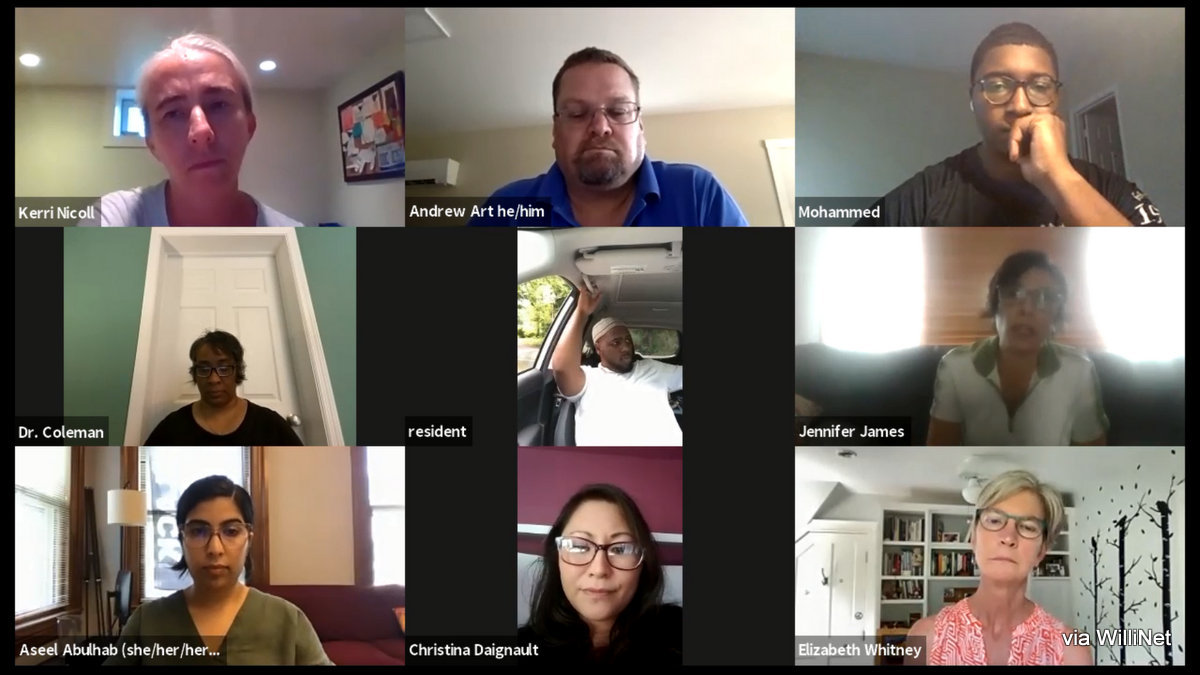
The lead researcher on the project and several of her colleagues met last Monday with the town's Diversity, Inclusion and Racial Equity Committee to talk about the project and spread the word about an appeal that also included a flier sent to every mailbox in town and distributed at the annual town meeting.
Jennifer James said the ultimate goal of the project is to form recommendations about how the town can make institutional changes, including in its policing structure, to ensure that all current and future residents feel safe and welcome.
"We'll reference the national conversation and the systemic issues everyone has been talking about and what the research says about what kinds of programs work and don't work," James said. "The working group will be composed of members of the community to feed in ideas, and we'll subject those ideas to what research exists. And we'll ask how do we develop something unique to Williamstown's needs."
Kerri Nicoll, a member of the DIRE Committee and one of the local social workers who worked with former Town Manager Jason Hoch to get the Community Safety and Wellbeing Assessment initiative off the ground, noted that the point of the project is to make sure that Williamstown has solutions that fit the needs of the small town.
"I think [Hoch's] initial idea based on what he had seen was, 'Let's hire a social worker and embed them in the police department,' " Nicoll said. "The social workers asked Jason if he would have a conversation with us about this idea, and we presented him research and the pros and cons on the direction he was thinking about going.
"What we were finding was that most of the examples we could locate at the time were in really big cities, and we knew the approach a large city was taking to these issues might now be what we need here in Williamstown. If we live in a small town that has the means to investigate what our needs are and design a system that works for our community, why not invest in that rather than in an individual position we may or may not need?"
The first stage of that research is finding out what residents actually need, and that is where the one-on-one interviews come in.
"We chose not to do a survey because we didn't want pre-determined answers," James said. "We wanted in-depth interviews so people could use their voices. We do have to record these sessions, but they basically will be used to upload a transcript to a software program that will help us with a thematic analysis. The recordings themselves will be destroyed."
James said the interviews can take anywhere from an hour to two hours depending on how much the interview subject has to say, and that they can be done in-person, via zoom or over the phone depending on the interviewee's preference.
"This is the community assessment phase of the study," James said. "We will later meet with members of the Williamstown Police Department and talk to them about well-being and safety and will look at their statistics and do a policy analysis.
"The third prong is we're developing a working group to look at program development and what other communities in the Berkshires are doing and some of the most creative programs in the country. We're not coming in with solutions. We're coming in with research questions, engaging the community and being as thorough as we can."
Residents interested in participating can register through the town's website or call 413-458-3500 extension 117.
DIRE Committee member Andrew Art asked the social workers if there was a danger that their research sample might include over-representation of community members who already feel safe and not capture the needs of marginalized populations like those who DIRE seeks to center.
"We very much want to hear from people who feel unsafe, who feel marginalized, who feel unwelcome, however that has made itself present in their lives," Nicoll said. "We also said we want to hear from all the people who do feel safe. What we don't want is to only talk to people who feel unsafe, find a solution that makes them feel safer and then makes all these other people suddenly feel unsafe.
"The idea is to make everyone feel safe and welcome in the community. We will pay careful attention to who we're hearing from."
Although the interviews will be anonymous, the researchers will collect demographic information on the interview subject, Nicoll explained.
"If we find after the first round of interviews that we just interviewed 100 people over 65 with incomes above twice the medium income, we'll know we need to do more targeted outreach to people who don't fall into that group," she said. "That does not mean we don't want to hear from people who have been heard and do feel safe. But because there are people in our community who, for generations, whose voices haven't been heard, we need to lift those up."
Tags: DIRE, needs assessment, survey,