Williamstown Select Board Talks Dog Park, Short-Term Rentals
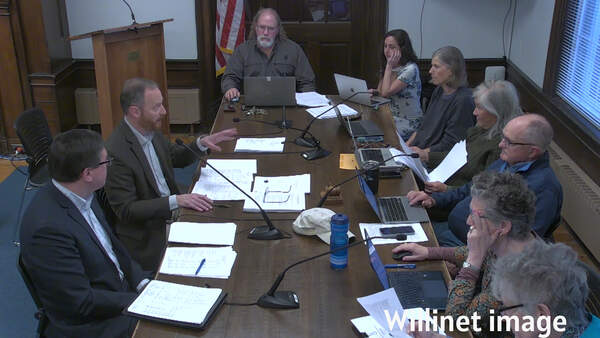
WILLIAMSTOWN, Mass. — The Select Board could be going back to the drawing board on a proposal to designate an area of the Spruces Park for off-leash dogs.
At last week's meeting, Andrew Hogeland gave his colleagues an update on a topic that has been discussed at length by the board this year.
Hogeland said he had consulted with other stakeholders in the park, specifically the Hoosic River Watershed Association, Williamstown Rural Lands Foundation and town Conservation Commission.
"I figured they would have some thoughts about what happens in that territory," Hogeland said. "They did. Not entirely in favor, as you might predict."
The Conservation Commission, for example, suggested that the Select Board hold off on making any designations for use of the park until after town meeting decides whether to put all of the Spruces under the care, custody and control of the Con Comm — an action the Select Board later recommended against at the April 8 meeting.
The conservation groups also pointed out to Hogeland that a significant portion of the Spruces acreage is designated as a priority habitat for endangered species.
"The concept of having dogs running around that environment is something we should think seriously about," Hogeland said.
He directed his colleagues to a map in the meeting packet showing just how much of the park's land is a protected habitat.
"That's another factor we need to work through if we're going to have a dual use Spruces Park," he said.
And, he later noted, the Select Board's initial concept for an off leash dog zone put the activity in the most sensitive part of the property.
"When Randy [Fippinger], Bob [Menicocci] and I went up the first time, we came back with a concept map that took the entire western half of the Spruces and made that for off leash," Hogeland said. "Actually, that's exactly where the [endangered species] habitat would be, so the reverse would be you'd have that on leash, and you'd need to have your off leash area where the houses used to be and the parking lot."
Hogeland reminded the board that the entire Spruces property is defined as either a floodway (near the Hoosic River) or flood plain by the Federal Emergency Management Agency, which regulates the land. That regulation would come into play if the town wanted to install fencing for a dog park at some point.
"[Community Development Director] Andrew Groff and I worked on a concept plan that included a soccer field just barely on the border [of the floodway] but mostly in the less protected area [flood plain], but FEMA balked at that," Hogeland said. "They're a very protective group."
Among the issues the Select Board addressed in a marathon first meeting of the month were a proposed mountain bike trail network, the display of the official town flag inside Town Hall and the warrant for next month's annual meeting.
The board also discussed the results of a survey it sent out to operators of short-term rentals in town as part of a fact-finding exercise to determine whether the town should regulate the rentals commonly referred to as Airbnbs.
The board received meager results from the survey, with just 29 responses from 128 surveys sent to in-town operators registered with the Department of Revenue (23 percent).
Hogeland said what little data the board did receive shows that the town does not have a problem with housing stock being lost to, essentially, full-time short-term rentals.
"The fear that prompted me to worry about short-term rentals wasn't realized," he said. "The fear was that there are so many short-term rentals out there that they were pre-empting regular full-time housing for people in our town. There seems to be not much of that, if any. Again, we don't have 99 [responses], but with the data we have, that seems not quite as worrisome yet."
Fippinger noted that data also shows that if the town created a regulation that limits Airbnb rentals to something like 150 nights per year — as the Planning Board suggested the Select Board consider — the 29 respondents to the survey would not be harmed.
And Stephanie Boyd, now a member of the Select Board who served on the Planning Board when it first took up the short-term rental question, reminded her colleagues that the point of a regulation is to prevent a widespread loss of housing stock to Airbnbs, not necessarily address a pre-existing problem.
"I think we have lost some houses to short-term rentals," Boyd said. "Relatively recently, I saw a house advertised for sale, and it noted on there, 'tens of thousands of income from short-term rentals.' So real estate agents are recognizing the opportunity for short-term rentals for housing stock. I think we want to dissuade houses that would have been for residents being turned into permanent hotels."
Fippinger agreed.
"If I'm a homeowner, and I have the ability to rent out a space as much as I want … the incentive for me is to keep it off the long-term market," he said. "The turnovers are more profitable for me. However, if I know there is some cap — 150 days, for example — I know my potential income is limited."
Jane Patton said that while she is not against "running in front of problems," she maintained her objection to the Select Board drafting a bylaw proposal on short-term rentals for a future town meeting to consider.
"I still feel like it is a tad invasive in terms of telling people what they can do with their property," Patton said. "And the fact is that we don't have any data that I know of, even irrespective of this survey, showing we have a proliferation of non-residents or corporate entities buying up these properties for short-term rentals.
"I'm still loath to dive into a solution when we're not sure to what degree we may have a problem or what reasonable concern there is that we might suddenly have one."
Fippinger pointed out that the town already has regulations about homes, noting the requirements for inspections when a homeowner does renovations.
The town also heavily restricts commercial activity in its residential districts, and proponents of a short-term rental ordinance argue that full-time Airbnb properties are, essentially, mini hotels.
The board discussed sending out another round of questionnaires with the thought that some may have gone to "snow birds" who were out of town when the surveys arrived in their mailbox. Members also agreed that they need to decide one way or another on whether to propose a bylaw.
"I understand there are opposing views here, and that's fine," Fippinger said. "It doesn't need to be a unanimous vote. The Planning Board sent language [for a proposed bylaw] to us a while ago, and it would be nice to vote on something. It doesn't have to be soon. We can get more data."
Tags: dog park, short-term rentals,