Police Reforms Could Cause Shift Deficit for Lanesborough Police Department
LANESBOROUGH, Mass. — Police Chief Robert Derksen said the state's new police reforms could cause a shift deficit, meaning the town likely has to hire a sixth full-time police officer in the coming years.
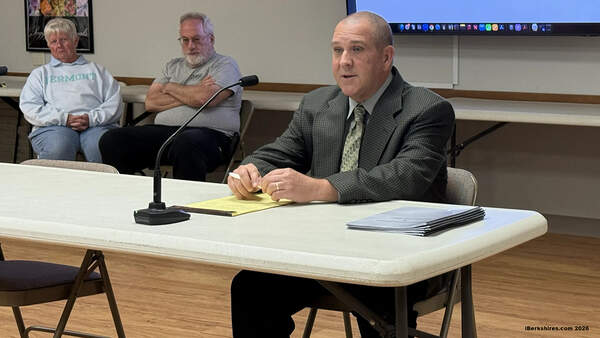
The Finance Committee invited Derksen to speak in detail about the police budget, staffing and training at their Monday meeting. Derksen said when taking into account allotted time off, the current five full-time officers is not enough to keep the station staffed at all times.
"What I've communicated with not only the police advisory commission, but the select board themselves is I did a staff and analysis," he said. "And if you take our full-time officers and you factor in the days off that they get per-contract, whether it be vacation or sick time and assume that they use their accruals, and just to have one officer 24/7, five officers can't do it. Five full-time officers can't cover it. It actually leaves you a deficit of about 111 shifts a year."
Derksen said the seven part-time officers currently on staff would usually cover these extra open shifts. He noted, however, that state police reform will quickly make this significantly harder, with two part-timers becoming essentially decertified as soon as June 2022.
"I have a great concern as the police reform is implemented," he said. "So basically they the state set up a system where over the next three years, any part-time officer has to basically raise the level of training to be equivalent to what a full-time officer would have received in the past."
This new training, which Derksen referred to as the bridge academy, requires officers to have five years of part-time experience and 2,400 hours of patrol experience to attend. In addition to the academy's cost, which Derksen estimated to be about $6,500 per officer, he said this is a significant hurdle for some of the town's part-time officers, many of whom are officers as a secondary job.
"What this means is a lot of your true part-time officers just don't have the hours," he said. "If they have less than five years, they would almost have to be working three or four shifts a week in order to reach that 2,400 hours."
A sixth officer would resolve the shift deficit issue, according to Derksen. He said the department currently has 10 part-time officers budgeted, despite only having seven, meaning they could potentially use that money, in addition to other sources of money, to hire someone full time.
"If the part-timers are gonna go away eventually in three years, why not get ahead of the game and add that sixth position now," he said. "That's six full-time positions to cover those vacant shifts. And then it's going to take me time to get that person up to training. Even when I hire someone new, typically, it's a three- or four-month field training program, even if they're already an experienced police officer."
While sending some part-time officers to the bridge academy is technically an option, Derksen said that it is unlikely Lanesborough will be able to.
"I only have one or two that even have expressed interest in attending the bridge [academy]," he said. "And again, me as an administrator and trying to determine whether or not it makes financial sense for the town to invest that kind of money, knowing that they might only work one or two shifts a month. Am I getting that return on investment?"
Derksen said the new reforms are a significant issue for smaller communities like Lanesborough. He said many similar-sized communities are doing away with part-time officers.
"They're all not all obviously, but the majority, the ones locally are phasing their part-timers out to either phase them into full-time employment or to phase them out altogether," he said.
Derksen said he understands why the state wants higher requirements for part-time officers, noting that New York requires the same training regardless of full time or part time, but feels the way they are going about it is confusing. He said even officers who complete the bridge academy might not necessarily be eligible to become full-time officers.
"I think the state's motive is not a bad one, it's the implementation that isn't the greatest," he said.
While they did not vote on anything during the meeting, Finance Committee member Robert Reilly said the board should support Derksen's request.
"It is a financial reality for us and it's a very practical reality for us that it is going to be harder to find cheap, just part-time officers," he said. "It's going to be more difficult to be a part-time officer anywhere in Massachusetts. Full-time officers are going to be harder to find, but I think we need to find full-time officers and I think we can justify that financially with what's coming."
Tags: police officer,