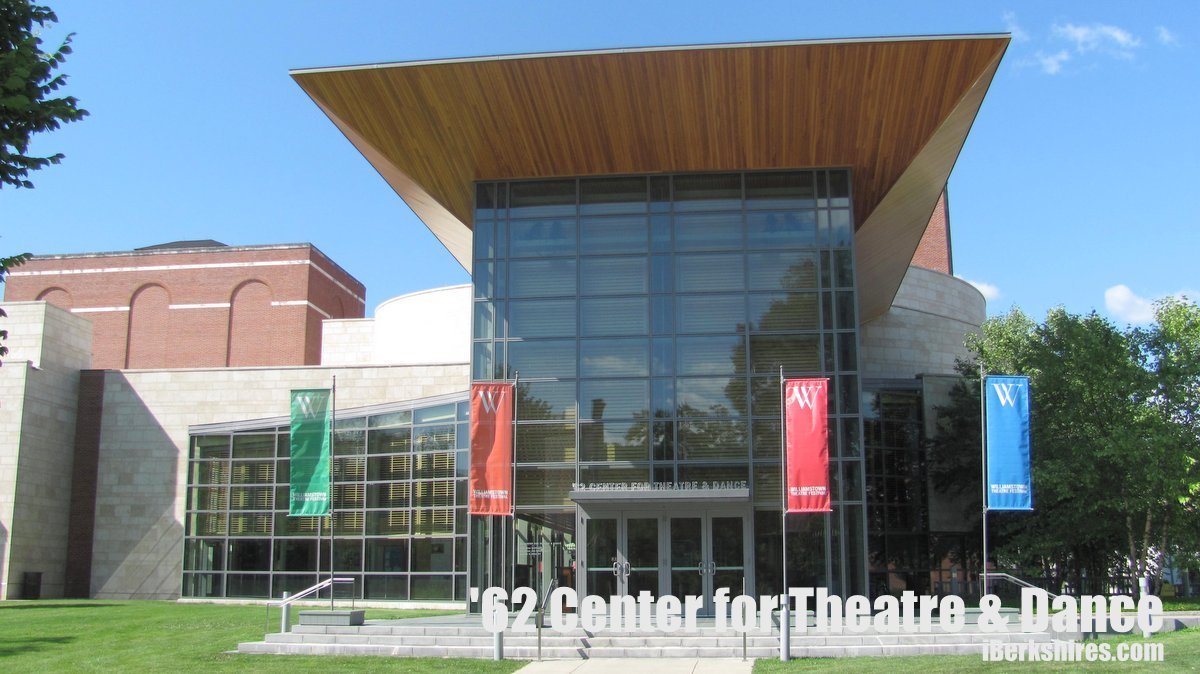
'62 Center Winter and Spring Season
WILLIAMSTOWN, Mass. — The '62 Center for Theatre and Dance (CTD) will present a mix of theatre and dance, virtual and in-person.
CTD presents student and world-class artists celebrating diverse and challenging theatre, music, and dance programming for the Williams College community and beyond. All virtual programming is free and open to all.
COVID-19 is still a present and evolving public health issue. As such, Williams College and the '62 Center are keeping a close eye on the latest state and federal recommendations. The College's policies, based on a preponderance of caution for the health and safety of students, faculty, staff, artists, and community members, might require a change on short notice.
For current policies being enforced, visit the '62 Center's website.
The visiting artist CenterSeries has two productions in the spring season. Opening the winter/spring semester will be a virtual performance of Cie Hervé KOUBI's "What The Day Owes To The Night," on Feb. 10, 2022.
In a lyrical, explosive marriage of traditional Sufi dance and contemporary hip-hop, French-Algerian choreographer Hervé Koubi, trained both as a medical doctor and dancer. Performed primarily by dancers from North Africa with street dance backgrounds, the work traces Koubi's discovery of his Algerian roots through his experience coming of age in contemporary France. With gravity-defying athleticism and mesmerizing grace, the cast of performers weaves together a striking of the complex ties that bind us. "This is a creation of poetic beauty…If he (Koubi) can make worlds as largely absorbing as the one he conjures here, he is an important addition to dance," reports The New York Times. There will be a post-performance Q&A hosted by Rashida K. Braggs, Associate Professor of Africana Studies and Faculty Affiliate in Comparative Literature, Faculty Fellow of the Davis Center, and the Office of Institutional Diversity, Equity, and Inclusion with choreographer Hervé Koubi, dancer Houssni Mijem, and rehearsal director Guillaume Gabriel.
The visiting artists season closes with the return of Elevator Repair Service (ERS) to present Baldwin and Buckley at Cambridge, March 11-12, 2022.
Founded in 1991 by Artistic Director John Collins, ERS's theater pieces are built around a broad range of subject matter and literary forms; they combine elements of slapstick comedy, hi-tech and lo-tech design, both literary and found text and the group's own highly developed style of choreography. In 1965, James Baldwin and William F. Buckley, Jr. were invited to the Cambridge University Union to debate the resolution "The American Dream is at the Expense of The American Negro." What resulted was an incendiary and revealing confrontation between one of the most influential figures of the Civil Rights Movement and the father of modern American conservatism. The highly-acclaimed experimental theater company Elevator Repair Service continues its rich tradition of adapting unconventional texts (Gatz, Arguendo, The Sound and the Fury), and stages the historic debate verbatim. In our contemporary moment, Baldwin and Buckley at Cambridge invite reckoning with the timeliness of Baldwin's arguments and the power of debate to illuminate truth and point towards justice.
Supporting this production, the CTD will present a virtual panel discussion, "The Fire This Time: How the Baldwin/Buckley Debate Can Energize Our Politics" on Feb. 16 at 7:30 PM.
This virtual panel will feature Garry Bertholf (Assistant Professor of African American Studies, Wesleyan University) and Linfield University Professor Nicholas Buccola, who is the author of The Fire is Upon Us: James Baldwin, William F. Buckley Jr., and the Debate over Race in America (published by Princeton University Press in 2019). The panelists will discuss the famous Cambridge Union debate in terms of its historical significance and contemporary political purchase. Together with ERS's upcoming performances at Wesleyan and Williams, then, this panel is meant to help celebrate Black History Month on campus.
The CenterSeries performances are made possible by the W. Ford Schumann '50 Endowment for the Arts and the Lipp Family Fund for Performing Artists.
The Williams College Theatre Department continues to engage its students and audiences by offering a spectrum of productions, ranging from canonical hits to newly devised performances. The spring productions include In The Room: Theatre Majors' Workshop Series, March 4-6, and Sometimes the Rain, Sometimes the Sea by Julia Izumi, directed by Kym Moore, May 5-8.
The Williams College Dance Department has three spring performances. The Zambezi Marimba Band kicks off the season with the Zambezi Dance Party!, Feb. 18 & 19. On April 22 & 23, Sankofa and fellow students will present a Choreography Showcase. Kusika, artistic directors Sandra L. Burton and Tendai Muparutsa, and contemporary dance ensemble, CoDa, artistic directors Erica Dankmeyer and Janine Parker, will perform May 7 & 8.
Tickets can be purchased by visiting 62center.williams.edu. Additional fees may apply. The Box Office is located in the main lobby of the '62 Center. During the fall and spring semesters, phone (413-597-2425) and window service are available Tuesday–Friday, 10:00 AM–3:00 PM. Window service will also be available 1 hour before all ticketed events.
The Box Office is closed during college breaks, college holidays, and Winter Study. Box Office assistance can also be reached at 62BoxOffice@williams.edu. Please note that all events at the '62 Center are closed to the general public until further notice.
Tags: dance, Williams College,