Williamstown Town Meeting Sends Zoning Bylaws Back to Planning Board
WILLIAMSTOWN, Mass. — Maybe it is the venue.
For the first time in nine years, Williamstown on Tuesday held a town meeting in the gymnasium at Mount Greylock Regional School. And just like in 2013, the hot-button issue was left unresolved.
Back then, the question was whether to try to use a town-owned property off Stratton Road to build replacement housing for the homes lost at the Spruces Mobile Home Park due to Tropical Storm Irene.
This time, it was a series of Planning Board proposals to modify the town's zoning bylaw to make it less restrictive and allow for more housing options in the town of 7,700.
On Tuesday night, town meeting voted decisively to send those bylaw amendments back to the Planning Board for further study.
Kenneth Kuttner, who was elected to the Planning Board at May's annual town election, spoke from the floor of the meeting to propose referring most of his colleagues' work product from the 2021-22 meeting cycle back to committee.
"I would like to thank the Planning Board for moving this to the front burner," Kuttner said. "These are well-intentioned upzoning proposals. There are good arguments for higher density zoning.
"But the Planning Board proposals are unproven and fly in the face of good planning practices. To the best of my knowledge, no other town in Western Massachusetts has gone so far in deregulating multi-family housing."
That was a reference to the first of a series of bylaw amendments on the warrant, Article 40, which would have allowed, by right, three- and four-family dwellings in the town's General Residence and Southern Gateway zoning districts.
Other zoning proposals the Planning Board put before the town would have allowed the same three- and four-unit homes in the Rural Residence 2 and RR 3 districts; removed other barriers to multifamily homes; and reduced the dimensional requirements for homes by proportionate amounts in all the residential districts.
Advocates argued that the changes would have allowed more homes to be built, different types of housing and generally created more opportunity for new residents to come to town.
Critics contend that the Planning Board did not adequately study the potential impact of the changes they propose and did not meaningfully engage residents before advancing the proposals to town meeting.
"I have felt from the beginning [of the 2021-22 meeting cycle] that we bit off way more than could be absorbed in a meeting of this type," said Planning Board member Roger Lawrence, who voted in the minority against most of the proposals that passed the board this spring. "We bit off more than we could chew, and now we're trying to chew it.
"We can do the job. We can bring it back a year from now."
In part, Stephanie Boyd, who voted for most of the proposed changes in committee, agreed.
"The Planning Board didn't do the type of outreach we've done in the past," Boyd said. "A big part of me would like to ask if we can have a do-over. But in the meantime, there are people who can't find homes in this town."
Boyd said if the town could pass just one of the articles proposed, it should be Article 40, the three- and four-unit home proposal.
"We know we need more rental homes," she said.
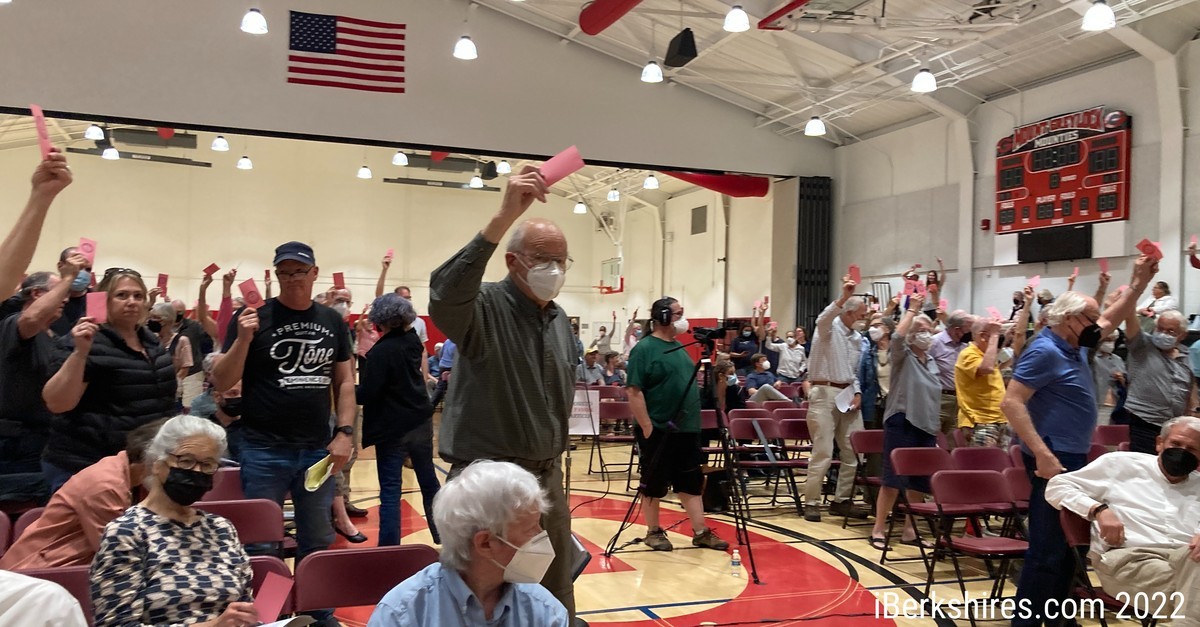
In the end, the vote to send Article 40 back to the Planning Board passed, 176-98 with 64 percent of the residents voting in the affirmative.
A subsequent motion to refer to the Planning Board Article 41 and Articles 43-46 passed, 181-68.
That vote came after several residents went to the mic, some for the second time during the general zoning discussion, to argue for and against increased study and conversation.
"The confusion we're having now is a reason that we should refer to committee," Sherwood Guernsey said. "I happen to have gone to several of the Planning Board meetings. I sat through hours. I was only able to speak at the very end when it was 10 o'clock both times. A lot of people are busy. We don't have time to go to every single meeting."
"I did research on global trends and market trends on housing density in rural areas," Nat Romano said. "The research is so different because of COVID trends. … The closest we can come to having a comparable data set is to go back to the Spanish flu.
"Affordable housing needs to be very well planned. This is not affordable housing. This is just more housing. We need the research on it."
Jane Patton stepped down from her seat on the dais as a member of the Select Board and argued that the Planning Board members were elected to make proposals to town meeting and that the board had, in fact, been looking at easing zoning restrictions on housing for years.
Carin Demayo-Wall, who lost to Kuttner in May's election, expressed frustration with the idea that town meeting would not get a chance to weigh in on the articles.
"I don't get to vote tonight because we're throwing it back to committee," Demayo-Wall said. "This is the most undemocratic town meeting I've ever attended. We're using fear-mongering and created confusion to stop the vote.
"I hope to heck that next year we do bring something back, but we're probably going to go back to what the town has done for 30 to 40 years and hide behind ‘research' and academia instead of removing barriers."
The 2013 decision to take no action on the Lowry property ultimately meant town meeting never had to decide whether to try to remove the land from conservation, a step the town counsel had advised was possible. The Conservation Commission ultimately did its own study that came to a conclusion contradicting the town counsel on the question; meanwhile, Williams College donated land that ultimately was developed into a 40-unit senior housing apartment complex that was intended to replace some of the 225 units lost at the Spruces.
Even without the lengthy and complex debates that would have ensued if the Articles 40-41 and 43-46 had been decided on Tuesday, the meeting lasted about 4 1/2 hours.
The meeting passed all of the town's fiscal articles – mostly without discussion and by overwhelming majorities or unanimous voice votes.
Appropriations to non-profits – either from town coffers or Community Preservation Act funds – drew more debate, but all ultimately passed. Also successful were a series of home rule petitions to go to Boston – two to amend the town's charter to eliminate gender-specific language and remove a requirement that the town manager live in the town and two to request increases to the town's licenses for alcohol retailers.
The town also passed by an overwhelming majority a citizens' petition to put the town on record in support of the Fair Share Amendment that will be on the November ballot in the commonwealth.
Less successful was a citizens' petition that would have created a stipend for residents who serve on town boards and committees. That failed by a margin of 89-42 at the end of the night.
Tags: town meeting 2022,