Williamstown Officials Discuss Pros, Cons of Municipal Fiber Optics
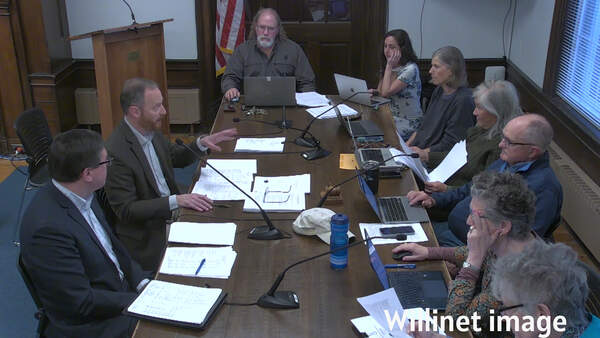
WILLIAMSTOWN, Mass. — The Finance Committee last week discussed whether the town should consider investing in townwide broadband that could deliver residents up to 1 gigabyte of connectivity for a little more than residents currently pay a private vendor.
Although no decisions were made and no votes were taken, the general gist of the conversation was that there are a lot of unknowns and risks that the town has to consider before taking that step.
Andrew Cohill of Virginia-based Design Nine Inc. presented the results of a feasibility study his firm conducted on behalf of the town.
For an estimated cost of $7 million, the town could construct a fiber optic network that it then could lease to an internet service provider that would deliver internet access to residents and businesses on the town-owned hardware, Cohill said.
"Local governments and regional entities have long made investments in shared infrastructures," Cohill said. "Airports and roads are two of my favorite examples. What Williamstown has been looking at is not going into the ISP business but simply providing some digital infrastructure a private company would use to deliver internet.
"All telecom is some form of public/private partnership."
Cohill argued that a high-speed internet connection available to every residence in town would be a driver of economic development, long a concern of town officials interested in attracting new residents and expanding the tax base.
"I've just seen a recent report that says they think as many as about 30 to 35 percent of workers are going to continue to work remotely, which is much higher than it was three years ago," Cohill said. "One of the things I like to say is neighborhoods have become business districts."
And there is some evidence that current residents would be on board with the idea.
Design Nine conducted a survey of residents that found 72 percent of respondents want better internet service and 87 percent described themselves as "likely" or "very likely" to switch to a town-developed fiber network if it was available.
That is encouraging to proponents of a town-owned fiber optic network. Design Nine said at least 60 percent of the residents and businesses would need to switch to the town-owned system within three years of installation in order to make the network financially viable.
The cost per user is projected to be between $65 and $75 per month, Cohill said. The typical cost for broadband internet in town is $50 per month according to Design Nine's research, but many users by their communications services in "bundles" (some combination of phone, internet and TV), so it is harder to pin down an actual monthly cost.
Cohill was joined by representatives of Westfield's Whip City City Fiber, a municipally-owned ISP that delivers internet to its residents on a city-owned fiber-optic network and which has partnered with other communities throughout Western Massachusetts to create public systems.
Caitrin Ferriter told the Fin Comm that Whip City has the capacity to handle Williamstown's internet needs.
"Our ultimate goal in working with towns is to become their ISP," Ferriter said. "We provide 24/7 technical support. We do have people located all throughout Western Mass now. We have people who can go out at a moment's notice. … We also do the billing."
Part of a Williamstown user's bill likely would be used to pay off the bond the town would need to help pay the $7 million upfront cost of creating the network. Alternatively, Williamstown could follow the example of Leverett in Franklin County, which paid for its fiber optic network through taxation and charges a lower monthly fee to customers who sign on to use the network.
The latter solution could reduce the need to worry about the "take rate" to keep the system viable, but it could be a hard sell to residents who have no desire to switch to a municipal system.
After hearing from the Virginia consultant and the Westfield utility, Finance Committee member Charles Fox called their presentation "compelling" and asked why the town would not consider a municipal fiber optic network.
His colleagues and others in attendance had no trouble answering.
"It's a matter of people's risk adversity," said Select Board member Andy Hogeland, who was part of the group of residents who commissioned the Design Nine study. "The survey responses are great, but when you ask people to pay their money, it's a different game. It's a risky business.
"Towns do it, but there's also the risk that if you put in the system and don't do it properly, you lose subscribers because Charter is there."
Hogeland said in the towns he looked at that built municipal networks, at least one of three conditions were present that don't apply to Williamstown: the town has no fiber or no internet, it has a pre-existing public utility (Whip City Fiber is a division of Westfield Electric and Gas, in operation since 1860), or it received financial support from agencies like the Massachusetts Broadband Institute, which supports "unserved" or "underserved" populations.
"We don't have any of those factors," Hogeland said. "I think the 70 percent vote [to raise money through taxation] in Leverett made perfect sense because they didn't have anything."
Former Select Board member Jeffrey Thomas said the last couple of years have shown that the town does not have the internet deficiencies many thought it did a few years ago when it started to look at a municipal system.
"We all lived through the pandemic," Thomas said. "The community moved to working from home, we were on Zoom, we were streaming Netflix. I did fine, and I have a very internet-intensive job that I did from home without a problem.
"I think there may be a few super users in the community who may want gigabit speeds, but I would argue that very few of us in the community truly need those. And, also, I think if you look at the track record for Spectrum, they've been able to increase bandwidth over time."
Thomas also emphasized that the survey results found that only 18 or 19 percent of residents said they would be willing to pay up to 20 percent more for internet on a municipal system versus a commercial system.
Fin Comm Chair Melissa Cragg, who was re-elected to that position at last Tuesday's meeting, echoed that point.
"I worry a lot if there is a big pocket competitor able to wait us out on a price war," she said.
Cragg noted that there are opportunities along with the risk to a municipal project.
"It would be very interesting to do that if we could price it in a way that addresses something we're hearing about, particularly during the pandemic, which is the unaffordability of internet to some residents," Cragg said.
Whip City Fiber's Ferriter said the utility offers discounts to income-eligible users through the FCC's Affordable Connectivity Program.
Don Dubendorf, who serves on the town's Comprehensive Plan Steering Committee, told the Fin Comm that he does not know if the time is right for Williamstown to make the investment.
"I think it's inevitable we will have fiber in the home," Dubendorf said. "The question for us is timing. Do we do it now or do we do it later? I'm not sure we're there yet.
"I think the fact of the matter is nobody likes the incumbent [ISP]. Pricing is too high. Service is slow, etc. That's what monopolies do. Competing with a monopoly with deep pockets is a scary proposition."
While it was conducting the feasibility study on municipal broadband, the town did clear a bureaucratic hurdle that would allow for the creation of a public utility if voters ultimately decide the time is now. At consecutive annual town meetings in 2020 and '21, town meeting attendees voted to authorize the creation of a "municipal light plant," the commonwealth's term for any such utility. Those votes merely enabled the creation of such a utility at a later date without attaching any money to the project.
At the end of last Tuesday's discussion, Fox, who initially expressed enthusiasm for the project, appeared swayed by some of the concerns others raised.
"I thank so many of you for very persuasive reasons why this is an overwhelming adventure to consider embracing," Fox said.
Tags: Internet,