Williams College Lays Out Concepts for Potential Campus Changes
WILLIAMSTOWN, Mass. — Williams College would see a reconfiguration of its dorms and radical changes to its athletic infrastructure if it follows the path laid out by an ambitious campus plan that grew out of a multi-year strategic planning process.
A project manager from the college and an associate planner from Boston design firm Sasaki Associates gave a presentation on Tuesday to the town's Comprehensive Plan Steering Committee.
"For the last year and a half or so, we have been hard at work on our own campus framework planning effort, which is the first large-scale, consolidated planning at a campus level that the college has endeavored in its long-standing history," Williams' Keenan Chenail told the committee.
"This is a project that came up directly out of the strategic plan from the work of the built environment working group, which identified a need for the college to have a little bit better idea of the strategic alignment of our overall capital dollars toward, basically, our physical infrastructure and how do we align the dollars we're putting to work in the buildings we have on campus with the aspirations of the institution as a whole."
Chenail and Sasaki's Dorothy MacAusland stressed that the capital plan they presented is conceptual and by no means near the stage where the college will be seeking permits or breaking ground any time soon. They also did not identify a timetable to implement any of the ambitious goals laid out in the plan.
"Our goal is to provide a guide book, an outline for the college to design how to plan rather than a definitive list of projects," MacAusland said.
"These are what we consider potential projects," she added at one point. "They are not approved by the college. There is not funding allocated toward them. We have just identified these projects as potential ways to address multiple needs"
The planning team's "guide book" is guided by a number of principles, including sustainability, which factors prominently in the proposal to take off line some of the school's oldest, least efficient and smallest residence halls and move those beds into updated facilities.
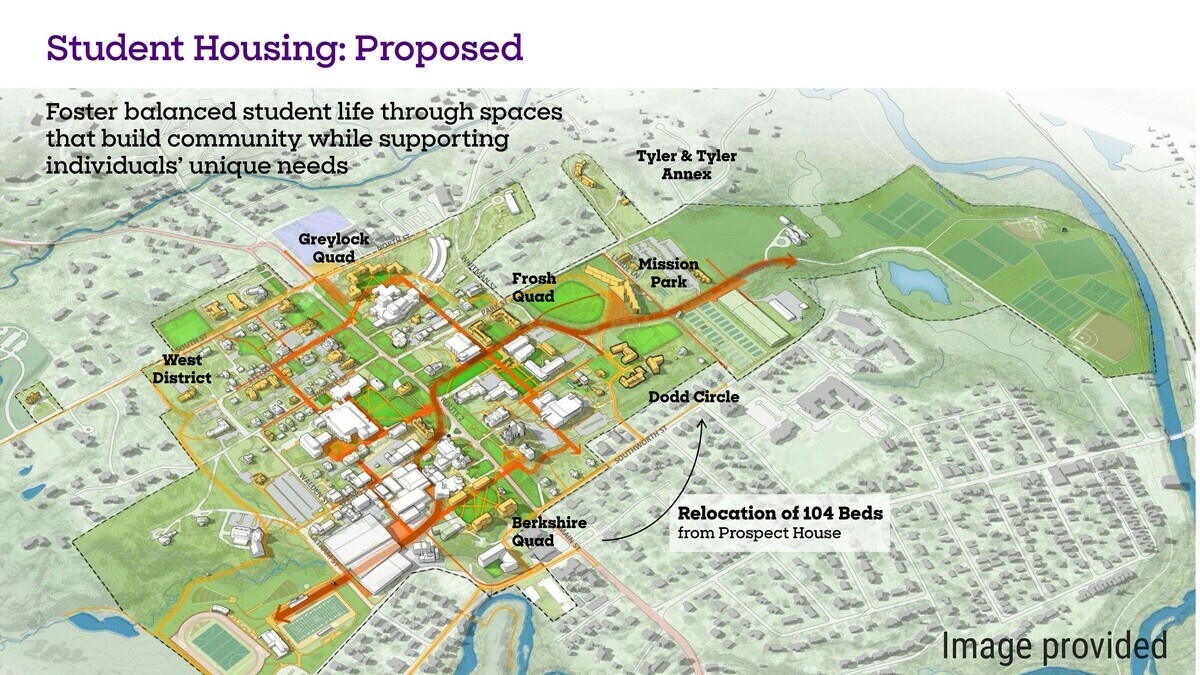
One of the most noticeable changes on the conceptual designs is the elimination of Prospect House, a four-story, 104-bed residence hall near the college's Lansing Chapman Rink.
"We have heard that student housing has a long way to go in terms of [Americans with Disabilities Act] accessibility," MacAusland said. "We're working closely with the team working on energy and the carbon master plan, thinking very carefully about sustainability of some of the smaller residence halls and whether they are operationally efficient.
"A new opportunity would be to locate [those 104 beds] at Dodd Circle, which we think would bring new life to that part of campus."
Dodd Circle is a cluster of dorms around Dodd House, a three-story, 76-bed dorm on Mission Park Drive off Southworth Street on the north side of campus. The planners recommend redoing the circle by: renovating Dodd, tearing down two of the smaller dorms in the circle, reusing two other small dorms for faculty offices and building an up-to-date 60-bed dorm and 111-bed dorm on the site.
"We also took a look at the building stock we have," Chenail said. "You see a lot of big-ticket items on this plan. But core to this in principle is: What is the best fit for the building stock we have? We have over 160 buildings on campus, and they're in varying states of the spectrum from repair to disrepair – much more of the latter than the former, and we don't need to get into that. But understanding what a building is meant to do and where it can perform is really critical to the plan and to the success of not only this plan but the energy and carbon master plan the college is envisioning as well."
Another big change in the life of the college's resident student population under the plan pitched on Tuesday: consolidating full-service dining halls from their current three locations down to two: a new cafeteria on the south side of campus to replace the nearby Driscoll Dining Hall and expanded dining services at the Paresky Center in the middle of campus.
Both of the new dining hall concepts entail changes that would be noticeable to the non-resident population.
Expanding dining services at Paresky would mean an addition on the Park Street side of the building to increase the kitchen's footprint. The planners' concept for a new dining hall at the current site of Prospect House is a three-story structure with an elevator to accommodate pedestrians who need help navigating the grade change at that end of campus.
Perhaps the most noticeable change for non-students in the plan laid out on Tuesday would affect one of the college's most public-facing features: its intercollegiate athletic program.
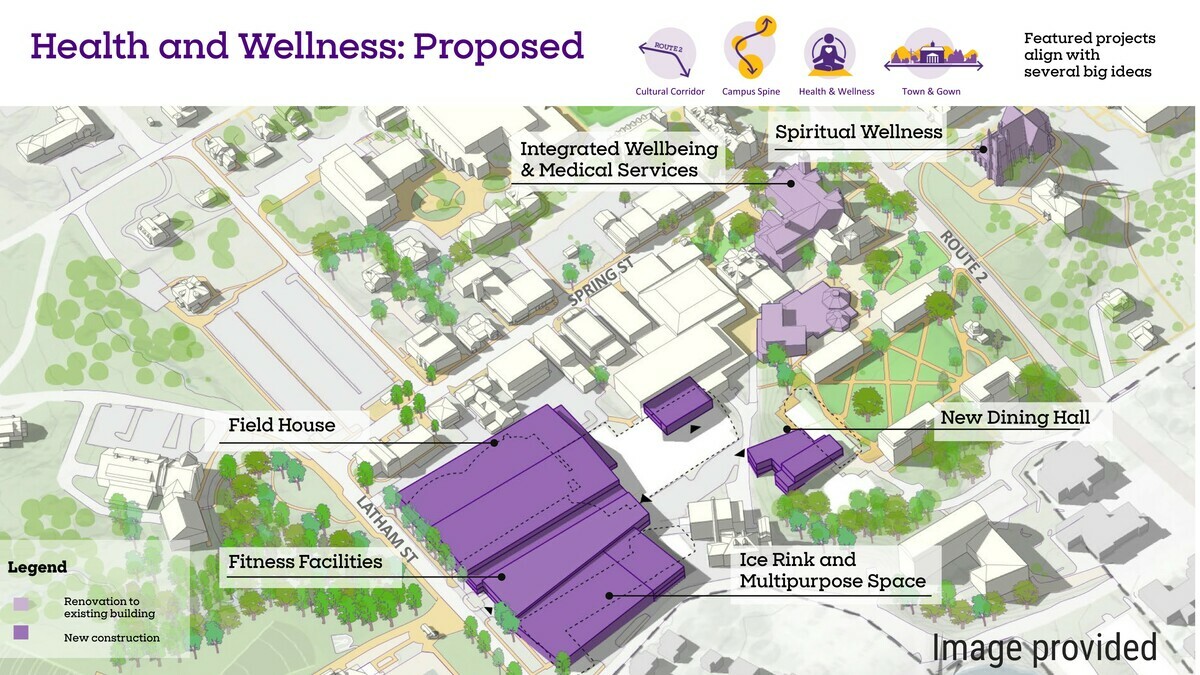
One of the "big ticket" changes in the plan is a replacement of the school's current field house and hockey rink, building over the current parking lot alongside the current field house and creating parking below the new field house, rink and fitness facilities.
The proposal is part of a "health and wellness" strategy that also would move the college's infirmary and counseling services from the Thompson Medical Center and Pond House, off Hoxsey Street, to the current Lasell Gym at the top of Spring Street.
"Lasell Gymnasium does not function well for recreational programming and hosting athletic events," MacAusland said. "We've heard it's difficult to navigate and requires a lot of renovation, and it's not accessible.
"So what we're proposing doing in this district is moving integrated wellness services and medical services to a renovated Lasell. That really showcases Williams' commitment to the whole student and the well-being of the student as well as members of the community."
The proposed field house/fitness center/rink complex would involve taking over land that currently houses the college's facilities department, located across the parking lot from the current field house.
Planning Board member Stephanie Boyd asked the college's team where they saw the facilities shop relocating.
Chenail said there were no solutions for that question that could be shared publicly.
"Williams is looking at its holdings and assets and looking at locations proximate to campus, just not central to campus," he said.
At another point, Select Board member Randy Fippinger asked from the floor of Tuesday's meeting whether the college had any plans to increase its footprint in the town through land acquisition.
"I think the college is always interested in strategically acquiring properties in town that fit the mission of the college," Chenail said.
Sarah Gardner, a member of the town's Comprehensive Plan committee and a professor of environmental studies at the college, asked whether the developers of what is titled "Campus Plan Concepts" did an analysis of whether their proposals added or subtracted from the current building inventory's square footage.
The planners said the concepts are not developed to that point, but reiterated that principles of sustainability drive their effort.
"We understand the tenet of ‘no new net,' and we're working creatively to get there," Chenail told Gardner.
The "Campus Plan Concepts" presentation was framed around nine strategies labeled as its "Big Ideas," areas like "Establish a Mixed-Use Wellness District" and "Foster a Cohesive Dining Network." Idea No. 2 on the list was "Reimagine Route 2 as a Cultural Corridor."
"[That means] amplifying the visibility and connectivity of arts, culture and the institutional on both sides of [Main Street]," MacAusland said. "So thinking of Route 2 as a zipper rather than a divider."
The presentation gave no details on how that "zipping" could be accomplished, other than referencing a previously announced plan to move the college's art museum from one section of Main Street (Lawrence Hall) to another (the former site of the Williams Inn).
Committee member Don Dubendorf said the college's plan to rethink the Route 2 corridor is relevant to the town's development of a master plan.
"I've been around since 1970, and [Main Street] has been at once deeply appreciated and enjoyed and at the same time ignored by the town and the college, almost intentionally ignored, even as it is a celebrated feature of our town," Dubendorf said. "Neither institution has been intentional about it. Sometimes we build buildings in the public right of way, sometimes we plant trees without talking to each other and so on and so forth.
"It should be a treasure. The notion that we would take that more seriously is very powerful, and I think it's something this committee should spend some time thinking about with the college. We can't afford to ignore its potential as we have and take it for granted. It's a shame we've done it for so long."
Tuesday's presentation to the Comprehensive Plan Steering Committee was still a work in progress but, the team said, a nearly completed work.
"We are going to be presenting the campus plan to the [college's] Board of Trustees in January," MacAusland said. "This will be close to the final plan, and we'll present with the goal of having it approved at [the board's] subsequent meeting in April."
Tags: master plan, Williams College,