Eversource Seeking Federal Funds for Pittsfield Microgrid Project
PITTSFIELD, Mass. — Eversource is seeking federal funds to develop Advanced Metering Infrastructure (AMI) in the city. The clean energy system is also referred to as "smart metering."
On Tuesday, the company held a listening session for its intent to submit a funding application through the Infrastructure Investment and Jobs Act passed in 2021. The bill allocated $107.5 billion for energy, power, and electric grid reliability.
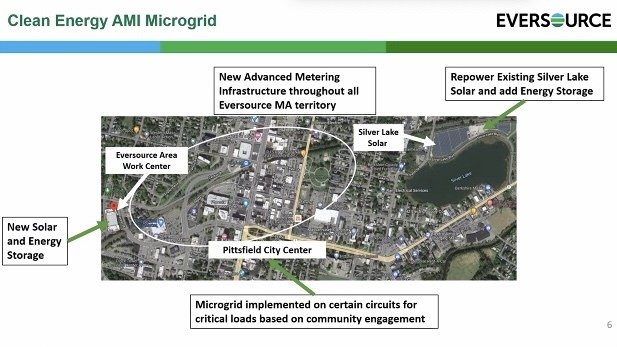
The project would involve a microgrid implemented in certain circuits based on community feedback, new solar and energy storage at its West Street facility, and the repowering of the Silver Lake solar facility with added energy storage.
"This microgrid that's being proposed here is really unique and really special," said Tracy Dyke-Redmond, manager of the Community Solar Resilience Program. "And offers special advantages that we think would be of particular value to Pittsfield."
While planning is in the early stages, the company wants to inform the community on the project.
"One of the important parts of what we're trying to do is to create an environment where we can have open dialogue on a regular basis to try to make whatever we do better and make sure that it's serving the needs of the community," manager of strategic planning Steven Casey said.
The goal is to create a microgrid to improve reliability and efficiency and will allow critical infrastructure to be favored during an outage, such as hospitals and emergency services.
Concept papers were submitted in December and the U.S. Department of Energy encouraged Eversource to submit a full application upon review. The full application needs to be submitted by March 15 and funding will be given out over the summer with a five-year award period.
"It’s a competition," senior analyst Thomas Regan-Lefebvre said about the funding. "There were about 300 applicants and fewer than half were actually encouraged to move forward with the application."
Because solar technology has moved quickly over the past decade, the Silver Lake solar facility that was built in 2010 needs renovations so that it can double the size for the same footprint. For the company, it makes even more sense to maximize the renewal power with battery storage.
There is no budget yet but the federal government has indicated that it will fund up to 50 percent of the project.
"We're in the middle of the process of creating the budget and that's going to be comprised of different components to the project, you have the area work, center solar and storage project, you have the repowering Silver Lake, the new battery storage at Silver Lake, the distribution upgrades in protection and control systems that are needed to run a microgrid," Casey said, adding that there is also the community engagement that is required.
He pointed out that the project also involved testing new ways of thinking and doing things.
"One of the good things about AMI meters is you can remotely connect and disconnect them so that if the microgrid starts and you have critical loads that you want running, the other loads can be turned off remotely and that allows you to maintain service for the critical loads," Casey explained.
"So AMI meters have that ability, at least AMI meters for all like smaller loads, so residential and small commercial. One of the things we're contemplating and proposing in this project is to develop a larger load three-phase, remote disconnect meter, which is not available in the marketplace right now."
He expects that the work could start at the end of this year or the beginning of next year at the earliest. After getting approval from the federal government, the project will also have to be approved by the state Department of Public Utilities and go through local permitting.
Dyke-Redmond explained the reliability and efficiency benefits that the microgrid provides.
"The microgrid is really oriented to provide power when there's a power outage but most of the time there isn't a power outage and so the solar facilities are producing solar power and that power has value and there is new legislation in Massachusetts that allows electric distribution companies like Eversource to build solar power in a way that will benefit communities and climate change resilience," she said.
"So particularly for the solar power at the area work center, we’ve been thinking about these kinds of projects in multiple communities and we have some of these projects in front of the DPU right now so we're waiting to hear back and we'll see what they say but, in general, what we have been thinking and what we've proposed is that during normal operations, when that solar power is generated it creates revenues that then we would provide those revenues back to the community."
For Pittsfield, there would be a community engagement process to determine the best use of the benefits.
In December, the DPU approved Eversource’s AMI implementation plan for the entire state. Planning for the replacement of all meters in the service territory is underway.
"And that also comes with new communications and back-end systems to be able to collect the data and bill customers and implement new kinds of rates and all that," Casey said.
"So, that project is in the procurement stage right now. The initial plan is to begin putting those new meters in throughout our service territory starting in early 2025 and being done by 2027. So throughout all of our service territory, throughout the whole state."
Initial plans are to start in Western Mass because the meters are older than those of Eastern Mass but the details have not been finalized.
Berkshire Environmental Action Team Executive Director Jane Winn and founder of No Fracked Gas in Mass Rosemary Wessel asked questions during the session.
Tags: electrical grid, eversource,