image description

MassHire Helps Expand Career Readiness, Plans In-Person Annual Meeting

By Brittany PolitoiBerkshires Staff
Print Story | Email Story

PITTSFIELD, Mass. — The MassHire Berkshire Workforce Board has assisted more than 1,000 students with career-connecting activities across multiple sectors during the past year.

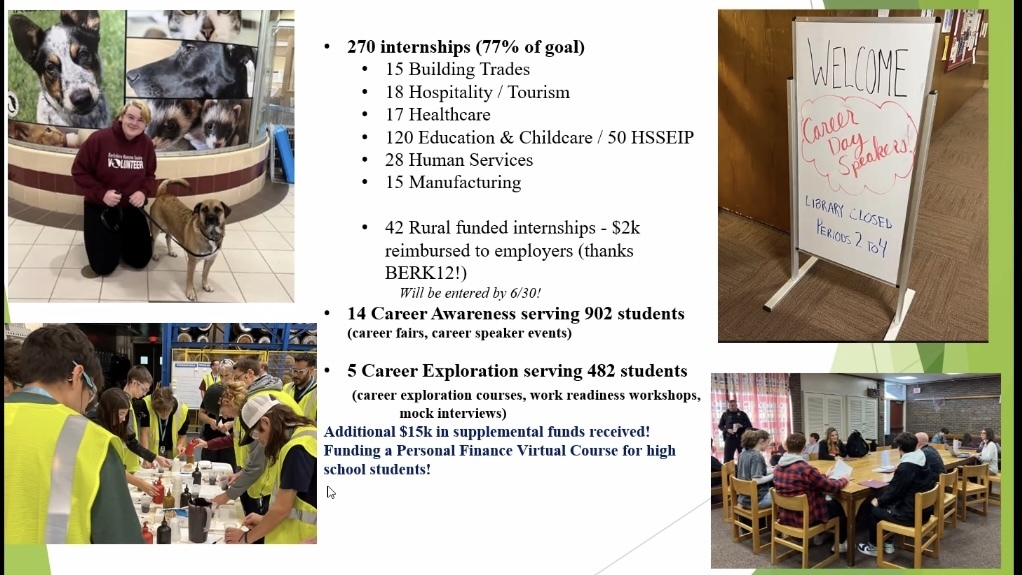
"So far, we've had 14 career awareness activities take place serving about 902 students and we've had five career exploration activities take place serving around 482 students," Youth Director Heather Shogry-Williams reported at the quarterly meeting last week.

"We have a lot of great career awareness and exploration activities set to take place within the next couple of months so those numbers will definitely increase."

This included work readiness workshops and career fairs, speaker events, and exploration courses.  

The organization's School to Career database shows that 270 young adults have been placed in internships and structured work experiences this year, 77 percent of the goal.

These were in a range of critical sectors including building trades, hospitality, health care, education and childcare, human services, and manufacturing.

A majority of the placements — 120 — were in education and childcare.

MassHire received a generous amount of funding through the BERK12 initiative from the state Department of Elementary and Secondary Education to support rural school districts. This has allowed it to invest in rural districts, providing stipends to teachers and staff that serve on college and career teams and reimbursing employers up to $2,000 in paid wages to 42 interns.

An additional $15,000 in supplemental funds were received from DESE for a virtual financial literacy course targeted at high school students. The course currently serves 15 high school students and one teacher.

Shogry-Williams pointed out that the county's innovation college and career pathways are expanding this year.  oosac Valley High School, Mount Everett High School, Monument Mountain High School, Lenox High School, and Pittsfield High School received planning grants and an invitation to apply for part B of the designation.

Innovation pathways provide an industry overview and exploration for students focused on critical sectors.

The organization is working with Berkshire Health Systems to develop a practice assistant course for students in health care pathways at Lenox, Monument, and Hoosac Valley high schools. MassHire's college and career teams have assisted other schools in expanding career readiness systems and activities.

"Our college and career teams are just rocking it this year," Shogry-Williams said.


"They are doing amazing work, expanding upon their school districts' college and career planning systems. I am very happy to say that we have a college and career team in every single district. That's been my dream for a very long time and it's happening."

The board's annual meeting will return in person on June 8, Executive Director Heather Bougler reported.

"Finally in person, we will not have the option for hybrid," she said. "It will be an in-person meeting at the Hotel on North in June so we're really excited. We will have our annual awards and the guest speakers."

Berkshire Black Economic County President and Executive Director A.J Enchill gave an overview of the council's services and recent activities.

The Berkshire Black Economic Council was first formed in 2019 and was incorporated in 2021.  Recently, it received a 501(c)(3) nonprofit designation from the Internal Revenue Service.

The council provides technical assistance to Black entrepreneurs and Black-owned businesses in Berkshire County with about 98 on its directory at the moment.

Enchill is serving as co-chair of Gov. Maura Healey's "jobs and a flourishing economy for all" policy committee, which is tasked with building a dynamic economy that reduces costs for people and businesses while lifting up workers.

Alongside Downtown Pittsfield Inc and MassDevelopment, the BBEC will be offering grants to small businesses that are new to the downtown Pittsfield area.

"Due to COVID, we've lost a lot of businesses in our downtown," Enchill explained.

"So in order to reactivate our downtown, we're now offering these grants to fit out the interior space of these vacant storefronts to make them turnkey so then, that new business owner can get the setup that they would need to thrive."

There is also flexible capital that can be used to leverage negotiations with a landlord.

"The other key criteria inquiry that we have is how will your business complement the existing businesses on North Street?" Enchill said, adding that they want to fill vacancies and support entrepreneurs but also connect them to resources.


Tags: workforce development,   
If you would like to contribute information on this article, contact us at info@iberkshires.com.

Dalton Planners Hold Public Hearing on Tiny Homes Bylaw

By Breanna SteeleiBerkshires Staff

DALTON, Mass. — The Planning Board held a public hearing last week on a bylaw for mobile accessory dwelling units (ADU) that will be brought before a special town meeting.

For nearly two years, Amy Turnbull has been trying to amend the current ADU bylaws to allow mobile tiny homes.  

A movable tiny home is defined as a unit under 400 square feet that meets all of someone's daily needs, including sanitation, cooking, and other facilities, and which is also mobile. Most homes considered "tiny" are built on a trailer so they can be towed.

Her proposal defines a movable tiny house as a "residential property with an existing primary house, intended for year-round living," and outlines eight conditions for approval.

Among these conditions: the unit must adhere to accessory dwelling unit regulations, undergo site plan review, be licensed and registered with the state Registry of Motor Vehicles, have approved energy, water, and wastewater systems, and comply with American National Standards Institute 119.5 and National Fire Protection Association 1192 safety requirements.

Additionally, the unit must be certified for ANSI or NFPA compliance by a manufacturer or third-party inspector, including adherence to Appendix Q and the International Residential Code's structural guidelines and energy efficiency standards. The tiny house cannot move under its own power, and its undercarriage, wheels, axles, tongue, and hitch must be concealed from view. Wheels and leveling or support jacks are required to rest on a level gravel or paved surface.

Turnbull has gotten enough signatures for her petition to amend the current bylaws to add her definition of the mobile ADUs. Last Wednesday, the board held a public hearing on the petitions, which will be voted on at a special meeting.

Turnbull says she has two reasons for wanting to add this to the town's bylaws: aging in place and affordable housing.

"We need a variety of housing types in Dalton, and that we also need to address the idea that you know nearly 30 percent of our population by 2035 is going to be over 65 years old, and it's problematic because  ... there's not enough choice for these people to to age in place,"she said. "What movable tiny houses does, is it provides a less restrictive ADU. It's much cheaper to place, and it's easier to place, less time consuming. And what it offers to people is it offers people who are owners a place for their children to come and live, or a caregiver to come and live, or for the people who own their own house to come and live while they rent out their maybe their three bedroom home to a new family who wants to attend to Craneville simultaneously."

She said people need to move away from calling and treating the tiny homes as though they are trailers, as one former Planning Board member has voiced opinions on.

"That is an opinion, and I think we need to get over that, because I want to say that these are foundation homes, and that the chassis is a foundation, and it's a stick-built home on a chassis, and in very many ways it's like a modular house. I think we will not be surprised in the next 10 years if we see the market turn around and start to make smaller, tiny modular homes, but that is not the case right now, and we have a dire need for affordable housing," she said.

At a former Fire District meeting the Water Department drafted regulations for water hook-ups for these types of homes. The superintendent sent a letter to the Planning Board to be read at the meeting stating it will not be a hindrance for sewer system connection.

"The Department of Public Works does not feel that mobile ADUs will be an issue with the town sewer system. The homeowners will be responsible for any issues outside of the sewer main and connect and responsible for connecting in, so that would address any permits, fees, or anything like that would be added to that," the letter states. 

"The Water Department, as we've stated previous, and as you stated, the water department has come up with their own set of SOPs, standard operating procedures, for hooking up a an adu and a mobile adu, which will then have to meet winterization and all those, but they've laid out a plan for that, that they have, so I'd like to point that out," board Chair Robert Collins said.

One concern was raised that if someone can have a mobile ADU could they also have another tiny home on their property, including the main house. That situation is not likely, said Turnbull, as it would cost a considerable amount of money. Town Manager Eric Anderson also stated that in his former community when they adopted similar laws their first one wasn’t put in until a couple years later and then maybe one a year.

View Full Story

More Pittsfield Stories