Williamstown Town Manager Details Reasons for Trail Overrun
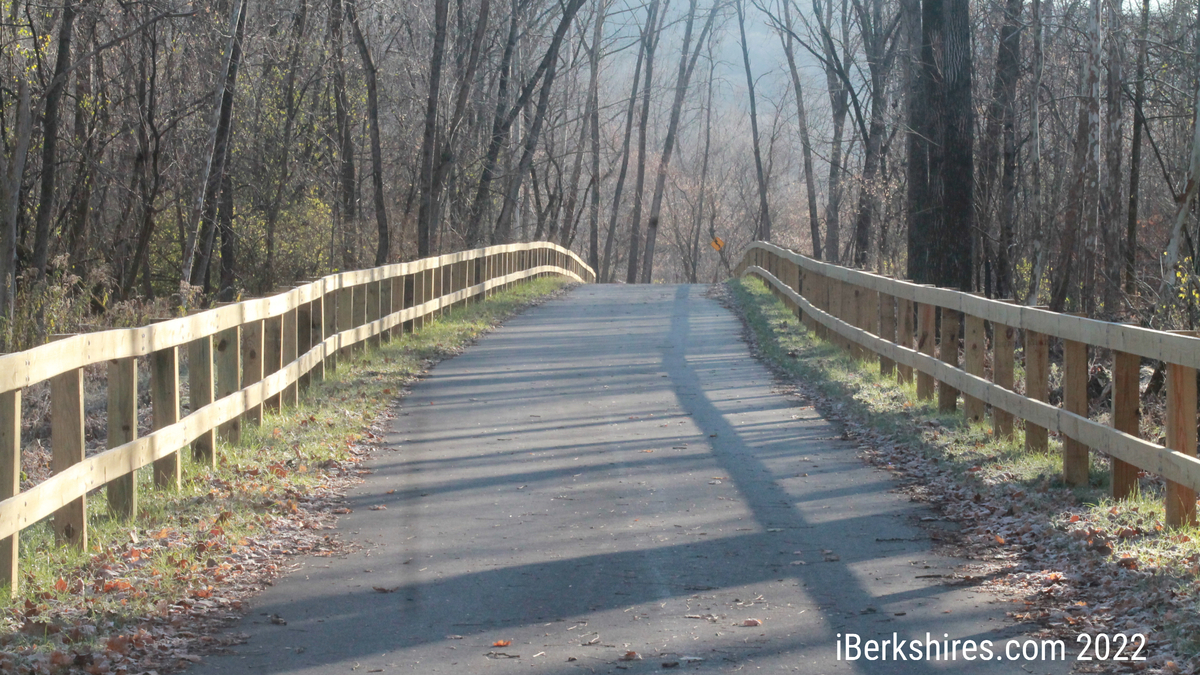
WILLIAMSTOWN, Mass. — A flawed design process is responsible for the $1.3 million overrun in a 2.4-mile bicycle and pedestrian path built under the auspices of the Massachusetts Department of Transportation, the town manager said this month.
The town is on the hook for that $1.3 million, which exceeds the 10 percent contingency that MassDOT built into the budget for a multimodal trail bid at around $5.3 million.
At a meeting of the town's Finance Committee this month, Town Manager Robert Menicocci gave his most detailed public explanation of how the project's cost came in so far above the $5.8 million that the state agency contributed.
"There are two programmatic pieces as part of the project that fall into the category of: In a perfect world, maybe it wouldn't have happened," Menicocci said. "One I think was the overall bid and design, which related to the fact that, a lot of time, these trails are put in on existing rail beds, and you know what you're going on. There is solid earth underneath you. And a lot of the area where our bike path went in, there was wetland underneath and relatively virgin land.
"The bid came in with a very, very low number identified for fill, for gravel, for things like that. The aggravating piece of this was that DOT, in conversations with them about this, has said, 'Yeah, that number was light.' "
Another "programmatic" factor was an increased cost for dealing with hazardous material on the route from the junction of Syndicate Road and North Street (U.S. Route 7) to the Spruces Park, the eastern terminus of the new trail.
"There was a cost-effective plan in place to take care of that, but there was a time delay issue getting that done, and it didn't happen," Menicocci said of the hazardous material. "So they had to truck it off site, and that cost a lot of money."
Menicocci acknowledged that a third factor in the overrun was beyond the control of the project's designers: increased materials cost related to the COVID-19 pandemic.
"That's something that, at some level, we have to make our peace with and say, ‘That happened, and it happened to everybody,' " he said.
To date, the town has paid $600,000 of the overrun as a gesture of good faith, but it continues its effort to get MassDOT to foot more of the bill, Menicocci said.
"It's not a dead issue yet," he said. "But the reality of it is work has been done, the contractor needs to be paid. We paid a portion of it to show good faith. But we're holding back, essentially, with no grounds. We have a signed contract that says we're on the hook for this.
"So if you hear from anyone that we're not paying our bills, it's kind of true. We're holding this back to try to leverage some recourse."
To put the $1.3 million in perspective, the town's operating budget for the current fiscal year (not including capital costs, enterprise funds like the water and sewer department or the appropriation from the Mount Greylock Regional School District) was about $9.3 million. The overrun for the bicycle/pedestrian trail is about 14 percent of that figure.
It therefore was a major talking point for the Finance Committee when it conducted its annual review of the town's Department of Public Works budget.
Menicocci has sought numerous sources of funding to pay the bill for the trail, including an unsuccessful attempt to earn support from the town's Community Preservation Committee.
The biggest single source he has identified is the town's allocation under Chapter 90, the commonwealth's program for assisting municipalities with infrastructure. Although Chapter 90 is funded by receipts from the state's gasoline tax, Menicocci has said the bike path is an allowable use, according to Boston.
The issue is that the town already has identified needs for those Chapter 90 funds.
"We try to accumulate Chapter 90 money for large projects," said DPW Director Chris Lemoine, who retired shortly after presenting his fiscal year 2024 budget to the Finance Committee.
Lemoine said the town typically receives a $300,000 allocation each year under Chapter 90.
"We try to save that and build up our balance sheet for large projects," he said. "A good example will be South Street. It will cost a lot more than $300,000, so we build up our pot, so to say. … But $300,000 for road maintenance is nothing, which is why we have to save for large projects."
The members of the Finance Committee used the explanation of the town's strategy of accumulating Chapter 90 funds as an opportunity to discuss the pros and cons of spending the money each year — as other communities do — and bonding for large projects, like a South Street rebuild, versus saving up for the big-ticket items.
A member of town staff at the Fin Comm's March 8 meeting, viewable on the town's community access television station, Willinet, said the South Street project will cost the town in the neighborhood of $2 million.
"We may not decide [the bonding versus saving question] by the time of town meeting," Fin Comm Chair Melissa Cragg said. "But it's something we should probably continue working on outside the budget cycle."
Menicocci indicated that fiscal efficacy may not be the only consideration.
"We also have to accept that borrowing is fraught politically," the first-year town manager said. "Right now, we move projects along, and you don't have to deal with the [voters'] mood of, ‘We don't want you to borrow,' and then the project gets stalled and the road caves in. I think that's a consideration."
The capital budget Lemoine presented this month totaled $497,400, a 6 percent increase from the $467,600 in FY23. The big ticket items in that total that the town will send to May's annual town meeting include: $280,000 to replace a 14-year-old street sweeper; $107,300 for milling, paving and curbing on Meacham Street; and $60,000 for design work to redo Church Street, where residents have raised particular concerns about curbing and ramps for pedestrians near the senior center and Proprietor's Field senior housing complex.
Another notable expenditure in the FY24 DPW budget relates – as so much does in the budget discussion — to the bicycle/pedestrian path.
Lemoine budgeted $20,000 for an electric-powered utility vehicle to help maintain the 2.4-mile trail.
"You can't be driving up and down a bike path with a great big truck," Lemoine said. "Think of [the planned acquisition] as a heavy-duty, glorified golf cart. Someone can go pick up trash, move dead trees out of the way, things of that nature. People will be asking for this type of service. That's why we're budgeting for that."
The one-time capital acquisition is not accompanied by any increase in personnel to care for the trail. For now, Menicocci said, the town is absorbing that work into its employees' current hours.
As for the much bigger one-time cost of the trail, Menicocci promised the Fin Comm that he continues to seek a solution that will not further drain the town's Chapter 90 reserves or hit the budget appropriated from local property taxes.
"The resolution is: The bill has to be paid," he said. "And we will pay it in one form or another. What we hope we'll be able to do is — we know the state is in pretty good shape, financially. They've got the money kicking around. We just have to find the right corner and find the support from our politicians to say, ‘You've got to make it right for the town.' "
Tags: bike path,