Pittsfield Residents Argue Over West Street/Holmes Road Changes
 |
| The meeting lasted over two hours. |
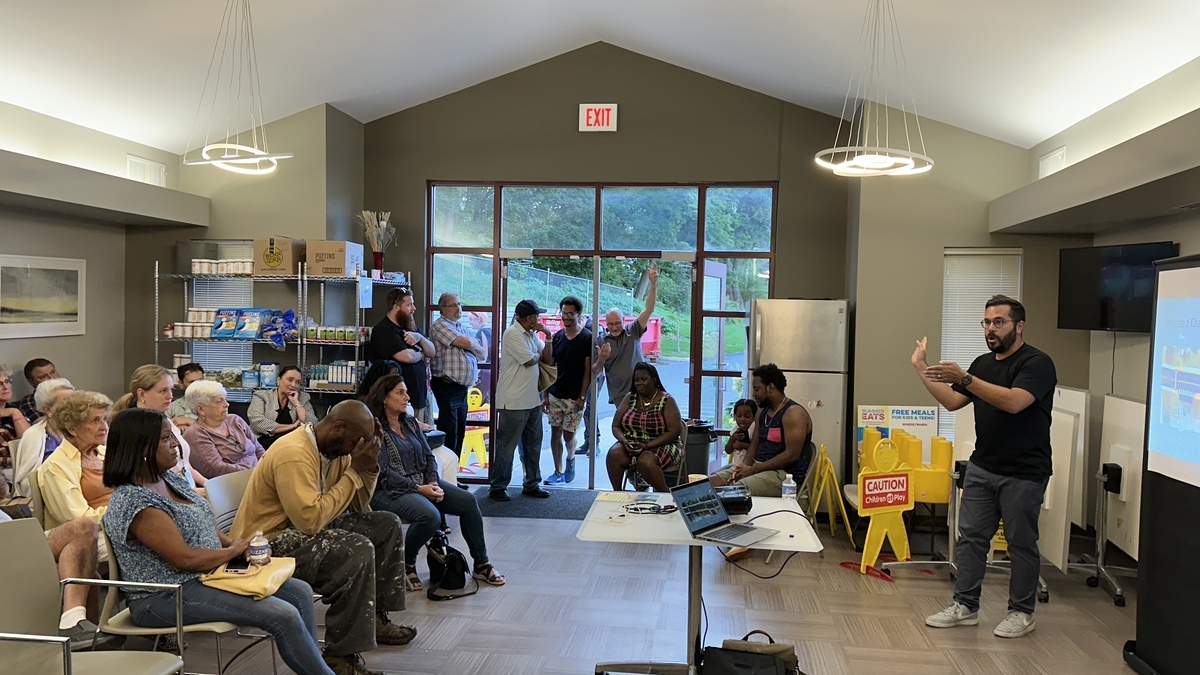
PITTSFIELD, Mass.— During the final West Street/Holmes Road Changes community forum, residents agreed to make the roads on the west side safer changes need to be made.
However, by the end of the two-hour-plus meeting on Wednesday, there was no consensus among residents on how to best accomplish this.
The proposed designs cover the stretch of road on Holmes Road between Williams Street and Elm Street and West Street from the intersection of Government Drive and College Way to Valentine Road.
Proposed changes to the Holmes Road corridor include new Americans With Disabilities Act (ADA) compliant sidewalk ramps, rapid flashing beacons at the mid-block street crossings, raised crosswalks at Cambridge Avenue and Strong Avenue, the replacement and repair of the existing sidewalks, extending sidewalk from Foote Avenue to Grace Terrace, and reconfiguring travel lanes from a 12-foot car lane with a three-foot shoulder to a 10-foot car lane with a five-foot bicycle lane.
Proposed improvements to the West Street corridor include narrowing the road, reconfiguring travel lanes into 10 to 11-foot travel lanes, upgrading ADA-compliant ramps, rapid flashing beacons at mid-block street crossings, re-aligning crosswalks, shortening pedestrian crossing distances, eliminating dedicated turn lanes, and reducing turning radii.
City of Pittsfield engineer Tyler Shedd said the current roads were not built for the city's current population.
The current designs were built with "an eye on a city that's 100,000 people," Shedd said. He said it is overbuilt and "leading to pedestrian and vehicle accidents that would otherwise be avoided."
Safety was one of the main drivers of conversation Wednesday with many residents noting the roadway has always been dangerous.
One person commented that growing up he would be grounded for crossing the street to go to the park due to how unsafe it was.
The danger of crossing that busy section of West Street was further demonstrated by Peterson Desire who lost his wife Shaloon Milord last year. Milord was crossing the street with their daughter when she was struck by a car.
Desire said through a translator, that every time he passes that section of West Street by Dorothy Amos Park he can't help but cry.
To inform the proposed designs, Shedd reviewed MassDOT's Crash data and determined since Jan. 2020 there have been 69 reported accidents.
"Of the accidents reported 23 resulted in minor injuries, 2 resulted in major injury, and 1 resulted in a fatality–Shaloon Milord," Shedd said in a follow-up email.
Of the 69 accidents, 62 happened in the 25 MPH zone, from Backman Ave to Dewey Ave.
During the community forum, residents argued that rather than making so many changes the city should improve its enforcement when it comes to speeding.
Shedd explained that enforcement is just one of the three tactics needed to address speeding.
"Speeding and road design is a three-part problem, and they call it the three E's," Shedd said.
The "three E's" of addressing speeding are–enforcement, engineering, and then education, he said.
Shedd added that enforcement isn't always easy as there are only six officers in traffic control who are responsible for monitoring approximately 200 miles of road in the city.
Commissioner of Public Services and Utilities Ricardo Morales added that engineering can help alleviate the problem and narrower roads have been shown to decrease speeding.
"There's ample evidence, empirical, anecdotal, scientific, and theoretical that says lower speeds are correlated with narrower lanes," Morales said.
As for education, Shedd said they hope to accomplish this with the community forum itself.
"We are talking about why we're doing changes, why we think they work, and all that," Shedd said.
Commenting on the actual design, a majority of residents approved of the idea of developing raised crosswalks. The only concern that they had was how it would affect plows in the winter.
Both Shedd and Morales ensured that it would not affect the plows as it is not high enough and plows are supposed to only go 25 MPH.
Residents also expressed that they would like the city to work on improving the visibility of the crosswalks by making them a brighter color.
Concerns were raised by residents regarding the elimination of the dedicated turn lanes. They feared that it would cause a lot of confusion leading to more accidents. There was also a fear that it would congest traffic and cause road rage.
Another addition that caused an up-roar in the meeting was the inclusion of bike lanes in the designs. Residents expressed that the city's current bike lanes are not frequently used, cause confusion, and eliminate parking.
The inclusion of bike lanes in the designs removes the breakdown lane where St. Mark's Catholic Church parishioners park most days of the week, former Ward 6 city councilor Jim Massery said.
"On Sunday, we just accept people are gonna park there," Shedd said.
Morales agreed, adding that they could add signage to the design to make that official. He also disputed the claims that the bike lanes are barely used citing data taken from their camera system.
"Even if there was one bicycle at that intersection, it will be detected. It will be logged as a bicyclist and it will trigger the light to change for that cyclist," Morales said.
Based on data collected at the intersection of Columbus Avenue and North Street, approximately 2 to 3 hundred bicyclists use the bike lane a day. Morales said on a day when the weather is poor, that number drops down to approximately 110.
There are approximately 3,000 pedestrians that walk that intersection a day.
With this final community forum, the Public Works Department will bring the community comments to the design consultant Fuss And O'Neil. They hope to have a new design plan by January.
They will present these new designs to the community by late fall.
During a follow-up conversation, Shedd and Morales said Fuss and O'Neil estimated the total cost of the changes would be around $800,000.
The city already has $600,000 earmarked toward the project. Depending on the timing of the construction the city may be able to split the cost over two years, Shedd said. The city was able to do this with Tyler Street.
There are also other sources of funding like Chapter 90, Shedd said.