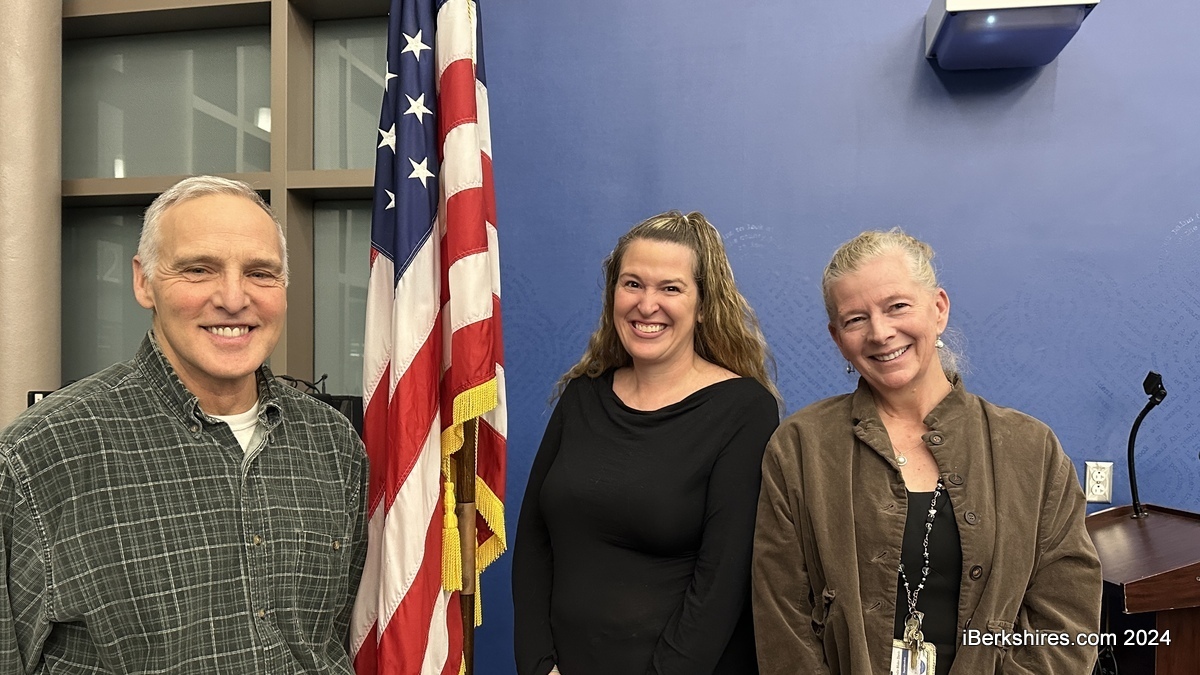
DALTON, Mass. — Central Berkshire Regional School Committee appointed its newest member, Sara Tucker, during its meeting last week.
Tucker will be serving as the committee's Dalton representative taking the place of the town's former representative Nicole Tucker. Although Sara and Nicole share a last name they have no relation.
Nicole Tucker decided to leave her seat early, which caused a vacancy on the committee that needed to be filled. The district put a call out for applications and received three but two dropped out.
The seat will be included in the elections in November so the community can vote who they want to have as the Dalton representative.
Sara Tucker is a supervisor for an adolescent unit at the state Department of Children and Families.
As a social worker, she has experience working with teens in the criminal justice system which the committee has not had before, committee Chair Richard Peters said.
"I'm excited actually, because obviously she has a lot of energy and a lot of really good experience and it's good to have a really great mix of people, parents, other folks who've been not in education, folks that are in education, and we have a really good blend of all of the above characters," Peters said.
"So, it really works out well and everybody on the committee is very respectful and it's just a pleasure to be on this committee, and I hope it maintains that for sure. It actually makes it really nice. So, I'm excited to have her, that's for sure."
Tucker has children in the district, one who will be going to Nessacus Regional Middle School next year and another one is involved in special education and receives Individualized Education Program services. She also is president of the Parent Teacher Organization.
"Since my kiddos started, I've been trying to figure out ways to kind of be helpful to the school system to be helpful to my children and their growth within the school system," Tucker said.
"I think she has an excellent background," Superintendent Leslie Blake-Davis. "She has great ideas, great suggestions. She's very invested in all students. She has children in the district."
As the PTO president, Tucker has helped the Craneville Elementary School principal bring in more "diversity, equity inclusion" with a reading program.
The program works to increase belonging and make children feel included while also encouraging readers, especially the reluctant readers, she said. She is also working with Craneville to bring the entrepreneur fair for its fifth graders.
She has a master's degree in social work from the University of Albany in New York and a post-master's certificate working with adolescents and children that are dealing with different challenges.
"Having that experience and coming from where I'm trying to kind of fix things. I would love to be able to kind of come in here and help create more positive change for our kids and our staff," Tucker said.
If you would like to contribute information on this article, contact us at info@iberkshires.com.
Your Comments
iBerkshires.com welcomes critical, respectful dialogue. Name-calling, personal attacks, libel, slander or foul language is not allowed. All comments are reviewed before posting and will be deleted or edited as necessary.
No Comments
Social Service Organizations Highlight Challenges, Successes at Poverty Talk
By Brittany PolitoiBerkshires Staff
Dr. Jennifer Michaels of the Brien Center demonstrates how to use Narcan. Easy access to the drug has cut overdose deaths in the county by nearly half.
PITTSFIELD, Mass. — Recent actions at the federal level are making it harder for people to climb out of poverty.
Brad Gordon, executive director of Upside413, said he felt like he was doing a disservice by not recognizing national challenges and how they draw a direct line from choices being made by the Trump administration and the challenges the United States is facing.
"They more generally impact people's ability to work their way out of poverty, and that's really, that's really the overarching dynamic," he said.
"Poverty is incredibly corrosive, and it impacts all the topics that we'll talk about today."
His comments came during a conversation on poverty hosted by Berkshire Community Action Council. Eight local service agency leaders detailed how they are supporting people during the current housing and affordability crisis, and the Berkshire state delegation spoke to their own efforts.
The event held on March 27 at the Berkshire Athenaeum included a working lunch and encouraged public feedback.
"All of this information that we're going to gather today from both you and the panelists is going to drive our next three-year strategic plan," explained Deborah Leonczyk, BCAC's executive director.
The conversation ranged from health care and housing production to financial literacy and child care. Participating agencies included Upside 413, The Brien Center, The Food Bank of Western Massachusetts, MassHire Berkshire Career Center, Berkshire Regional Transit Authority, Greylock Federal Credit Union, Massachusetts College of Liberal Arts, and Child Care of the Berkshires.
The federal choices Gordon spoke about included allocating $140 billion for the U.S. Immigration and Customs Enforcement, investing $38 billion to convert warehouses into detention centers, cutting $1 trillion from Medicaid over 10 years, a proposed 50 percent increase in the defense budget, and cutting federal funding for supportive housing programs.
Gordon pointed to past comments about how the region can't build its way out of the housing crisis because of money. He withdrew that statement, explaining, "You know what? That's bullshit, actually."
"I'm going to be honest with you, that is absolute bullshit. I have just observed over the last year or so how we're spending our money and the amount of money that we're spending on the federal side, and I'm no longer saying in good conscience that we can't build our way out of this," he said.
Upside 413 provided a "Housing Demand in Western Massachusetts" report that was done in collaboration with the University of Massachusetts at Amherst's Donahue Institute of Economic and Public Policy Research. It states that around 23,400 units are needed to meet current housing demand in Western Mass; 1,900 in Berkshire County in 2025.