Mosquito Spraying Polarizes Pittsfield Meeting Ahead of BOH Vote
PITTSFIELD, Mass. — Mosquito spraying remains a polarizing topic as the Board of Health approaches its decision on a control plan.
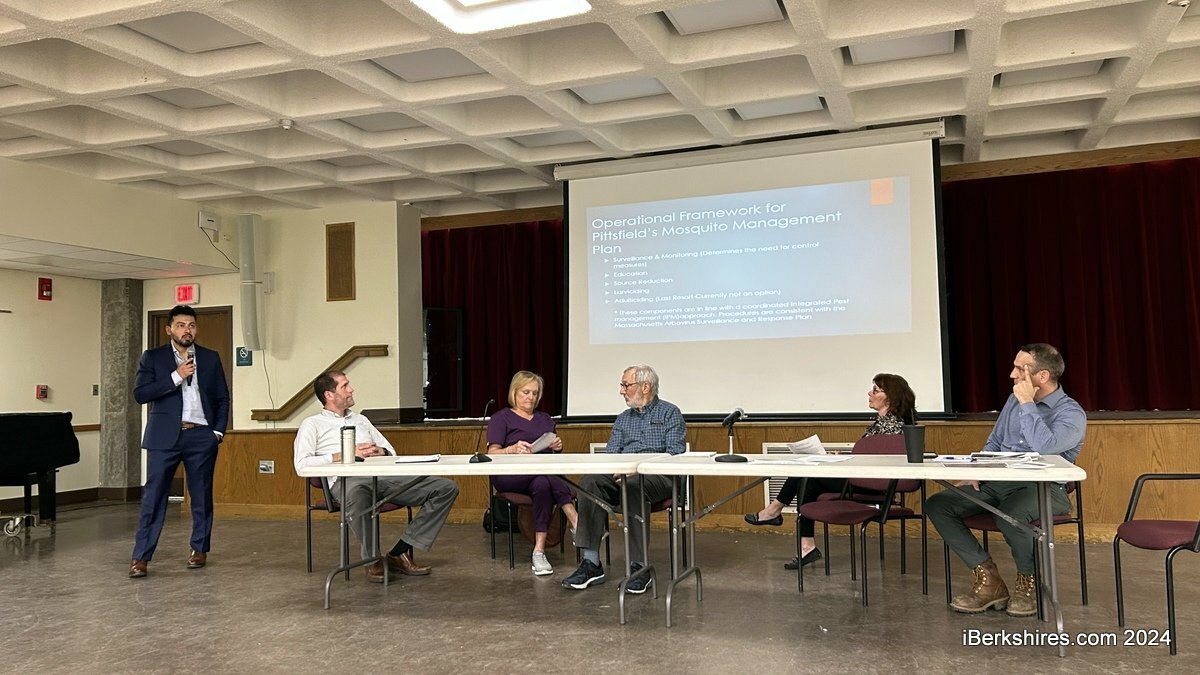
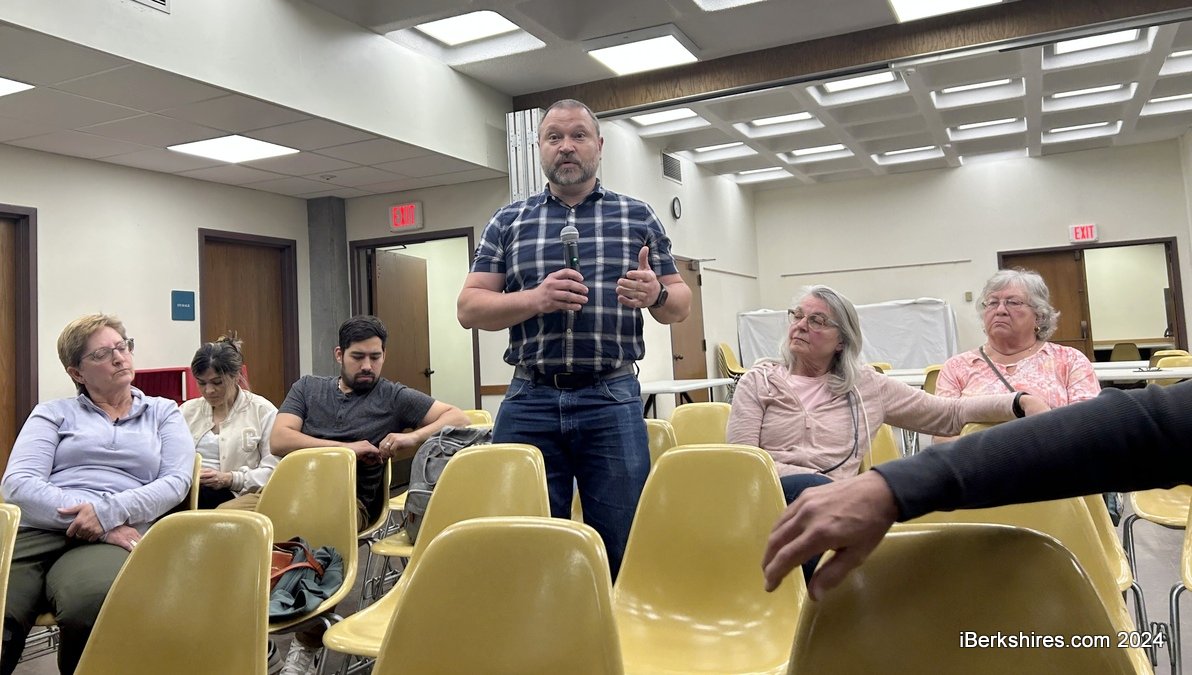
Health officials held a community meeting on Monday before the board's Wednesday vote on the yearly plan with the Berkshire County Mosquito Control Project. A small crowd gathered at the Berkshire Athenaeum, offering passionate and differing views on adulticide spraying.
"I'm appalled that people last summer were ignoring the risks and the advice of the Board of Health," an immunocompromised resident said, pointing to the elevated risk if she were bitten by a mosquito infected with West Nile virus or eastern equine encephalitis.
Another resident with a chronic health problem said she is "more concerned about the toxins and the inflammation from the toxins than I would be about the very small threat of a diseased mosquito."
Director of Public Health Andy Cambi said surveillance, monitoring, and education are the operational frameworks of the plan, with adulticide spraying as a last resort. This component was discontinued in 2021 but after six mosquitos tested positive for West Nile virus last summer, the board unsuccessfully requested that it be resumed.
He said the board realizes that more conversation needs to be had about spraying, as it is a part of the plan. Health officials also understand the community's concerns.
"I'm hoping through conversation that we can come up with some compromise that works for everyone," Council President Peter White said.
In Massachusetts, local health boards are responsible for disease prevention and control. The city has contracted with the project for more than a decade and last year's plan included the addition of mechanical source reduction and two products for larval and adult control.
Those in favor of spraying see it as crucial for managing the sometimes oppressive amount of mosquitos in the area while mitigating disease and those against have environmental concerns and argue that mosquito-borne illnesses are not prevalent.
As a new father and scholar of microbiology and infectious diseases, resident Nolan Hernandez, a microbiologist, said he knows how detrimental EEE can be to the infant and elderly populations. Repercussions of contracting the disease include death or lifelong neurological damage, he said.
"It's definitely worth making an effort to reduce the mosquito population," he said. "Also being from Colombia myself, in a country that doesn't do much mosquito control, I've seen firsthand the amount of children that do pass away and live with these diseases for the rest of their lives."
Hernandez added that having the luxury of mosquito spray offered by the government, it is not beneficial to argue against it.
BOH members later spoke to health equity and Cambi said not everyone can afford to have their yard sprayed by a private company. The point, he said, is to be proactive in providing a resource for residents who don't have that option.
"There are a lot of people that can't afford to spray and if we find a West Nile virus-positive mosquito in one of those traps and some of those neighbors can spray, you can't, we're not actively doing something to address that disease carrier then a lot of people are out of luck. It does become an equity issue," Chair Roberta Elliott said.
Resident Libby Herland cited her 24 years of experience as a land manager in the state and said EEE is not a threat in the area though it could be at any time. She said larvicides are not benign and "it still has impacts to what we call non-target organisms like birds, bats, dragonflies, damselflies that eat mosquitoes."
She would like to see the city educate residents on different types of biting and non-biting mosquitos and make better efforts to control stagnant water that breeds the insects.
"Talking to people about their yards is great but I think there is a lot of garbage around town and if we can pick up some of that garbage right there and if you can pick up that garbage right there you've got a way to reduce some of the sources of the mosquitos," she said.
White, speaking as a resident, said he would like to see an opt-in program rather than an opt-out program, backpack or ATV spraying rather than trucks, and a forum that includes environmental agencies that are not pro-spraying so that a compromise can be found.
"We are probably looking at upwards of $158,000 for this program on the cherry sheet this coming year and I'd like to see it used wisely," he said.
"I'd like to see the Department of Public Services involved in this, not just the Health Department. We've already pointed out some problems where if you report something on (the PittSMART app,) it's only going to the Department of Public Services where it needs to go to both."
White lives next to a brook and a swamp and does not want to see it sprayed because he likes having fireflies, moths, bats, and other positive environmental aspects in the neighborhood.
"Ultimately, I'd like to see no spraying but I know there are some very strong advocates for it and I think with being open to an opt-in program, getting neighborhood consensus, keeping it out of the neighborhoods that don't want it, we might be able to get further this year than we've gotten in the past," he said.
"I'm only one person on the council so I'm not speaking for the council. I'm speaking for myself."
There was also discussion about mitigating stagnant water on city property, statewide statistics, and the nature of chemicals used for the spraying.
Cambi clarified that the board has the authority to vote on the plan and feedback from the meeting needs to be considered in that decision.
"I'll just add that the adulticide is only one piece of this. We're looking at doing more aggressive and widespread education. We're also looking at source control. We know that needs to be better," Elliott said.
"Some things we can control and obviously some things we can't. Where there is standing water, we often have no control over that, especially when we have a really wet summer or spring."
Tags: mosquito spraying,