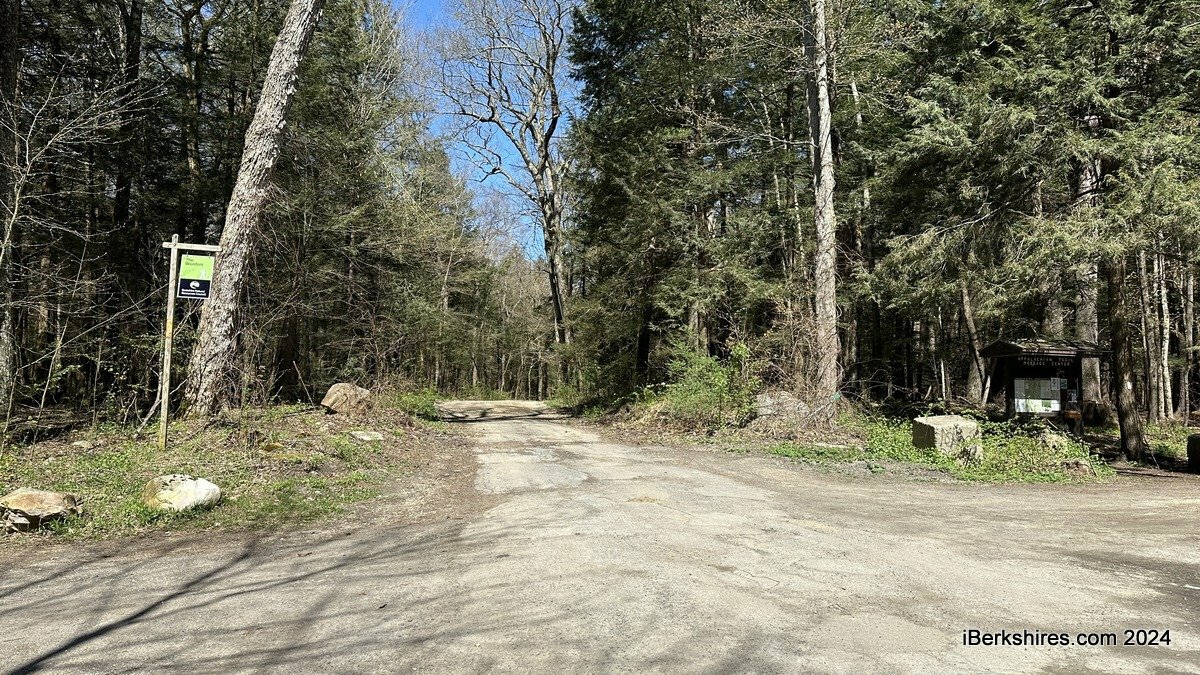
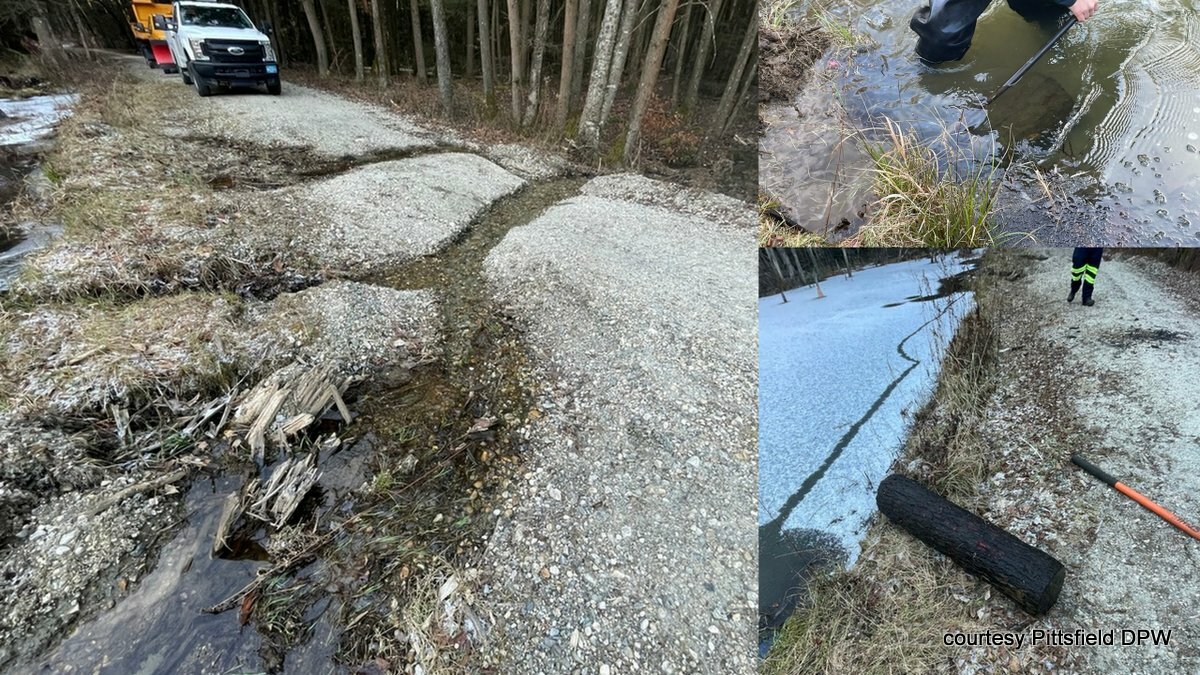
Gulf Road was reopened last week after a washout caused by a stopped up culvert was repaired. The seasonal road had closed two years.The city of Pittsfield pulled two logs out of the culvert and repaired the dirt road.
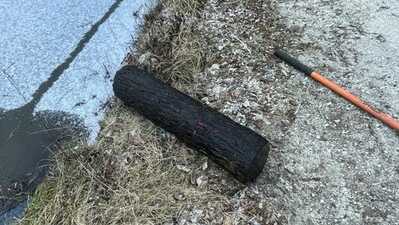
One of two logs pulled out of the culvert. Beavers were initially blamed for the flooding.
LANESBOROUGH, Mass. — After being closed for more than two years, Gulf Road reopened on Wednesday for the season.
For the last week, the town Highway Department has been clearing up fallen trees and graded the stretch of road on both its side and Dalton's side on Wednesday, Lanesborough Department of Public Works Director Charlie Durfee said.
The seasonal dirt road closed because of flooding caused by what was initially thought to be from a beaver dam that was located on the Pittsfield stretch.
It was initially assessed that the beavers were blocking the culvert, but this may have been incorrect, Pittsfield City Engineer Tyler Shedd said.
"The logs were clean-cut on each end, which suggested they were cut by a chainsaw," Shedd said
The road often serves as a shortcut between Lanesborough and Dalton by drivers to avoid retail-related traffic at Allendale Plaza and Berkshire Crossing in Pittsfield. It runs about 1.7 miles from Route 8 near the Connector Road in Lanesborough, through Pittsfield and around the Boulders Reserve and comes out in Dalton, where it turns into High Street.
A pool of water overtook the roadway last year, causing surface damage. The flowing water eroded the gravel road, creating rills and gullies that cut into the roadway, Shedd said.
The Pittsfield Department of Public Works started to unblock a culvert and repair the road in mid-December.
The city ran into some delays because the area is mapped as an Estimated Habitat of Rare Wildlife by the Massachusetts Natural Heritage and Endangered Species Program, Pittsfield Conservation Agent Robert Van Der Kar said.
This required that the city obtain a permit with the Massachusetts Endangered Species Act before removing the debris obstructing the culverts, he said.
When work to remove the woody debris started, the department discovered that there were two 10-inch diameter logs about 3 or 4 feet long that had made their way into the pipe under the road.
A laborer from the Highway Division waded into the pool and used a pry bar to extract the first log that was nearest the inlet to the pipe.
When the water run increased but was still not free-flowing, they discovered the second log at the outlet end of the pipe.
They used the pry bar once again to dislodge the log and guided it through the pipe, where it was collected and removed from the stream channel, Shedd said.
It is unclear what the exact cost was to repair the road. The "Highway Division purchases and keeps certain materials on hand, like loam, crushed stone, and gravel, to make repairs such as this," Shedd said.
It took approximately three crew members from the highway division a full eight hours to clear and repair the road, along with about eight hours of work by a city engineer.
"I would characterize the cost as minor in the context of the Department of Public Services and Utilities budget," Shedd said.
If you would like to contribute information on this article, contact us at info@iberkshires.com.
Your Comments
iBerkshires.com welcomes critical, respectful dialogue. Name-calling, personal attacks, libel, slander or foul language is not allowed. All comments are reviewed before posting and will be deleted or edited as necessary.
No Comments
Social Service Organizations Highlight Challenges, Successes at Poverty Talk
By Brittany PolitoiBerkshires Staff
Dr. Jennifer Michaels of the Brien Center demonstrates how to use Narcan. Easy access to the drug has cut overdose deaths in the county by nearly half.
PITTSFIELD, Mass. — Recent actions at the federal level are making it harder for people to climb out of poverty.
Brad Gordon, executive director of Upside413, said he felt like he was doing a disservice by not recognizing national challenges and how they draw a direct line from choices being made by the Trump administration and the challenges the United States is facing.
"They more generally impact people's ability to work their way out of poverty, and that's really, that's really the overarching dynamic," he said.
"Poverty is incredibly corrosive, and it impacts all the topics that we'll talk about today."
His comments came during a conversation on poverty hosted by Berkshire Community Action Council. Eight local service agency leaders detailed how they are supporting people during the current housing and affordability crisis, and the Berkshire state delegation spoke to their own efforts.
The event held on March 27 at the Berkshire Athenaeum included a working lunch and encouraged public feedback.
"All of this information that we're going to gather today from both you and the panelists is going to drive our next three-year strategic plan," explained Deborah Leonczyk, BCAC's executive director.
The conversation ranged from health care and housing production to financial literacy and child care. Participating agencies included Upside 413, The Brien Center, The Food Bank of Western Massachusetts, MassHire Berkshire Career Center, Berkshire Regional Transit Authority, Greylock Federal Credit Union, Massachusetts College of Liberal Arts, and Child Care of the Berkshires.
The federal choices Gordon spoke about included allocating $140 billion for the U.S. Immigration and Customs Enforcement, investing $38 billion to convert warehouses into detention centers, cutting $1 trillion from Medicaid over 10 years, a proposed 50 percent increase in the defense budget, and cutting federal funding for supportive housing programs.
Gordon pointed to past comments about how the region can't build its way out of the housing crisis because of money. He withdrew that statement, explaining, "You know what? That's bullshit, actually."
"I'm going to be honest with you, that is absolute bullshit. I have just observed over the last year or so how we're spending our money and the amount of money that we're spending on the federal side, and I'm no longer saying in good conscience that we can't build our way out of this," he said.
Upside 413 provided a "Housing Demand in Western Massachusetts" report that was done in collaboration with the University of Massachusetts at Amherst's Donahue Institute of Economic and Public Policy Research. It states that around 23,400 units are needed to meet current housing demand in Western Mass; 1,900 in Berkshire County in 2025.