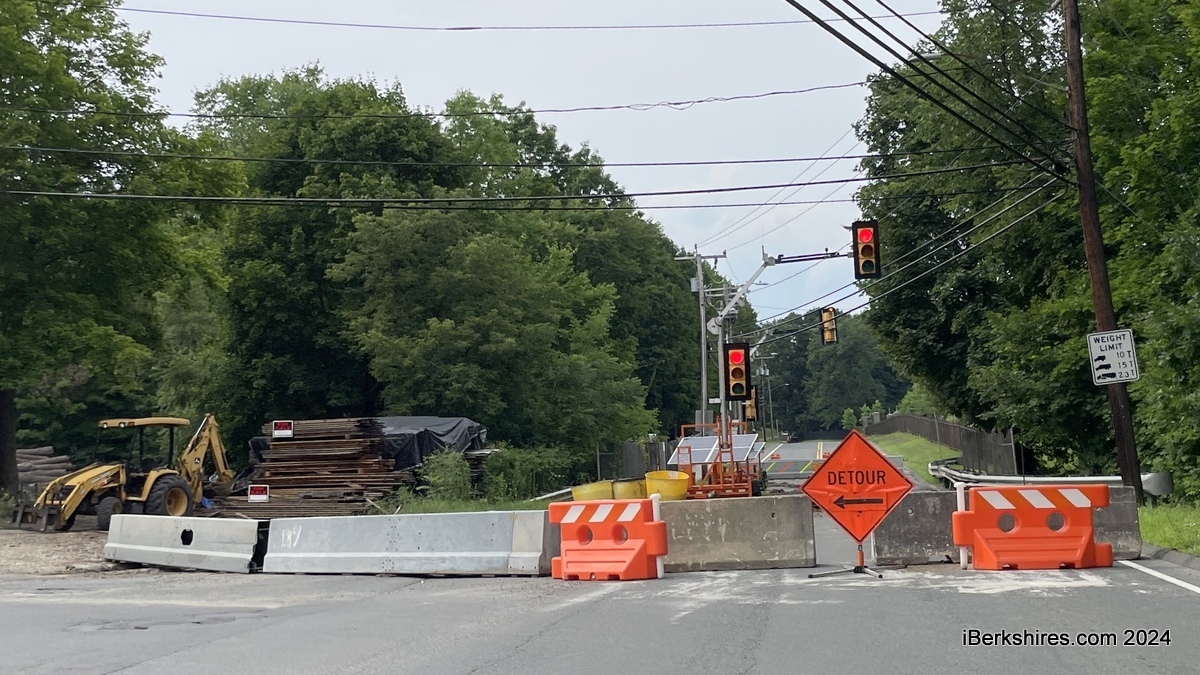
image description
The Pecks Road bridge was abruptly closed on Monday afternoon after a state inspection found dangerous deficiencies.

Rapid Deterioration Fully Closes Pecks Road Bridge
By Brittany PolitoiBerkshires Staff
Print Story | Email Story

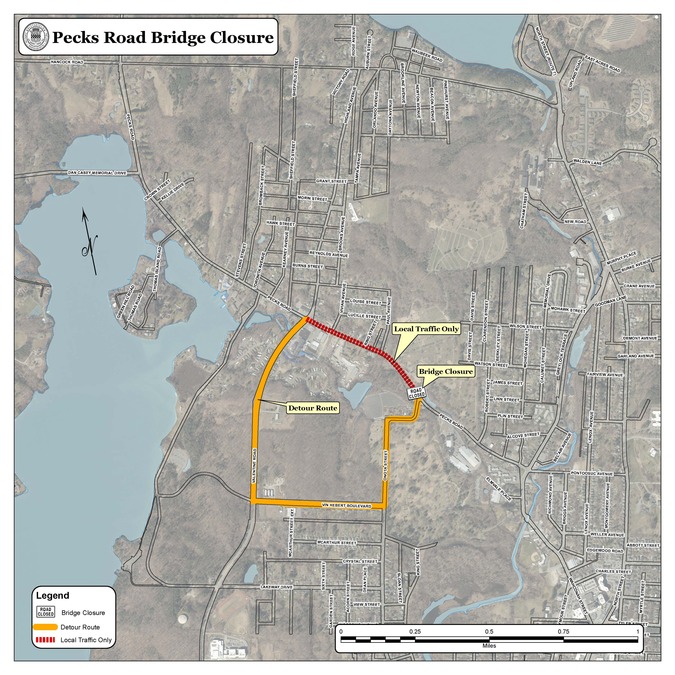
Detours have been set because of the closed bridge.

PITTSFIELD, Mass. — Rapid deterioration of the Pecks Road bridge has led to its closure until further notice and a hopefully expedited process to replace the entire structure.

The bridge was fully closed to traffic on Monday following an inspection from the Massachusetts Department of Transportation that found six areas of deterioration. Repair work is slated to begin in August by Rifenburg Contracting Corp. and the city says it continues to work closely with MassDOT on steps ahead.

Work will include demolition and reconstruction of the bridge over Onota Brook that has been reduced to one lane for five years. A detour has been routed from Pecks Road to Onota Street, Vin Herbert Boulevard, and Valentine Road.

"Today, upon a 6-month routine inspection, the state found signs of rapid deterioration and ordered the bridge to be closed," Commissioner of Public Services and Utilities Ricardo Morales wrote in an email.

"We are now moving towards having the bridge replaced in one go, as opposed to splitting the work in phases and maintaining traffic flow. This has some setbacks but overall the project should be completed faster."

The bid was awarded to the contracting company for $1,535,420 with a 10 percent construction administration budget and a 10 percent contingency budget, bringing the total estimated cost to $1,842,504.

Morales reported that the city has multiple authorizations for funding from previous years and a state Small Bridge grant that will cover all of the costs. He said a schedule will be shared once the contractor finishes changing the construction approach.


Pedestrian access is still available until construction begins.

The state found structural deficiencies on the south side of the bridge in 2019 and requested that it be closed. Because of the sudden nature of the request and without indication of these deficiencies from prior inspections, the city requested that a section be opened with a single lane of travel, Morales explained.

This was granted and the city started the "lengthy" design process while travel was reduced to one lane with a temporary signal and a ban on heavy vehicles.

"The design process had a rocky start with pandemic-related delays," Morales reported.

"In 2021, the design was pushed through and by 2022 it was fully designed and submitted to DOT for Chapter 85 approval. Under this review period, the DOT had major changes proposed and it took the city until late 2023 for all to be resubmitted. Approval was granted soon after and the city moved to bid the work and hire a contractor."

During the inspection on July 22, MassDOT found:

  • settlement in the wearing surface along the east curb, full length x 3 feet wide by up to 2" deep (This aligns with bay 17)
  • buckling of beam 18 along with a gap between the deck and the beam forming up to 1/4"
  • beam 17 bottom flange is distorted up to 1/4" full length
  • beam 16 bottom flange is distorted 3/4" full length. (Beam has several holes in the flange and web)
  • beam 14 has holes at the north end and the web is distorted 1-1/4" out of the plane
  • beam 13 web is distorted 5/8" out of the plane

For questions, contact the Engineering Division at 413-499-9327


Tags: bridge work,   closure,   

If you would like to contribute information on this article, contact us at info@iberkshires.com.

Lanesborough Planners Bring STR, ADU, Signage Bylaws for Town Vote

By Breanna SteeleiBerkshires Staff

LANESBOROUGH, Mass. — The Planning Board held a public hearing on the much anticipated bylaws for short-term rentals, accessory dwelling units, and signage to be presented at the annual town meeting.

For the past few months, planners have diligently been working on wordage of the new bylaws after Second Drop Farm's short-term rental was given a cease and desist because the building inspector said town bylaws don't support them.

The draft bylaw can be found on the website.

The board voted on each of the four articles and heard public comment before moving to entertain any amendments brought forward.

A lot of discussion in the STR section was around parking. Currently the drafted bylaw for parking states short-term rentals require two parking spaces, and with three or more bedrooms, require three spaces but never more than five.

There were questions about the reasons for limiting parking and how they will regulate parking renters choose to park on the lawn or the street. Planners said it is not their call, that is up to the property owner and if it is a public street that would be up to the authorities.

Some attendees called for tighter regulation to make sure neighborhoods are protected from overflow.

Lynn Terry said she lives next to one of the rented houses on Narragansett Avenue and does not feel safe with all of the cars that are parked there. She said there can be up to 10 at a time on the narrow road, and that some people have asked to use her driveway to park. She thinks limiting to five cars based on the house, is very important.

The wordage was amended to say a parking space for each bedroom of the house.

Rich Cohen brought up how his own STR at the Old Stone School helps bring in money and helps to preserve the historic landmark. He told the board he liked what they did and wants to see it pass at town meeting, knowing it might be revised later on.

He said the bylaws now should not be a "one size fits all" but may need to be adjusted to help protect neighborhoods and also preserve places like his.

After asking the audience of fewer than 20 people, the board decided to amend the amount of time an short-term rental can be reserved to 180 days total a year in a residential zone, and 365 days a year in every other zone. This was in the hopes the bylaw will be passed and help to deter companies from buying up properties to run STRs as well as protecting the neighborhood character and stability.

They also capped the stay limit of a guest to 31 days.

Cohen also asked them to add "if applicable" to the Certificate of Inspection rule as the state's rules might change and it can help stop confusion if they have incorrect requirement that the state doesn't need.

The ADU portion did not have much public comment but there were some minor amendments because of notes from KP Law, the town counsel.

View Full Story

More Pittsfield Stories