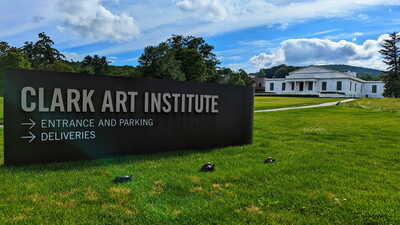
Clark Art Screens 'Stellet Licht'

Print Story | Email Story
WILLIAMSTOWN, Mass. — On Thursday, April 10, the Clark Art Institute continues its Small Town film series with a subtitled screening of Stellet Licht (2007) at 6 pm in the Manton Research Center. 
 
According to a press release:
 
Bookended by a sunrise and a sunset, Carlos Reygadas' film unfolds gradually and beautifully. Set and filmed in a German Mennonite community in Chihuahua, Mexico and with dialogue in the Mennonite dialect Plautdietsch, the film follows the simple story of a married man, Johan, (Cornelio Wall Fehr), who has fallen in love with another woman, Marianne, (Maria Pankratz), to the consternation of his wife Esther (Miriam Toews). The film explores the transgression of boundaries, be that the confines of the marital bed, the borders of the community, or indeed the boundaries of life and death itself. A cast of non-professional actors, all of whom are from Mennonite communities, give raw yet graceful performances. Often compared to Danish director Carl Theodor Dreyer's 1955 Ordet, Reygadas similarly combines an ascetic visual language with elements of magical realism. (Run time: 2 hours, 16 minutes)
 
Free. Accessible seats available; for information, call 413 458 0524. 

Tags: Clark Art,   

If you would like to contribute information on this article, contact us at info@iberkshires.com.

Theater Review: 'Driving Miss Daisy' Is a 'Wondrous' Production

By Alan PetrucelliSpecial to iBerkshires
PITTSFIELD, Mass. — Alfred Uhry's "Driving Miss Daisy" rolled into the St. Germain Stage in late May, marking the opening of Barrington Stage Company's 2026 season.
 
And what a wondrous, welcoming production it is. Uhry won a Pulitzer Prize for his work; he won an Oscar for the 1989 film adaptation of the play, which also won the Best Picture Oscar. Yes, that's how good it is.
 
Daisy Werthan is a 72-year-old white Jewish widow in Atlanta whose car accident destroyed her Packard — and her chance to ever drive herself again.
 
"Mama, we are just going to have to hire someone to drive you," her adult son Boolie tells her. 
 
She is adamant: "What I do not want — and absolutely will not have — is some chauffeur sitting in my kitchen, gobbling my food and running up my phone bill."
 
Enter Hoke Colburn, an unemployed African-American illiterate who grew up in rural Georgia during the Jim Crow-era South. Boolie hires him at $20 a week, and in a span of 85 minutes and a decade or so, this odd couple develop a tight bond that overcomes their cultural, gender and class differences. 
 
Though she's living in a racially explosive time in the South, the irascible Miss Daisy doesn't consider herself racist, nor does she fully accept the realities of the racist culture that has even resulted in a bombing at her own synagogue (a true event in Atlanta, in 1958).
 
View Full Story

More Williamstown Stories