Williamstown Town Meeting Gets Short-Term Rental Bylaw
WILLIAMSTOWN, Mass. — After three years of talking about the issue, the Planning Board on Tuesday wrapped up its work on a short-term rental bylaw proposal.
Now, it is up to town meeting to decide whether to implement the local regulation.
On a vote of 5-0, the board sent its proposal to the May 22 meeting after making one amendment and considering feedback it received in the form of letters from constituents.
The amendment is a provision that would exempt military members or foreign service members deployed overseas from the local limit on the number of days a house can be used as an "Airbnb" during the time of their deployment.
That idea came to the board late in the process through its outreach meetings this winter and was first discussed by the body at its March meeting. All agreed on Tuesday that the exemptions made sense.
The main business for the board on Tuesday was its statutorily-required public hearing on the two zoning bylaw amendments it is proposing for the annual town meeting.
One of those proposals first came up last summer, when the town's public works director asked the body to look at a regulation on closed-loop ground source heat pump geothermal wells in the town's Water Resource districts.
The bylaw the board crafted would require a special permit for any such geothermal wells in the district if they use any heat transfer fluid other than potable water. Systems that use only potable water would continue to be allowed by right, but systems that could potentially leak contaminants in the water resource area would require an engineering report, "certifying that the system as proposed poses no threat to the health and safety of the artesian aquifer that supplies public water to the Town of Williamstown."
The proposed bylaw on short-term rentals, commonly referred to by the trade name Airbnb, would apply to the town's residential districts and would limit rentals of dwelling units to 90 days in any calendar year with the following exception: if the owner is occupying part of the property during the rental period, those rental days won't count toward the 90-day limit.
In other words, if enacted, an owner-occupant of a residence could rent out their accessory dwelling unit or a single bedroom in their home for an unlimited number of days. Likewise, if the owner-occupant lives in an ADU on the property, they can rent the lot's primary dwelling unit for as many days as they like.
The Planning Board first took up the short-term rental issue in 2022, considering whether a local regulation could address potential negative impacts of the emerging industry while also preserving the benefits of STRs, which are seen as supplement to the local stock of conventional hotel and motel rooms during peak demand and as a way to supplement the income of homeowners.
The potential drawbacks include disruption to residential neighborhoods by the creation of de facto motels in those areas and the potential for entire homes to be removed from the town's housing stock by investors who buy single-family homes with the intention of only renting them on a short-term basis.
Part of the impetus for the Planning Board's attention to short-term rentals is that when it has considered other bylaw amendments that would have allowed for more residential housing construction in town, one criticism planners heard was that new homes would be built just, "to be used as Airbnbs."
Since initially taking up the short-term rental question, the Planning Board at one point handed it off to the Select Board to consider a townwide regulation, only to see the latter board take no action. The planners then took the matter up again, aiming for a zone-specific regulation; under the bylaw amendment proposed to next month's town meeting, unlimited short-term rentals would continue to be allowed in the town's business districts.
No one addressed the board in the public hearing on Tuesday on either bylaw amendment.
But the board did receive some correspondence, which focused primarily on the short-term rental bylaw.
One, from a person who identified as living outside the area, said that they purchased a second home in Williamstown with the intent of using it, "while visiting the Berkshires," and using it as a short-term rental to "offset the costs of the home."
Another letter, which was unsigned, said the proposed bylaw, "would unfairly restrict short-rerm rental owners."
"These properties enhance Williamstown's appeal, generate tax revenue and provide essential lodging for visitors and residents alike," the anonymous letter continued. "STR hosts are hardworking individuals who offer an important service, and they should not be penalized for their contributions to the community."
A third writer, Alex Carlisle, called the proposed bylaw, "clearly an assault on small business."
Planning Board member Kenneth Kuttner rebutted that argument on Tuesday evening.
"I can kind of see that, but, on the other hand, zoning does regulate what kind of businesses can be operated in [the town's General Residence District]," Kuttner said. "We don't allow hotels in GR. … It's within our purview to say, this is a kind of business we'd rather see operate in the commercial area, not GR."
And the planners noted on Tuesday that the town's bylaw already has a provision for residents who want to operate something like a year-round motel in a residential district — as long as they have secured a special permit from the Zoning Board of Appeals.
Chapter 70 of the town code includes a provision for "tourist homes," which are defined as: "An establishment in a dwelling with transient accommodations for more than two and fewer than 10 overnight fee-paying guests, or any dwelling rented or leased for periods of fewer than 35 days more than twice in a year; includes establishments called 'bed-and-breakfasts.' If having more accommodations or not in a dwelling, such establishments are categorized as 'hotel or motel.' "
Currently, the town has no licensed bed and breakfasts, Community Development Director Andrew Groff told the board on Tuesday. The last remaining B&Bs did not reopen after the COVID-19 pandemic. But the planners noted that the tourist home provision is an option for homeowners who want to use a home as a full-time Airbnb.
The special permit process, meanwhile, would give neighbors a voice in explaining why the ZBA should deny such permit requests.
"There are other types of businesses," Groff said. "We allow low-impact professional and business offices in the GR zone, over a certain size, via special permit."
At one point in Tuesday's discussion, Groff indicated the proposed bylaw on the table would clean up an existing enforcement issue by legalizing the residences already operating as "tourist homes" as defined by the bylaw — as long as they comply with the 90-day limit — while keeping the door open for special permits for homeowners who want to rent as STRs for more than 90 days in a calendar year.
Enforcement of the proposed bylaw and its 90-day limit has been a frequent topic of conversation by the planners and was raised by one of the residents who submitted written comments.
"As usually happens, the few informed honest folks will follow the rules and many others will not, either because they don't know all of their obligations or they know but choose to ignore them," Paul Harsch told the planners in an email.
Harsch, a local real estate agent, also said he knew of other agents who are marketing Williamstown homes, "to investors of homes for this specific purpose."
As they have previously, the Planning Board members leaned on the belief that most of the town's bylaws are "enforced" by voluntary compliance. And when violations are discovered, there are mechanisms to address them.
"To use the simplest example in recent years, we did have a person operating a piggery on a parcel smaller than 5 acres," Groff said. "It was reported by a neighbor. [The offender] did not like the letter they got telling them to cease operations. So they appealed to the Zoning Board, and the Zoning Board said, 'Sorry, you have to stop operations.' "
While the proposed bylaw does specify fines for non-compliance, it does not speak specifically to monitoring homes to ensure compliance. Roger Lawrence said such a strategy has worked for past bylaws.
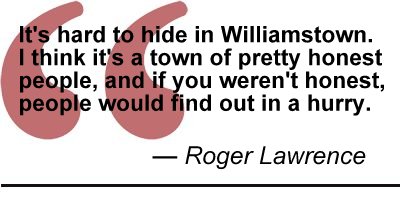
"We all live in a small town, and we all know each other," Lawrence said. "It's hard to hide in Williamstown. I think it's a town of pretty honest people, and if you weren't honest, people would find out in a hurry.
"We have a provision for penalty but not enforcement. I'm willing to bet those penalties will be imposed rarely."
Although Harsch's email argued the proposed bylaw does not go far enough, he indicated general support for its intent. Another of the five emails submitted for Tuesday's hearing praised the board for proposing a regulation that would help address the housing shortage in the commonwealth and, specifically, Berkshire County.
"We can't build the number of new housing units needed to meet the demand … ," Sarah Gardner wrote. "But we can retain more housing for people who need residences by regulating the number of short term rentals, allowing more housing for people who want or need to live in the community. Alternatively, we can continue to allow the growth of short term rentals to continue unabated.
"The first approach builds a more economically diverse and inclusive community, the second approach allows for more housing units to be investment properties."
Tags: bylaws, short-term rentals, town meeting 2025,