Dr. John Davis to Discuss Historic Deerfield at Williamstown Lecture
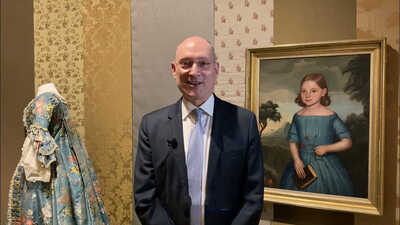 |
WILLIAMSTOWN, Mass. — Dr. John Davis, President of Historic Deerfield, will present a lecture titled "Historic Deerfield: Local Legacy, National Relevance" on Saturday, April 26, at 11:00 a.m.
The event will be held in the auditorium at Sweetwood, located at 1611 Cold Spring Road (Route 7) in Williamstown. The Williamstown Historical Museum (WHM) is presenting this free lecture.
Dr. Davis’ presentation will address the connection between Williamstown and Deerfield through individuals and artifacts, the current state of Historic Deerfield, and its summer exhibitions: "Envisioning America: Deerfield Academy’s Collection of Paintings and Drawings" and "Body by Design: Fashionable Silhouettes from the Ideal to the Real."
John Davis holds a PhD from Columbia University and is a graduate of Cornell University. His previous roles include Provost and Under Secretary for Museums, Education, and Research at the Smithsonian Institution, Executive Director of the Terra Foundation for American Art Europe (Paris), and Alice Pratt Brown Professor of Art at Smith College. He has authored, co-authored, or edited seven books, and his research interests encompass landscape painting, religion and visual culture, music and art, African-American representation during the Civil War and Reconstruction eras, the history of artists’ organizations, archival and documentary histories of American art, and 19th-century architecture and urbanism. Davis is an elected member of the American Antiquarian Society.
Historic Deerfield, Inc., was founded in 1952 by Henry and Helen Geier Flynt, parents of Henry N. "Hank" Flynt, Jr. (Williams ‘44), a longtime Williamstown resident and supporter of the WHM. In 1936, the Flynts enrolled their son at Deerfield Academy and subsequently began purchasing and restoring historic houses along "The Street."
Today, Historic Deerfield comprises twelve preserved antique houses dating from 1730 to 1850, featuring collections of regional furniture, silver, textiles, and decorative arts displayed within the period houses. The site also includes the Flynt Center of Early New England Life, a museum facility with exhibitions and visible storage, and the Henry N. Flynt Library, which contains over 21,000 volumes on the history and material culture of the region.
Additional information is available at www.williamstownhistoricalmuseum.org. The Williamstown Historical Museum can also be found on Facebook at