MassWildLife: Dragonflies are emerging
As spring moves towards summer and temperatures start to rise, native insects begin to take flight. Perhaps none are as extraordinary as dragonflies and damselflies. Dragonflies and damselflies are part of the order (scientific grouping) known as Odonata, an ancient group of insects that have been found in the fossil record as far back as 300 million years! There are over 160 species of "odonates" found in Massachusetts ranging in color from drab brown to bright red, blue, green, and even purple.
Keep reading to learn about dragonflies and damselflies, then look for them on your next outing. Simply sit near, walk close to, or boat along the edge of a lake, pond, river, or small stream to see these impressive hunting insects in action!
Life Cycle
These majestic flyers don’t always look like their adult forms. Wingless dragonfly and damselfly larvae (or nymphs) spend 10-36 months living underwater in rivers, lakes, and ponds. These juveniles swim and stalk through the submerged muddy terrain in search of other aquatic insects, tadpoles, and even small fish to prey upon. As they grow, nymphs undergo a series of moltings, shedding their exoskeleton for a slightly larger one each time.
When young dragonflies and damselflies are ready to take their adult form, they crawl out of the water for one final transformation. This metamorphosis does not occur within a cocoon, nor does it take days like with butterflies. Instead, adult dragonflies and damselflies hatch out of their own juvenile skins by cracking joints along the back of their exoskeleton and pushing themselves out of their nymphal form. The emerged adult rests in place, pumps blood into its wings to help them harden and spread, and finally takes to the sky. The entire process occurs within hours from the time they crawled out of the water.
Hunting adaptations
Odonates have large, compound eyes that provide almost 360-degree vision. Each dragonfly eye contains up to 28,000 lenses; damselflies may contain 7,000 lenses. The extraordinary optical ability makes it easy for these insects to pinpoint moving prey. In the air, dragonflies are the most skillful of insect flyers. They can move in virtually any direction. This is a skill that is nearly unique to dragonflies and damselflies and makes capturing prey rather easy. Dragonflies eat large insects including damselflies and even other dragonflies. Though they are more delicate fliers, damselflies are equally efficient hunters and consume large amounts of mosquitoes.
Damselflies vs dragonflies
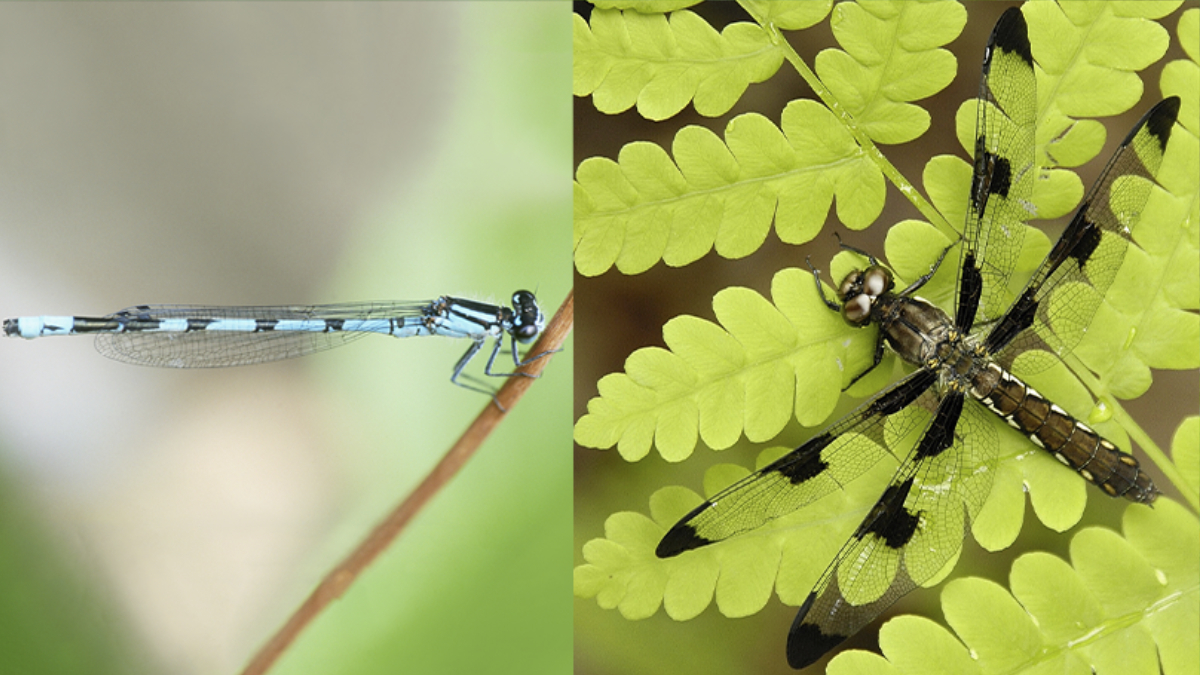
Damselflies:
- delicate and small-bodied with narrow abdomen
- head is wider than long, with eyes separated by more than their own width
- forewings and hindwings are similar in shape
- hold their wings pressed above the body or only partially open at rest
- weak fliers
Dragonflies:
- stout and large-bodied
- head rounded, with eyes covering much of the top and sides of the head
- forewings and hindwings are different shapes
- hold their winds out straight to the sides when at rest
- strong flier
Fun facts
The name "darner"—a family of large dragonflies—comes from the insects' resemblance to a darning needle.
Like birds, male odonates are often more colorful than females—a trait evolved to help attract a mate.
Dragonfly ancestors soared the skies before dinosaurs dominated the earth and had a wingspan of over 2 feet, making them the largest insect ever to live.