Clark Art Installation on 250 Years of Art in Mass
Print Story | Email Story
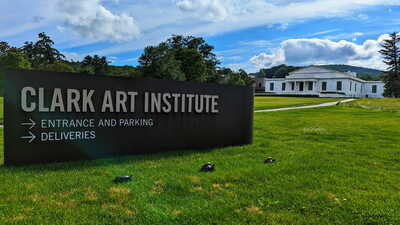
WILLIAMSTOWN, Mass. — The Clark Art Institute continues its new series of year-round public installations, Paginations, featuring works drawn from the Clark library's extensive holdings and curated by members of the library staff. 
 
The installations are featured in a newly designed space located in the Manton Research Center's reading room, just outside the entrance to the Clark's library and are on view for free during all open hours.
 
On view Sept. 26 through Nov. 16, Back Bay to the Berkshires: Celebrating 250 Years of Art in Massachusetts looks at some of the artists and artistic innovations associated with the Bay State through their relationships with book illustration, printing, and publishing. This display is held in conjunction with MA250, the Commonwealth of Massachusetts' commemoration of the semiquincentennial of the American revolution, and highlights the revolutionary spirit upon which the state was founded.
 
The Clark's library is widely recognized as one of the most important art history collections in North America, holding nearly 300,000 volumes in over 130 languages. The library's encyclopedic collection includes a number of special collections, including rare books, artist's books, decorative arts, photomechanical reproductions, and the world's only collection of ephemeral materials from the Venice Biennale. 
 
From its opening in 1962, the library has grown and changed to accommodate teaching spaces, visual resources, new programs and initiatives, and a never-ending array of new technologies. The library—one of the few remaining open stack art history libraries in the nation—is open to the public Mondays through Fridays from 9 am to 5 pm.
 
The library is housed in the Manton Research Center building and serves a wide array of patrons, including scholars, students, and researchers. Appointments can be arranged to explore special collections materials and library staff members are always happy to assist visitors in finding specific items of interest.

Tags: Clark Art,   

If you would like to contribute information on this article, contact us at info@iberkshires.com.

Williamstown Planners Finalizing Draft of New Subdivision Bylaw

By Stephen DravisiBerkshires Staff
WILLIAMSTOWN, Mass. — The Planning Board last week gave its final direction to the consultants hired to help the panel rewrite the town's subdivision control bylaw.
 
The town's contract with Northampton's Dodson and Flinker Landscape Architecture and Planning, which is funded by a state grant, expires on June 30, and the consultant is set to deliver a draft document in early July.
 
Last Tuesday, the board reviewed the latest progress from the consultant and considered some of the points discussed at its final, lengthy, video conference with Dodson and Flinker and its team on May 26.
 
Ultimately, plans to take the final draft and make any last decisions before presenting it to the town for a public hearing and adoption by the Planning Board later this year. Its goal has been to make the subdivision bylaw easier to navigate and more contemporary in order to encourage economic development.
 
At Tuesday's regular monthly meeting, Planning Board Chair Kenneth Kuttner told his colleagues he felt a lot of the issues were resolved at the May 26 session, including the development of a regulatory regime that ties infrastructure requirements to the size of a proposed development.
 
He also said he thought Dodson and Flinker's proposed language properly distinguishes between proposed developments in the town's core and those proposed in its rural residential districts.
 
"The thing they suggested, which I thought was interesting, was the 'payment in lieu of' for things like sidewalks in the rural area," Kuttner said in a meeting telecast on the town's community access television station, WilliNet. "So we could keep the sidewalk in the subdivision areas but require in the rural areas, payment in lieu of, which, as he said, would put the urban and rural development on an equal footing in terms of development cost.
 
View Full Story

More Williamstown Stories