Community Conversation Focuses on Local Farming, Food
NORTH ADAMS, Mass. — There are plenty of people within the Berkshire community concerned about food insecurity, and that worry hasn't been limited to just consumers.
Some of the small farms that dot the Berkshire landscape are also feeling vulnerable at a time with governmental help may be on the decline. This year, in particular.
"So this year sucked, like, as all of you probably know. I mean, from the get go, we had the DOGE cuts, and that trickle-down effect on the community and on farmers has been just one of immense insecurity," said Meg Bantle is a six-generation farmer and co-owner and founder of Full Well Farm in Adams. "We have grants that are still at risk of, you know, being potentially not funded, because that funding has been really in limbo."
Bantle was speaking at a community conversation Monday hosted by Steeple City Social, one of a series of monthly conversations co-owner Andrew Fitch has launched at the lounge.
"In honor of Thanksgiving, we wanted to have this monthly community conversation to be about food, to be about feeding the Northern Berkshires, about celebrating Northern Berkshires," he said, as the aroma of pies being baked by co-owner Meghan Daly filled the room.
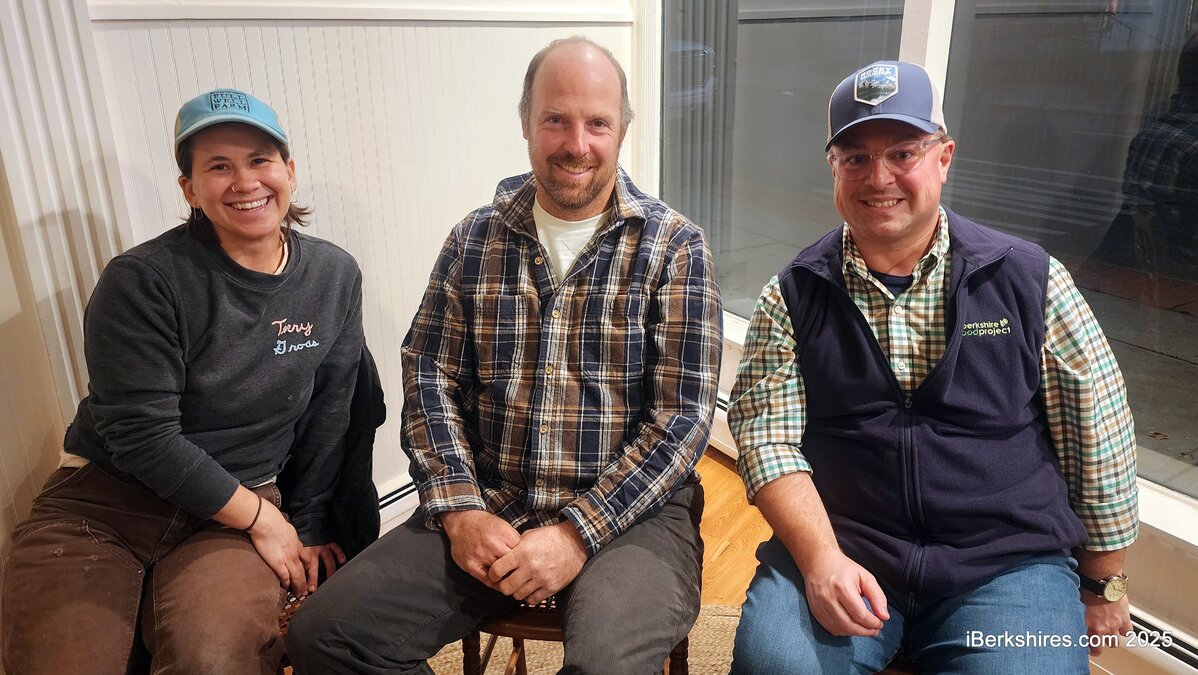
The panel of Bantle, Square Roots Farm owner Michael Gallagher of Lanesborough and Berkshire Food Project Executive Director Matthew Alcombright talked about the challenges and opportunities they've had working in food service and production.
"We're lucky here. We have a lot of local organizations that do a really good job of supporting farms. Berkshire Agricultural Ventures has been really huge for us. They're relatively new and they've done a lot of work with us," said Gallagher, who started Square Roots with his wife, Ashley Amsden, in 2010.
"We've had great support from Berkshire Grown. And then there are state and federal places where you need assistance, working with the Farm Service Agency, or the NRCS, the Natural Resources Conservation Service."
Bantle said these local nonprofits are helping to bridge the gap between community needs and the bottom line for farmers because of uncertainty at the federal level.
"Some of the agencies that Michael mentioned no longer have staff in the Berkshires, or have one staff person for the entire county," she said. "If we are trying to implement a project that we have received funding for, we have no one available to help us implement that funding or give us the approvals we need."
Bantle and co-owner Laura Tupper grow vegetables and flowers at Full Well Farm; Square Roots has pasture-raised pigs, beef cattle, turkeys and meat and egg chickens. Both are for-profit enterprises and offer some form of Community Supported Agriculture.
About a third of Full Well's CSA customers choose a low-income option or pay through the federal Supplemental Nutrition Assistance Program or other subsidy, and about a quarter of their market users.
The state's Healthy Incentives Program, HIP, allows those on SNAP to purchase fruits and vegetables from farm vendors.
"It was a way that the state was trying to specifically connect SNAP users to local agriculture," said Bantle. "I think that was a really creative and innovative program that I really love and has continued to suffer from funding cuts at different times. ... I just really appreciate that, and that means a lot to our farm."
Gallagher said HIP is like an extension of the market match program that vendors started doing at the North Adams Farmers Market.
"Berkshire Ag Ventures has taken over the fundraising for that and moved it to countywide, where they raise funds to match people's SNAP funds," he said. "It really does incentivize spending those SNAP dollars that you would spend anywhere. Incentivizes spending them at the market with local folks, and keeping that money sort of circulating the community."
Square Roots is also in the state's Agricultural Preservation Restriction program, in which the state buys the development rights to the land. This reduces the cost of the property and makes it affordable to farmers and ensures that it's going to be farmland forever, said Gallagher. "I think that we can do more of that and more work to protect farmland and make it affordable for farmers in a way that really gets makes it possible for people to get started because it's so hard for people to get started."
Both encouraged the community to continue to advocate for those programs, and Bantle noted that farms are integral to the local economy.
"I'm sure everyone in this room knows to shop local," she said. "But for farm businesses, it really is money that often stays local ... I'm going to Beck's Printing in North Adams to get my hats printed. Steeple City is going to Michael to buy their eggs. Like money that is spent with Berkshire businesses often stays with Berkshire businesses. So it's really like a community trickle-down effect to spend your money local."
Fitch said Daly had brought over pies that morning for the Berkshire Food Project and that $1 from the sales of the lounge's specialty drink were being donated to the project. During the summer, the flowers on the tables came from Full Well and the arugula in the salads.
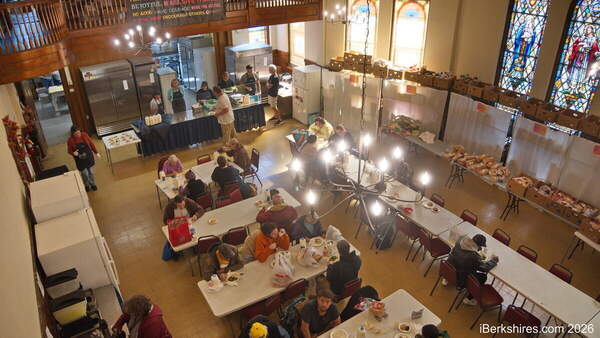
As for consumers, Alcombright said the numbers at the free lunch program have risen over the past year, and especially in the past few weeks when the SNAP program was in peril.
"The gaps for us are, we never know what they're going to be," he said. "It's the response from that, where the gaps have been closed up again by community support. And so the gaps that we're seeing are real, they're unexpected, and that's what kind of keeps us on our toes. That's what makes this job fun."
That community support has included state funds obtained by state Rep. John Barrett III, unexpected grant monies and charitable donations.
"It's really hard to say where those gaps are, because it seems where a gap opens, the gap is filled and but we don't know what that's going to look like going down the road," Alcombright said. "The Berkshire Food Project, I think for the first time in many, many years, has seen space in our freezers lately. That's not a bad thing. It's just reality that more people are in need. It's not reflection on the generosity of the donations and contributions that we're receiving. ...
"Maybe that's the gap. The gap is we're seeing unprecedented numbers, an increase in need, with a very generous and steady flow of contributions that just aren't meeting that need."
Tags: agriculture, Berkshire Food Project, food,