No Drought Conditions In Berkshire County
Print Story | Email Story
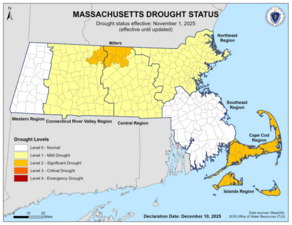
BOSTON — Energy and Environmental Affairs (EEA) Secretary Rebecca Tepper declared the Western Region has returned to Normal Conditions. 
 
Drought levels remain unchanged throughout the rest of the Commonwealth with the Cape Cod and Islands Regions, and Millers Basin at a Level 2–Significant  Drought; the Northeast, Central and Connecticut River Valley Regions at a Level 1–Mild Drought; and the Southeast Region at Normal Conditions.  
 
Drought is a look back on conditions over a period of time. Despite some improvements, drought conditions have continued in most of Massachusetts.  
 
During November, Massachusetts received rainfall ranging from 3 to 5 inches, with the Cape and Islands Regions seeing the highest totals. However, when looking back over the past 3 to 6 months, many areas still show deficits in precipitation. The forecasted rainfall is anticipated to bring relief to some regions of the state. 
 
The current drought, which began in 2024, has had significant impacts on the natural environment, including
 the drying of streams in nearly all regions, lower water levels in lakes and ponds, resulting in exposed banks, and impeding fish passage out to the ocean. Watering restrictions were implemented over the summer, and the local water supplies are currently stable. 
 
 The Drought Management Task Force (DMTF) collected and analyzed data from August 2024 through November 2025. 
 
The Massachusetts Department of Environmental Protection (MassDEP) will continue to assist communities in
managing their water systems. The Massachusetts Water Resources Authority (MWRA) water supply system is not experiencing drought conditions. 

Tags: drought,   

If you would like to contribute information on this article, contact us at info@iberkshires.com.

Pittsfield Council OKs $15M Borrowing for Drinking Water System

By Brittany PolitoiBerkshires Staff

PITTSFIELD, Mass. — The City Council last week approved borrowing $15 million for drinking water system upgrades, and heard a commitment from the Department of Public Works to consider solutions for the intersection of Onota and Linden Streets. 

Last month, the council supported the borrowing for the city's two drinking water plants during its regular meeting. 

Commissioner of Public Services Ricardo Morales explained that the decades-old filtration units need to be babysat "much more" than usual, and the city is due for new technology. 

Pittsfield's two Krofta water treatment plants were installed in the 1980s and are said to be beyond anticipated useful service and at risk for catastrophic failure that could result in a shortage of potable water. Krofta is a compact filtration system that Pittsfield will continue to use, with four new units at the Cleveland WTP and two at the Ashley WTP.  

"When the Krofta was built in 1980, I was there on the council, and here we are looking to repair or replace certain parts," Ward 1 Councilor Kenneth Warren said. 

"So 40 years later, I think we need to do that." 

The full drinking water project is expected to cost $165 million over the next eight years, with $150 million for long-term construction and $15 million for near-term needs. The initial ask would fund the final design and permitting for Phases 1-3 and Phase 1 of interim updates. 

The $15 million borrowing breaks down into $9.2 million for the design and permitting, $2.4 million for the construction of Phase 1, and $1.4 million in city allowances, including owner's project manager services, land acquisition, legal fees, and contingency. 

Pittsfield's water system includes six surface water reservoirs, five high-hazard dams, one low-hazard dam, two water treatment plants, two chlorinator stations, and gravity flow from the plants to the city. It serves Pittsfield, Dalton, Lenox, and the Berkshire Mall property. 

View Full Story

More Pittsfield Stories