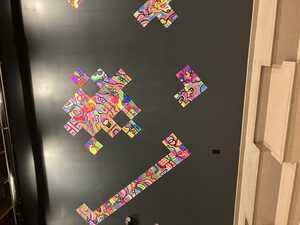
ADAMS, Mass. — Students from all schools in the Hoosac Valley School District will display art that "connects and expands on possibilities" inside the Adams Theater starting with an opening reception on Tuesday, Dec. 16 from 5-7 p.m.
Led by Hoosac Valley Elementary School art teacher Elizabeth Kick, third grade students drew a series of layered and echoed lines on 9-inch by 9-inch canvases, creating their own small pieces that naturally connect with their peers' pieces.
Inspired by elementary art teacher and blogger Cassie Stephens, the pieces begin with sharp lines in black tempera paint and extrapolate from there, with different colors, textures and line styles that reflect each unique student.
Middle school art teacher Terri Cooper and High school art teacher Kristin Driscoll joined the project, and more than 160 students have created pieces for the exhibit.
"They may zig-zag and curve, but they will always connect to this community," said Kick. "While each piece can stand alone, they can also connect to any other piece in the collection. And collectively they make a whole–just as the students connect to one another, the schools also connect, and we all connect to the entire Adams-Cheshire community and beyond". They're a continuum that illustrates how all our students will have different paths throughout their lives, but their paths are interconnected."
The theater will display the pieces until February 2026. The show will open with a reception on Dec. 16 for the Hoosac Valley artists and their families from 5-6 p.m. and to the public from 6-7 p.m. It's free to attend and no registration is required.
If you would like to contribute information on this article, contact us at info@iberkshires.com.
Your Comments
iBerkshires.com welcomes critical, respectful dialogue. Name-calling, personal attacks, libel, slander or foul language is not allowed. All comments are reviewed before posting and will be deleted or edited as necessary.
No Comments
Cheshire Receives Grant for South Street Water Main Project
By Breanna SteeleiBerkshires Staff
CHESHIRE, Mass. — The town recently received a grant that will help with water infrastructure on South Street.
Town Administrator Jennifer Morse last week informed the Select Board that the town has received $1,159,200 through the Housing Works Infrastructure Program for the South Street Water Main Project to upgrade the existing infrastructure to improve water reliability, quality and fire department needs for the town.
Department of Public Works Director Corey McGrath said it is a big win for the town, as it is a necessary project to help keep that portion of the road safe.
"This is absolutely amazing and huge for the town. That section from the lights to Lanesborough Road is bottlenecked. We have sections 4-inch, 6-inch, and 8-inch. So, although the static pressure down on Lanesborough Road and Route 8 is fine, as long as you don't use it, once we use it, that drops down. We see it with the Fire Department with the hydrants, so it's huge," he said.
"We have four businesses, two mobile home parks, multiple residents, a fire department, a commercial business, a commercial lot that could be a business at some time. So to not have the hydrants is risky. We have eight hydrants on that line. None of them are sufficient to fight a structure fire. So it's a big price tag, but we have a river that we have to go under, so that's what brings it up. So I can't express how important this is," he said.
The project was described as especially important because Route 8 is expected to be resurfaced in 2028 or later. Morse said he was told that after resurfacing, the town will be limited to emergency repairs for at least five years.
Select Board Vice Chairman Shawn McGrath thanked Morse for bringing more than $5 million in grants to the town since she was hired, leading to applause from the room.
"I don't think citizens realize how much money has been brought into the town since we went for the full-time administrator. So it's a huge job and a job well done," he said.
The board also hired new Police Officer Mitch Malloy, who is currently employed at Massachusetts College of Liberal Arts. Malloy was previously in the Navy and already has been through the police academy, so Police Chief Matthew Wright went before the board to ask if they would approve his hiring.
"[He] comes with that full-time academy training, which is invaluable to be able to have a candidate to be able to come in right off the bat, ready to hit the ground running. Interviewing him, I think he's going to be a great fit. I know he's going to be a great fit for our community, for our team that we're building at the police department," Wright said.
The board welcomed Malloy to the team.
The board also adopted a new town-issued cell phone policy and and a Cannabis Social Equity Policy. The board accepted phone policy unanimously and the social equity policy with one member abstaining and another denying. Morse said the social equity policy was necessary because the Cannabis Control Commission said the town was not in compliance.
The board members also spoke again with Town Clerk Whitney Flynn about the vault containing older documents of the town that are still at the former town hall. Chair Michelle Francesconi said it is not fireproof or waterproof, and that water issues had affected the surrounding area, expressing that something does need to be done and for Flynn to gather measurements and information on what she needs and about possible funding, including grant opportunities.
She also asked if a member of the board would act as a liaison with Flynn to help report back their findings, for which member Raymond Killeen volunteered. Flynn said more work will be done once the election is finished as it is a very busy time for her.
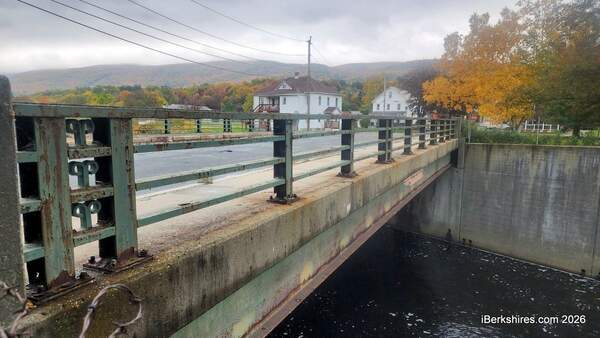
The single-span bridge, originally constructed in 1957, has developed several structural deficiencies in recent years, including deteriorating steel beams with section loss and rusting. click for more
Gabe Thomas carded an even par round of 71 at Stockbridge Golf Club Monday to finish two shots clear of the field and claim the first county individual championship for the McCann Tech golf team. click for more
The event showcases the strong sense of community that defines Adams while offering the perfect opportunity to enjoy the fall foliage, which is typically near its peak this time of year. click for more
During a routine compliance check last Thursday, a Tri-Town Health Department employee under the age of 21 attempted to purchase a pack of Camel Blue cigarettes without presenting identification at the gas station, located at 95 Commercial St.
click for more