2026 Point in Time Count on Jan. 25
PITTSFIELD, Mass. — The Point in Time count, which measures people experiencing homelessness, will occur on Sunday, Jan. 25, and the Three County Continuum of Care stresses that every survey matters.
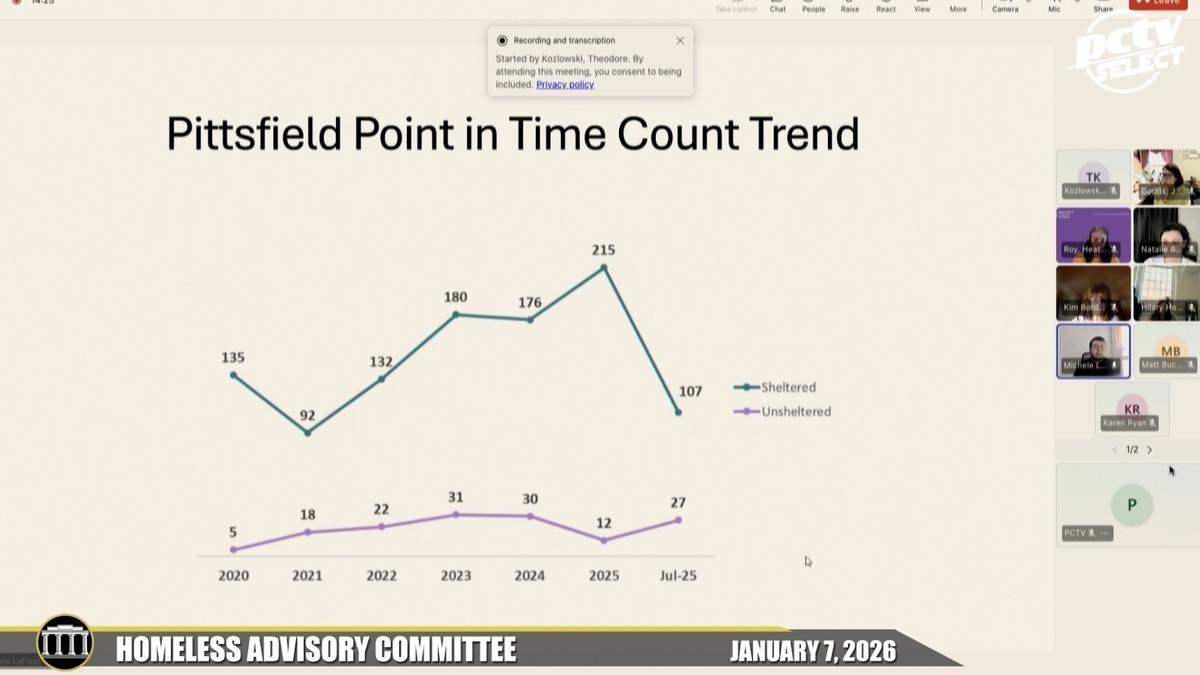
Earlier this month, the CoC's data and evaluations manager Michele LaFleur and compliance manager Natalie Burtzos reviewed past data with the Homelessness Advisory Committee and discussed planning for this year's count.
LaFleur described the PIT count as "our attempt to try and determine how many people are experiencing homelessness on a single night." Each year, it has to be conducted within the last 10 days of January.
In January 2025, there were 215 Pittsfield people in shelter, and 12 people unsheltered. In July, 107 city people reported being in shelter, and 27 people reported being unsheltered.
Of the unhoused individuals in the winter of 2025, 113 were people in families with children under 18. The PIT count for 2024 reported more than 200 people experiencing homelessness on that day.
Pittsfield's shelter data consists of ServiceNet's individual and family shelters, Soldier On's shelter and transitional housing, and Elizabeth Freeman sheltering areas. The winter count has increased significantly since 2021, and the CoC conducted a summer count on July 20 that showed fewer people in shelters and more unsheltered.
It was noted that the count misses people who are couch surfing or paying to live in a motel, as the reporting is on the burden of service agencies or community members who work with those experiencing housing instability.
ServiceNet's Director of Shelter and Housing Erin Forbush was surprised to see the 2025 count that low, and, like members of the CoC, cited issues with reaching people. Service providers and volunteers will have up to a week starting Jan. 25 to survey a person on where they were sleeping that night.
CoC surveyors do not collect full names or birth dates to protect people's identities.
Winter warming items and small gift cards will be distributed to survey takers. Surveys can be completed on a printable form or online.
Burtzos also gave updates on the program and federal actions that may impact sheltering in Western Massachusetts.
The federal Department of Housing and Urban Development published its Notice of Funding Opportunity for fiscal year 2025 funds in November. The posting included major changes that made it difficult to predict how many projects communities would have renewed, the CoC said.
"One example of a proposed change that had been published in the NOFO in November was that 30 percent of our community, so for all three counties, 30 percent of the budget called the annual renewal demand would be considered tier one and kind of like guaranteed to be funded, whereas normally it was 90 percent," Burtzos explained.
"So we have our own ranking and evaluation process within our communities, but it basically meant that we wouldn't be sure for a vast majority of our projects if they were going to be renewed or not, because they would be competing in a different tiered system nationally."
Because of litigation from multiple CoCs, HUD has been ordered to carry out a renewal process for FY2024.
Forbush said it is important to stay on top of what is happening within the federal government, and how it will "certainly severely impact folks that are in our community that are the most vulnerable."
"We're being hopeful that there's been some stopping of what was happening. But, maybe in other years, I would have said, 'OK, we've, we kind of made this hurdle,' but unfortunately, every hurdle we make there's like two more created," she said.
"So I just want people to be very vigilant and paying attention to the landscape, and then doing everything that we can, and sometimes that is calls and letters to our elected officials, where I think people are on board. It's not about convincing any of our Massachusetts elected officials, honestly, but they need to hear what we're needing and what the impact could be."
She added that it is the human service field's job to be advocates at this point, and that it is more important today than it has ever been.
Director of Community Development Justine Dodds agreed. She pointed out that this presidential administration is radically changing how homelessness is funded in the country, as there is a shift from permanent supportive housing to sheltering.
"I think the evidence has shown that we have followed this path for many, many years, because we know permanent supportive housing is a model that really works, as opposed to temporary shelter," she said.
"But again, it's a philosophy change that I think we all need to be aware of, and this has very real repercussions for Pittsfield, not only just the nation."
She pointed out that the CoC's work supports housing units for Pittsfield and the wider region, "So it really is critical that people are aware of what's happening and how those ripples will make a big difference in our community."
Tags: homeless, survey,